
Advanced Certificate in Agentic AI (Batch 1)
Features
Programme Overview
The Advanced Certificate in Agentic AI is purpose-built for the next wave of AI. Delivered live-online by IIT Delhi faculty, the extensive curriculum takes you from autonomous agent foundations to production-grade enterprise deployment, with hands-on exposure to 10+ industry-grade tools including LangChain, AutoGen, and CrewAI.
Every module ends with a hands-on project, building progressively towards a final enterprise capstone where you design, build, and deploy a fully functional AI agent. In a market where Agentic AI expertise is the most strategically valued capability, a certificate from CEP, IIT Delhi is the credential that sets you apart.
₹ 1,45,000 + 18 % GST
Registration Closed
Class Schedule
Saturdays, 3:30 PM – 6:30 PM
Eligibility Criteria
Graduate or Diploma holder
Minimum 1 year of work experience
Basic Python scripting ability and conceptual understanding of AI/ML is recommended
Programme Highlights
100 % Live-online Faculty Led Learning
Hands-on Builds With Real-World Tools And A Deployable Agentic AI System
Earn An CEP, IIT Delhi E-Certificate
# 1 In QS World University Rankings: South Asia 2026.
# 2 In Engineering Category By NIRF 2025
Programme Modules
What is Agentic AI: concepts, scope, and positioning in the AI landscape
Autonomy, goals, actions, and feedback loops in agent systems
High-level agent architecture: observe \(\rightarrow \) reason \(\rightarrow \) act \(\rightarrow \) learn cycle
Agentic AI vs GenAI, automation, and traditional AI systems
Model Context Protocol (MCP): context management, state handling, and tool contracts
Real-world use cases and industry applicability
Module-end Project 1: Agentic System Design Blueprint
Role of LLMs in agentic decision-making and autonomous reasoning
Reasoning workflows and structured prompting techniques
Advanced prompt engineering and prompt patterns (ReAct, reflection, constraints)
Planning, task decomposition, and self-reflection mechanisms
Reliability, constraints, and failure modes of LLM-based agents
Designing dependable reasoning pipelines for production systems
Cyber-physical systems integration: real-world case studies
Module-end Project 2: Autonomous Prompt Generation & Refinement System
Single-agent vs multi-agent systems: architectural differences
Role-based agents and dynamic task distribution
Communication protocols and coordination mechanisms between agents
System design principles, scalability considerations, and complexity trade-offs
Real-world multi-agent use cases: enterprise workflows, collaborative problem-solving
Module-end Project 3: Multi-Agent Collaboration System
End-to-end agentic workflows: from goal specification to execution
MCP-based orchestration of agents, tools, and external APIs
Enterprise automation and integration with legacy systems
Monitoring, control mechanisms, and human-in-the-loop oversight
Event-driven architectures and real-time agent responsiveness
Module-end Project 4: Agent-Ororchestrated Automation Pipeline
Retrieval-Augmented Generation (RAG) for agentic systems
Long-term agent memory architectures and state management
Deployment considerations: cloud, edge, and hybrid architectures
Governance frameworks, risk management, and responsible autonomy
Evaluation metrics, continuous monitoring, and compliance requirements
Enterprise and industry perspectives on agentic AI adoption
Designing and Deploying an Enterprise-Ready Agentic AI System
Objective: Design, build, and evaluate an end-to-end agentic AI system that solves a real-world problem, demonstrating autonomy, reasoning, orchestration, and responsible deployment. The system should be capable of observing its environment, reasoning through complex scenarios, taking autonomous actions, and learning from outcomes, all while operating reliably in a simulated enterprise context.
Project Scope
Customer Support Automation: Intelligent agent handling complex multi-turn conversations with knowledge retrieval.
Enterprise Workflow Automation: Multi-agent system coordinating across departments (procurement, approvals, notifications).
Research & Analysis Agent: Autonomous system gathering, synthesizing, and reporting on specific domains.
Cyber-Physical System Control: Agent-based monitoring and decision-making for IoT/sensor network.
Custom Domain: Student-proposed application with instructor approval.
Note: The list of projects and tools are indicative and can be modified at the discretion of the Programme Coordinator.
Learning Outcomes
Understand How Autonomous AI Systems Think and Act
Learn the fundamentals of Agentic AI and autonomous systems, gaining a clear understanding of how goal-driven agents observe, reason, act, and learn in real-world environments.Turn LLMs into Reliable Reasoning Engines
Leverage LLMs as powerful reasoning engines, using advanced prompting, planning, reflection, and constraint techniques to design reliable, self-directed AI agents.Design Intelligent Single and Multi-Agent Systems
Design and deploy single-agent and multi-agent systems, enabling intelligent task decomposition, coordination, and collaboration across complex workflows.Build End-to-End Agentic Workflows at Scale
Build end-to-end agentic workflows and automation pipelines, orchestrating agents, tools, APIs, and legacy systems using modern MCP-based frameworks.Develop Production-Ready Agentic AI Solutions
Engineer production-ready agentic AI solutions, incorporating RAG, long-term memory, state management, and scalable deployment across cloud, edge, and hybrid setups.Ensure Trust, Control, and Responsible Autonomy
Ensure reliability, governance, and responsible autonomy, addressing failure modes, monitoring, risk management, and human-in-the-loop controls for enterprise adoption.Build and Showcase a Real-World Agentic AI System
Deliver an enterprise-grade Agentic AI capstone, demonstrating real-world impact through a fully functional system ready for business, research, or industrial use.
Tools
Pandas
Num Py
Scikit-learn
Hugging Face
Orange
Crewai
Docker
Flowise
Gemini
Git Hub
KNIME
LIama Index
Microsoft
Programme Coordinator

Professor Santhosh Sivasubramani
Assistant Professor
Centre for Sensors, Instrumentation and
Cyber- Physical System Engineering (SeNSE)
Indian Institute of Technology Delhi
Prof. Santhosh Sivasubramani works at the intersection of autonomous decision systems, agentic AI, and intelligent computing architectures. These form the foundation of this programme. As an Assistant Professor at Indian Institute of Technology Delhi and Director of the INTRINSIC Lab, his work focuses on how AI systems can reason, coordinate, and act independently in real-world environments.
His research spans multi-agent systems, tool-augmented language models, and autonomous reasoning architectures. This directly shapes what participants will learn, including how to design, evaluate, and deploy agentic AI systems at scale. With 17 patents, including 11 granted, and a published book with Wiley-IEEE Press in 2024, his work reflects both depth and real-world application.
Beyond academia, he contributes to global AI education standards as an Elected Member of the IEEE Educational Activities Board Continuing Education Committee and a Board of Governors Member for the IEEE Continuing Education Program. Through the INTRINSIC Lab, participants gain exposure to cutting-edge research in agentic AI, RAG systems, and multi-modal decision-making, connecting theory with real deployment practices.
Programme Sample Certificate
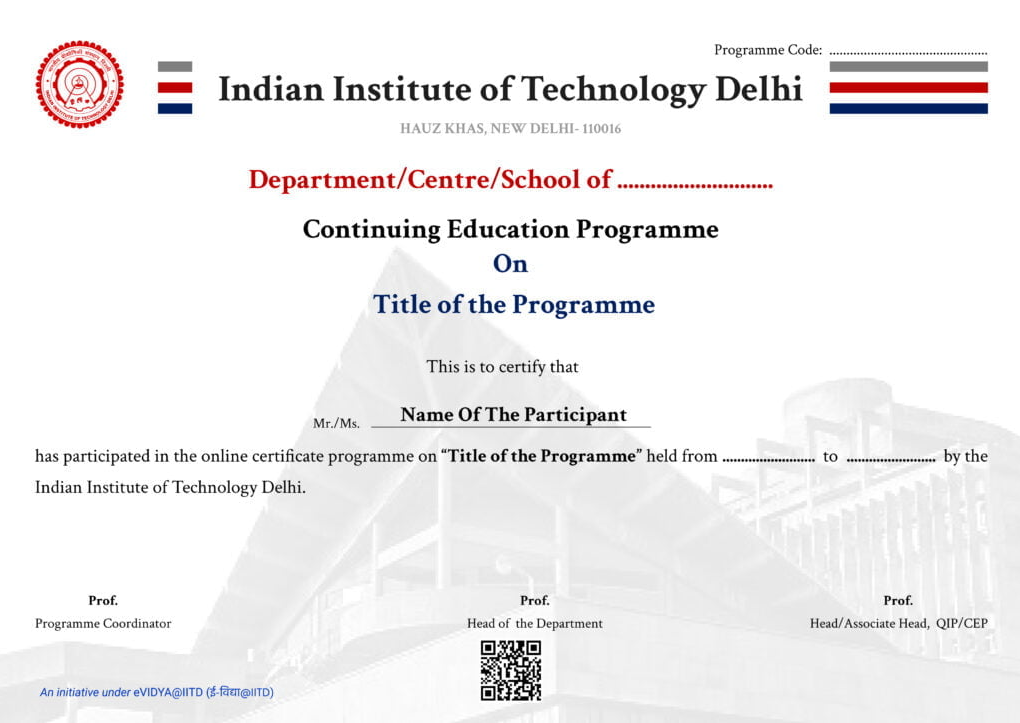
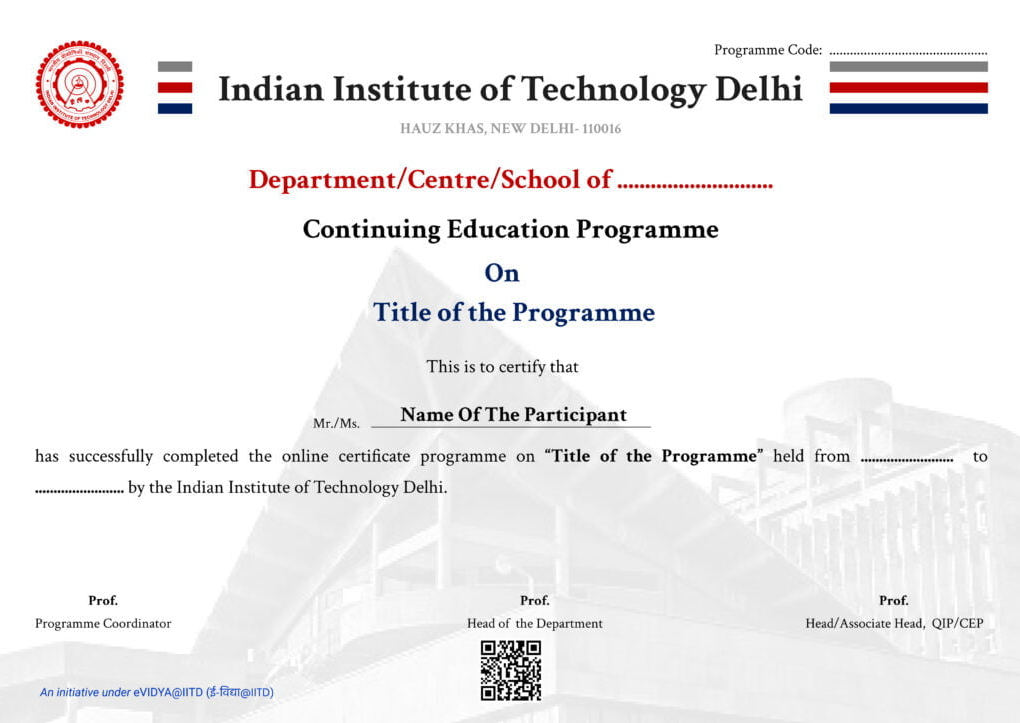
Candidates who score at least 60% marks overall and have a minimum attendance of 50%, will receive a 'Certificate of Successful Completion'.
Candidates who score less than 60% marks overall or have a minimum attendance of 50%, will receive a 'Certificate of Participation'.
This programme is organised by Centre for Sensors, Instrumentation and Cyber-Physical System Engineering (SeNSE), IIT Delhi.
Note: All certificate images are for illustrative purposes only and may be subject to change at the discretion of IIT Delhi. Only e-certificate to be issued by CEP IIT Delhi are shown above.
Installment Schedule
Programme Fee INR 1,45,000 + 18 % GST
Instalment | Remarks | Amount |
Instalment 1 | Within 5 days post-selection | INR 14,500 + 18 % GST |
Instalment 2 | 30th September, 2026 | INR 36,250 + 18 % GST |
Instalment 3 | 30th November, 2026 | INR 50,750 + 18 % GST |
Instalment 4 | 30th January, 2027 | INR 43,500 + 18 % GST |
Notes:
The actual programme schedule will be announced closer to the programme start.
GST (currently @ 18%) will be charged extra on these components.
Loan and EMI services are provided by Eruditus Learning Solutions Pvt Ltd, and IIT Delhi is not responsible for the same.
Refund Policy
Candidates can withdraw within 15 days from the Programme Start Date. A total of 80% of the total fee received will be refunded. However, the applicable tax amount paid will not be refunded on the amount paid.
If you wish to withdraw from the programme, you must email cepaccounts@admin.iitd.in and iitd.execed@emeritus.org, stating your intent to withdraw. The refund, if applicable, will be processed within 30 working days from the date of receiving the withdrawal request.
Frequently asked questions
The programme is open to graduates and diploma holders with a minimum of one year of work experience. Basic Python scripting ability and conceptual understanding of AI/ML is recommended.
The programme requires approximately 4 to 6 hours per week. This includes live Saturday sessions from 3:30 PM to 6:30 PM, weekly quizzes and time for module-end projects.
All live-online sessions are conducted by IIT Delhi faculty through the Continuing Education Programme (CEP). Every session is delivered live-online, ensuring real-time interaction, academic rig our and up-to-date content.
Assessment is based on four module-end hands-on projects, short weekly quizzes of 10 to 15 minutes each and a final enterprise capstone project. All three components contribute to the overall assessment score.
All assignments, quizzes, module-end projects and the final capstone are graded by IIT Delhi faculty, ensuring academic rigour and institution-level evaluation standards throughout the programme.
Yes. Participants who achieve 60% or more overall with at least 50% attendance receive a Certificate of Successful Completion. Candidates who score less than 60% marks overall or have a minimum attendance of 50%, will receive a Certificate of Participation issued by the CEP, IIT Delhi organised by the Centre for Sensors, Instrumentation and Cyber-Physical System Engineering (SeNSE), IIT Delhi.