
Advanced Certificate in AI Forward Deployed Engineering
Features
Programme Overview
The AI Forward Deployed Engineering Programme from IIT Delhi is designed for working engineers and technologists looking to build the skills that AI companies pay a premium for: deploying AI into real customer environments, making it work with real data, real users, and real enterprise constraints.
Led by the Head of the Bharti School of Telecommunication Technology and Management, IIT Delhi alongside leading faculty from across the IIT Delhi and subject-matter experts drawn from active FDE practice. The programme is structured around a 70/30 build-to-deliver split, combining deep engineering work with the client-facing delivery skills that separate a working prototype from a production-grade deployment.
Across the programme, participants will learn to design and ship production RAG pipelines, build and debug agentic AI systems, fine-tune and customise large language models, harden AI deployments for regulated industries under HIPAA, DPDP, and EU AI Act requirements, and communicate outcomes confidently to executive stakeholders. With five shipped capstone projects including a portfolio-grade final deployment defended live to a subject-matter expert panel. The programme equips learners to step into Forward Deployed Engineer, Applied AI Engineer, and AI Solutions Architect roles at the organisations building the next generation of enterprise AI.
₹ 1,65,000 + 18 % GST
Registration Closed
Class Schedule
Weekend Classes
Eligibility Criteria
Graduation in any of these disciplines: B.Tech/BE; BCA/MCA; B.Sc in all streams; BA/MA in mathematics
Programme Highlights
One Of India's First FDE Programmes
Taught By IIT Delhi Faculty; Industry SMEs Drive Sessions
Optional 2 -day Campus Immersion At IIT Delhi
QInsights No-Code Lab Access For Every Learner
70 /30 Build-to-deliver Split Across The Curriculum
Mini-capstones At Every Phase; Portfolio-grade Final Project
E-certificate From CEP, IIT Delhi On Completion
Security, Compliance, And Regulated-industry Deployment Covered
AI Mock Interviews And FDE Career Readiness Included
145 Hours Of Live And Recorded Learning
24 Modules Across 4 Structured Phases
Weekend Format Designed For Working Professionals
Programme Modules
BUILD
AI Foundations for FDEs
GPT, Claude, Gemini, open-weights, transformer architecture at FDE level, the FDE mental model: AI in client environment vs demo.
BUILD
Python & Production Engineering
Production Python (async, type-safety), FastAPI, Pydantic, Git workflows, structured logging, Docker. The things that make code shippable.
DELIVER
Discovery & Problem Framing
Run discovery sessions, frame AI use cases, map stakeholders (CTO, CISO, business owner). Turn a problem into a buildable scope.
BUILD
No-Code AI Prototyping
Visual RAG, agents and automations in IIT Delhi's QInsights lab. Sandbox access for every learner.
BUILD
Prompting & LLM Control
Few-shot, chain-of-thought, ReAct, structured outputs, prompt-as-code, and the quirks of each model.
◆ MINI-CAPSTONE 1
Ship your first working AI tool. Built end-to-end, documented like an FDE — a clean one-pager.
BUILD
RAG Architecture I
Vector databases (Pinecone, pgvector, Qdrant, Chroma), embeddings, chunking, hybrid search.
BUILD
RAG Architecture II
Re-ranking, query rewriting, citation handling, multi-tenant retrieval.
BUILD
Agentic Systems I & II
Agent patterns, tool / function calling, ReAct, planner-executor. MCP, LangGraph, CrewAI, agent debugging.
BUILD
LLM Evaluation & Observability
RAGAS, DeepEval, golden datasets, LLM-as-judge, regression testing, LangSmith / Langfuse, red-teaming.
DELIVER
PRDs, Solution Design & Trade-off Comms
PRDs for AI products, solution-design docs, communicating trade-offs to non-technical stakeholders, scoping pilots vs production.
◆ MINI-CAPSTONE 2
Build production RAG on messy enterprise docs. Full eval pipeline + architecture write-up.
BUILD
Fine-Tuning & Customisation
When to fine-tune vs prompt vs RAG. SFT, LoRA / QLoRA, distillation, dataset prep, eval gates, cost-benefit math.
BUILD
Deploying AI in Production
AWS Bedrock, Azure OpenAI, GCP Vertex. Serving frameworks, latency optimisation, caching, autoscaling.
BUILD
Cost, Latency & Scale
Token economics, caching layers, model routing, batching. What turns an unprofitable demo into a profitable product.
BUILD
Enterprise Integration
Customer data schemas, lineage, secrets, audit trails. SOC2, HIPAA, DPDP. On-prem and VPC deployments.
BUILD
Security & Responsible AI
OWASP for LLMs, prompt-injection defence, hallucination handling, PII, bias audits, DPDP & EU AI Act.
DELIVER
Stakeholder Alignment
Delivery planning, iteration cycles, managing scope changes, running war rooms during incidents.
◆ MINI-CAPSTONE 3
Rebuild a generic demo for a bank or hospital. Architecture + prototype + risk register.
◆ MINI-CAPSTONE 4
Audit a live LLM app end-to-end. Audit report + remediation playbook + governance plan.
BUILD
Vertical Playbooks
Deep dives into named domains. Fraud detection, ticket routing, multilingual workflows, clinical-grade healthcare RAG.
BUILD
AI Product Sense
Spotting patterns across deployments. When to build vs configure vs raise to product. The "eyes and ears in the field".
DELIVER
Outcome Communication & Demo Craft
Demoing to a Fortune-500 CTO. Deployment docs customers actually use. Presenting outcomes, not features. Portfolio storytelling.
★ FINAL CAPSTONE
Choose your track. Build the prototype. Harden it. Demo it — defended live to an SME panel.
See the principles. Then build them.
Every learner gets access to IIT Delhi's QInsights No-Code Lab, one of the world's very few visualisation labs. Principles of modern AI (RAG, agents, retrieval, evaluation) are taught visually first, with minimal setup effort, before you write production code.
QInsights
VISUAL IIT DELHI LAB
Visualise RAG retrieval flows
Trace agent decision paths
Prototype with minimal code
If you are getting ready to work inside the QInsights environment, tell me:
If you have a specific use case to prototype (e.g., customer support agent, document search)
The AI components you want to visualize first
If you want to discuss how to transition visual prototypes into production Python code
Python
OpenAI & Claude APIs
LangGraph
LangSmith
Pinecone
Weaviate
Docker
Kubernetes
AWS
Azure
GCP
CI / CD pipelines
Eval frameworks
SQL & vector DBs
Learning Outcomes
Ship RAG, agents and automation that survive messy data, real users and constraints.
Deploy cloud infra, vector databases, serving frameworks and MLOps pipelines end to end yourself.
Connect AI to CRMs, ERPs and APIs with audit trails and SOC2, HIPAA, DPDP compliance.
Defend against prompt injection and hallucinations, protect PII, and audit bias per EU AI Act.
Run discovery, separate pilots from production, and align CTOs, CISOs and business leaders.
Demo to SME panels, train teams, measure ROI, and sell business outcomes not features.
Tools
Python
AWS
Docker
Azure
GCP
Kubernetes
Lang Graph
Lang Smith
Open AI
Pinecone
Weaviate
SQL
Programme Coordinator

Professor Manav R. Bhatnagar
Head, Bharti School of Telecommunication Technology and Management,
Professor, Department of Electrical Engineering,
Indian Institute of Technology Delhi
Ranked among the world's Top 2% Scientists by Stanford University. Research spans quantum communications, 5G/6G networks, satellite communications and machine learning.
Awards: Dr. Vikram Sarabhai Research Award, NASI–Scopus Young Scientist.
In a fast-changing AI-led world, the professionals who will stand out are those who can take ideas from prototype to production, translating business problems into scalable AI solutions and driving adoption in real enterprise environments.
At IIT Delhi, we wanted to build one of India's first programmes in this space and stay ahead of the curve, in line with our legacy of academic excellence and frontier innovation. The curriculum has been curated with strong applied depth and multiple exit pathways, enabling learners to transition into emerging AI-first roles across industries.
Along with me, leading faculty from across the IITs and subject-matter experts from industry will drive parts of the learning.
Programme Sample Certificate
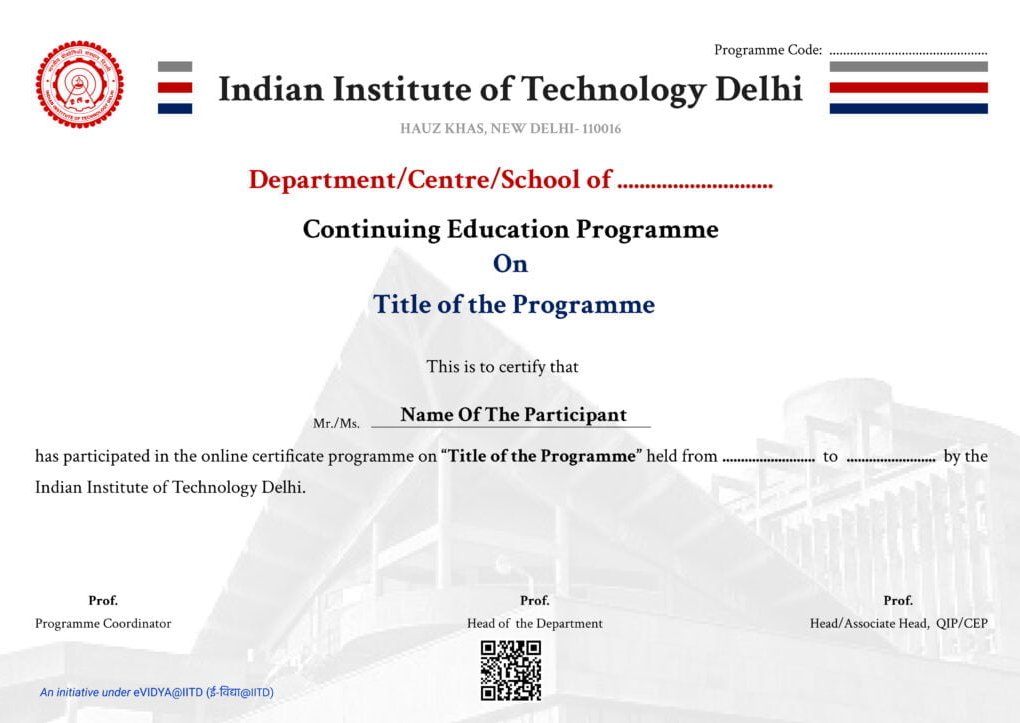
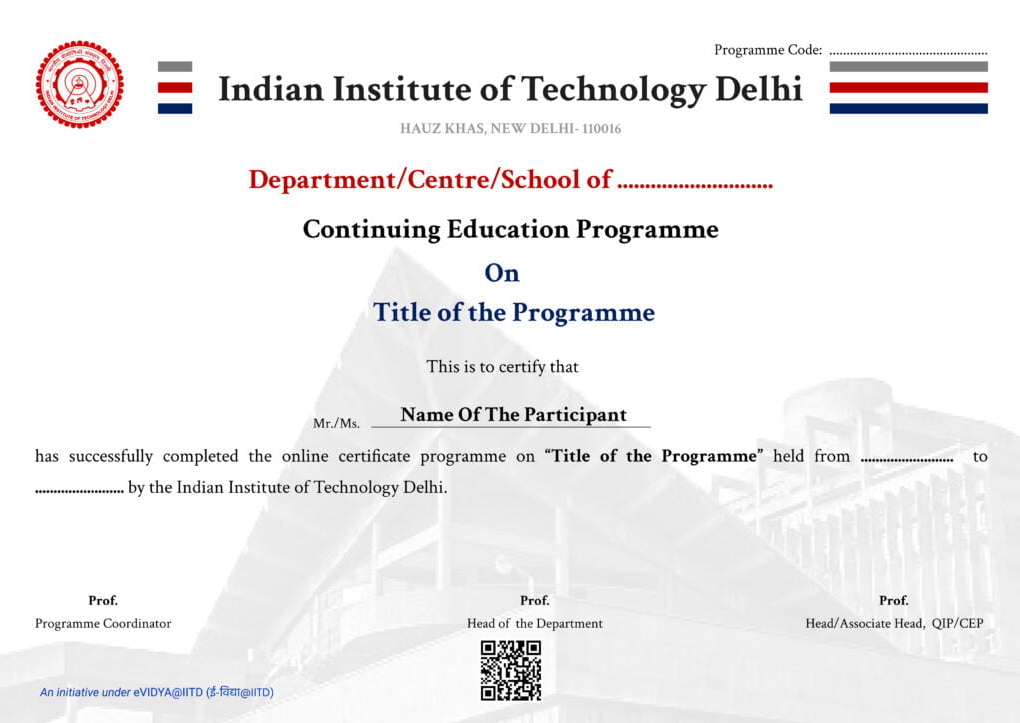
On completion, participants receive a certificate from the Continuing Education Programme (CEP), IIT Delhi. Two certificate types are issued, based on attendance and assessment performance.
Certificate of Successful Completion: A minimum of 50% attendance, along with at least 50% aggregate marks in quizzes, is required to qualify for the Certificate of Successful Completion.
Certificate of Participation: A minimum of 50% attendance is required to qualify for the Certificate of Participation.
Verifiable e-certificate only. No printed copy is issued.
Issued by Continuing Education Programme (CEP), Indian Institute of Technology Delhi.
Installment Schedule
Programme Fee INR 1,65,000 + 18% GST
Instalment | Date | Amount (₹)** |
Application Fee | Application Fee | 1,000 + 18 % GST |
1st Instalment | Within 3 days of the release of an offer letter | 15,000 + 18 % GST |
2nd Instalment | 16th October, 2026 | 1,50,000 + 18 % GST |
Note:
*GST @ 18% will be charged extra in addition to the fees
The application fee of INR 1,000/- + 18% GST is non-refundable and non-transferable. This fee is in addition to the programme fee and will not be adjusted against the total programme fee.
Refund Policy
Candidates can withdraw within 15 days from the programme start date. 80% of the total fee received is refunded. The applicable tax amount paid is not refunded.
Candidates withdrawing after 15 days from the start of the programme session are not eligible for any refund.
To withdraw, email cepaccounts@admin.iitd.ac.in and refunds_varsity_iitd@interviewbit.com. Refunds, if applicable, are processed within 30 working days.
Frequently asked questions
An Advanced Certificate offered by the Continuing Education Programme (CEP), IIT Delhi, one of India's first FDE programmes, built to take you from prototype to production AI.
Six months (24 weeks), 145 learning hours in total, 76 hours live online, 38 self-paced, and 31 hours of capstone and lab work.
Online, combining live and self-paced learning, with weekend sessions built around a full-time job. There is also an optional 2-day IIT Delhi campus immersion.
Five projects, four mini-capstones plus one final deployment. The final capstone is a portfolio-grade build in one of six industry tracks, defended live to a subject-matter-expert panel.
Admission is selective. You submit a roughly 10-minute online application with a ₹1,000 fee, IIT Delhi CEP screens against eligibility, shortlisted candidates receive an offer, and you confirm your seat before orientation.
A verifiable e-certificate from CEP, IIT Delhi (no printed copy). Two types are issued: a Certificate of Successful Completion or a Certificate of Participation.