
Advanced Certificate in Generative & Agentic AI with a Specialization in FDE (formerly known as Certificate Programme in Generative AI)- Batch 04
Features
Programme Overview
The Advanced Certificate in Generative & Agentic AI with a Specialization in FDE (formerly known as Certificate Programme in Generative AI Batch 3) (Batch 04), offered by CEP, IIT Delhi, is a 6-month live online programme designed to develop end-to-end AI engineering skills. It covers Generative AI, Large Language Models (LLMs), RAG, Agentic AI, and Forward Deployed Engineering (FDE), with 15 modules, 100+ live learning hours, six hands-on builds, and a final capstone project.
₹ 1,69,000 + 18 % GST
Class Schedule
Live online weekend sessions
Eligibility Criteria
01. Working Tech Professionals
Professionals with coding or programming experience who want to build AI systems.
02. STEM Graduates
Graduates and postgraduates in any STEM field with programming exposure.
STEM = Science, Technology, Engineering and Math's.
03. Students
Final or pre-final year students in CSE, IS, EIE, ECE, EE, IT and related disciplines. Also B.SC. and BCA students in Maths, Statistics, Computing or Data Science.
Coding, in Any Language
Coding experience in Python, Java, C#, JavaScript or any other language.
Python is used throughout the programme.
New to Python? Learn the essentials before the programme begins. Counsellors will share preparation material.
Coding knowledge is required for a quick ramp-up and familiarity.
Comfort with Core Math's
Studied Mathematics up to Class 12.
Basic understanding of matrices, probability and basic calculus.
Refresher resources will be provided before the programme starts.
Candidates are required to study these and other learning materials before the programme begins.
Programme Highlights
6 -Month Programme
100 + Live Learning Hours
15 Modules
6 Hands-on Builds
IIT Delhi Faculty
Capstone Project
E-Certificate From CEP, IIT Delhi
Optional Campus Immersion
Programme Modules
15 Hours · 5 Sessions
Linear Algebra and Probability Basics – Vectors, matrices, rank, SVD.
Probability and Optimization – Bayes, distributions, gradient descent.
Introduction to ML – Linear and logistic regression.
Evaluation and Unsupervised Learning – Regularisation, K-Means, PCA.
Neural Networks – Neural networks and backpropagation.
FDE Sprint 1 – Inside the FDE Role
Map the client workflow and pain points. (Module 12)
12 Hours · 4 Sessions
Introduction to NLP – Stemming, lemmatisation, edit distance.
Statistical Language Models – n-grams, smoothing, perplexity.
POS Tagging and Parsing – HMM, Viterbi, PCFG, CKY.
Semantics: Lexical and Distributional – Vector space, PMI, TF-IDF.
6 Hours · 2 Sessions
Word Representation – One-hot, Word2Vec, GloVe.
CNN and RNN++ – CNN for text, RNN, LSTM, GRU.
6 Hours · 2 Sessions
Transformer I – Seq2Seq, beam search, attention.
Transformer II – The encoder and the decoder.
FDE Sprint 2 – Client Discovery
6 Hours · 2 Sessions
Transformer III: Pretraining – Strategies for domain adaptation.
Fine-Tuning Strategies – Task-specific performance.
12 Hours · 4 Sessions
Instruction Tuning and Alignment I – SFT and instruction tuning.
Prompt Engineering – Prompt design with LangChain.
Alignment II – Value and policy optimisation, reward models.
RLHF – RLHF with the TRL framework.
FDE Sprint 3 – Production Prompting
3 Hours · 1 Session
1. RAG and Tool Augmentation – Retrieval, tool use, Toolformer.
FDE Sprint 4 – RAG on Client Data
RAG over the client’s SOPs, with citations. (Module 14)
FDE Sprint 5 – Wiring AI into Client Systems
10 Hours · 3 Sessions
Vision LM I – CNNs, Vision Transformers, CLIP.
Vision LM II – BLIP, LLaVA, MAE, Segment Anything.
Vision LM III – SAM extensions, open-vocabulary detection.
4 Hours · 1 Session
1. Advanced Topic I – Pruning, distillation, quantisation.
3 Hours · 1 Session
1. Advanced Topic II – Bias, hallucination, safety, privacy, governance.
FDE Sprint 6 – Ship, Monitor, Hand Over
12 Hours · 4 Sessions
Foundations and Patterns – ReAct, plan-and-execute, reflection.
Orchestration and Memory – LangGraph, human approval, MCP and A2A.
Evaluation and Observability – Trajectory evals, LLM-as-judge, tracing.
Safety and Deployment – Guardrails, injection defence, fallbacks.
01. Train a Fully Connected Neural Network
Module 1
You ship: A network with accuracy and loss curves over epochs.
Tools: PyTorch, TensorFlow
02. Fine-Tune a Pre-Trained Transformer
Module 4
You ship: A task-specific fine-tune, evaluated on precision and recall.
Tools: PyTorch, Hugging Face
03. Build a Transformer from First Principles
Module 4
You ship: Self-attention and positional encoding, benchmarked head to head.
Tools: PyTorch
04. Apply PEFT to a Large LLM
Module 5
You ship: A parameter-efficient fine-tune, compared with a full fine-tune.
Tools: PyTorch, Hugging Face
05. Build a Reward Model and RLHF Loop
Module 6
You ship: A reward model on human-labelled data, used to improve LLM outputs.
Tools: PyTorch, TRL
06. Build a RAG + Agentic Pipeline
Modules 7 to 11
You ship: Retrieval over your documents, then an agent with a human approval step.
Tools: LangChain, LangGraph
Domain Missions (Elective)
Build an AI agent for one industry, alongside the programme.
Healthcare – ClinicNote Copilot
Turns clinical notes into structured summaries.
Fintech – RegRadar
Flags what changed in RBI and SEBI circulars.
EdTech – The Socratic Tutor
An agent that remembers each learner.
Tools: LlamaIndex, LangChain, LangGraph
Learning Outcomes
1. Build a Strong AI Foundation
Maths, neural networks, Transformers and LLM basics.
2. Build and Fine-Tune LLMs
Pretraining, SFT, PEFT and RLHF.
3. Build RAG Applications
Production-ready retrieval with evaluation.
4. Engineer Agentic AI Systems
Tool use, memory and multi-agent workflows.
5. Work with Multimodal and Efficient AI
Vision models and smaller, faster models.
6. Ship It the FDE Way
Evaluate, secure, deploy and hand over to a client.
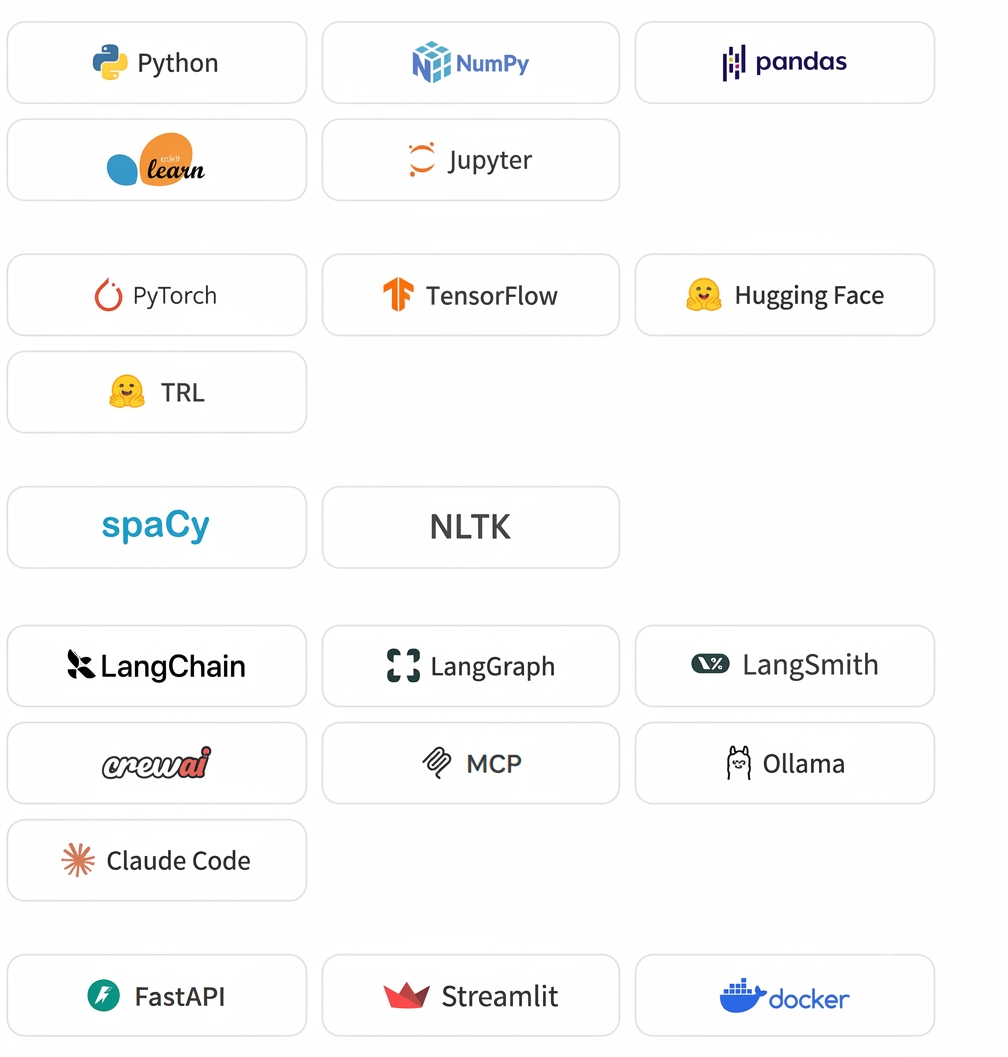
Tools
Python
Num Py
Pandas
Py Torch
Tensor Flow
Scikit-learn
Hugging Face
NLTK
Spa Cy
Jupyter Notebooks
Programme Coordinator

Professor Tanmoy Chakraborty
Rajiv Khemani Young Faculty Chair Professor in AI
Professor
Department of Electrical Engineering & Yardi School of Artificial Intelligence
Indian Institute of Technology Delhi
Founder and lead of the Laboratory for Computational Social Systems (LCS2), which builds economical, interpretable and adoptable language models.
Author
Introduction to Large Language Models
Research Focus
NLP, LLMs and social computing
Faculty Awards From
Microsoft, Google, Adobe and JP Morgan
Honours
ACM India Outstanding Contribution to Computing Education Award, youngest recipient
INSA Young Associate
Ramanujan Fellowship
Visiting Professor: DAAD at MPI Saarbrücken, PECFAR at TU Munich
Alexander von Humboldt Fellow, TU Darmstadt
Research and Editorial
Editor-in-Chief, ACL Rolling Review
Associate Editor: Computational Linguistics, TACL, ACM Computing Surveys
Program Chair, EMNLP 2025
Organising Chair, AACL 2025
Author of two textbooks: Social Network Analysis and Introduction to LLMs
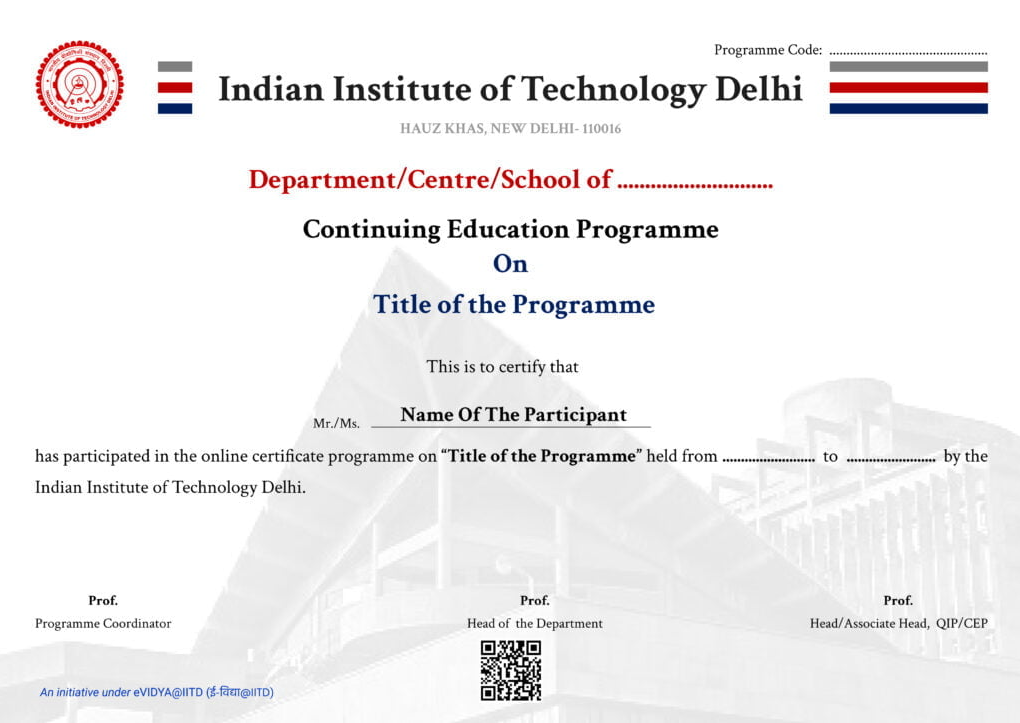
Programme Sample Certificate
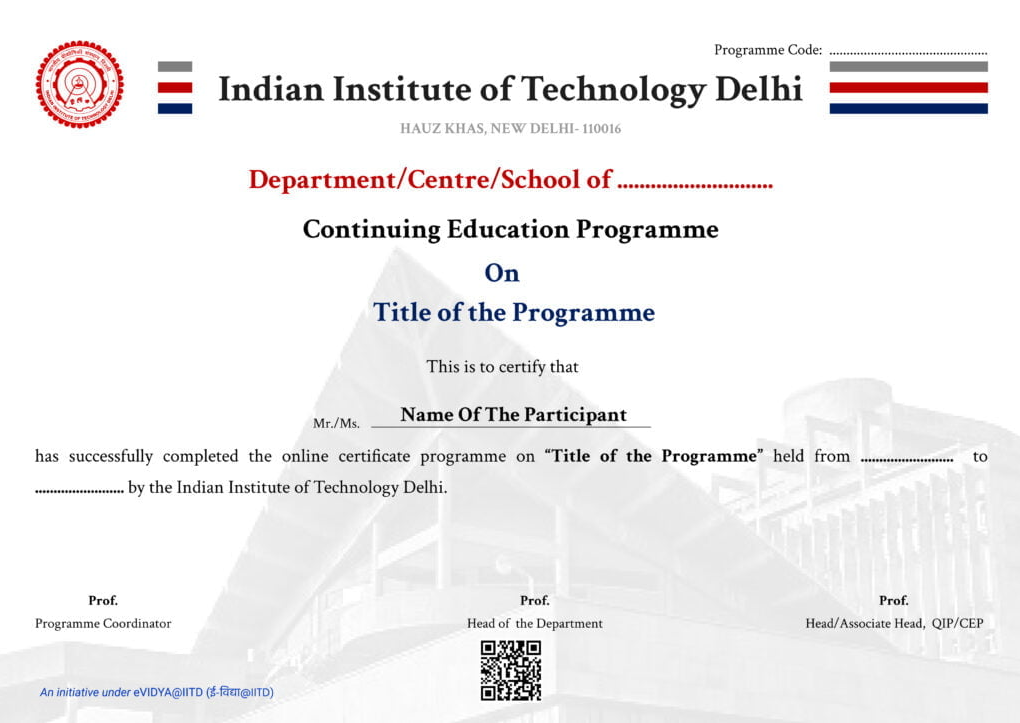
Type 01: Certificate of Successful Completion
At least 60% marks overall and at least 80% attendance.
Type 02: Certificate of Participation
Below 60% marks overall, with at least 80% attendance.
Certificate: e-certificate issued by CEP, IIT Delhi.
Organizing Department: Department of Electrical Engineering, IIT Delhi.
Installment Schedule
Programme Fees: ₹ 1,69,000 + 18 % GST
Instalment | Instalment Date | Amount (₹)* |
Application Fee | To be paid at the time of Application | 1,000/- |
1st Instalment | Within 4 days of offer roll-out | 30,000/- |
2nd Instalment | 23rd February, 2027 | 1,39,000/- |
Note:
| ||
Refund Policy
Withdraw within 15 days of the programme start date and 80% of the fee received is refunded. The tax paid is not refunded. There is no refund after 15 days. To withdraw, email cepaccounts@admin.iitd.ac.in and refunds_varsity@interviewbit.com. Refunds are processed within 30 working days.
Frequently asked questions
No. The curriculum starts from the maths behind AI. You need coding or programming experience.
All three. Modules 1 to 10 cover Gen AI, Module 11 goes deep on agentic AI, and Modules 12 to 15 are a six-sprint FDE Studio.
Every application is screened by the IIT Delhi Programme Coordinator. Shortlisted candidates are told by email.
At least 60% marks and 80% attendance earns the Certificate of Successful Completion. Below 60% with 80% attendance earns the Certificate of Participation.
Live online weekend sessions, so you can learn alongside work or study.
No, it is optional. Travel and stay are at your own cost.