
Advanced Certificate Programme in AI, ML and DL ( formerly known as Certificate Programme in Machine Learning and Deep Learning ) ( Batch 8)
Features
Programme Overview
The CEP, IIT Delhi Advanced Certificate Programme in AI, ML and DL, offers an in-depth exploration of machine learning (ML) and deep learning (DL), structured for learners without prior experience. The curriculum begins with foundational elements, including Python programming, data analytics, and applied mathematics, then progresses to core ML/DL modules, and concludes with real-world applications across diverse domains.
As technology advances rapidly in data science, computer vision, NLP, and AI-driven systems, understanding and implementing ML/DL has become essential. This programme goes beyond surface-level application to reveal the underlying functionality of these technologies, moving learners past treating ML/DL as a 'black box'.
Designed by top academicians and industry experts from premier institutions like IIT Delhi and IIT Guwahati, the course brings global perspectives and cross-disciplinary insights. The live online format enables interactive engagement with Q&A sessions and real-time explanations using virtual boards. With its structured content flow, expert-led delivery, and practical orientation, the programme equips participants with both conceptual clarity and hands-on proficiency to confidently leverage ML/DL in today's technology-driven world.
₹ 1,95,000 + 18 % GST
Registration Closed
Class Schedule
Saturdays and Sundays 10:00 AM to 12:00 PM (IST)
Duration
• 80 hours live online learning
• 20-30 hours assignments
• 20 hours (3 weeks) capstone projects
• 6 hours (1 day) optional campus immersion
• 4-6 hours on RAG and Agentic AI Evaluation
• 50% - End-of-programme MCQ-based exam
• 20% - Assignments/quizzes
• 20% - Capstone Project
• 10% - Attendance
Eligibility Criteria
Graduates or Postgraduates in B.Tech/M.Tech/ME/BE/BIT/MIT/BCA/MCA/ MCM Science Technology or BSc/MSc/BS/MS in Maths, Statistics, Electronics, Physics, Computer Sciences, AI, DS
Programme Highlights
Covers ML/DL From Fundamentals To Advanced Concepts
Build And Train Neural Networks With Keras & Tensor Flow
Exclusive Sessions On RAG And Agentic AI
Optional 1 -day Immersive Campus Visit At IIT Delhi
Expert-led Sessions By Esteemed IITD Faculty
Hands-on Learning With 9 Industry-focused ML/DL Tools
80 Hours Of Live Online Learning
Unique Bring Your Own Project (BYOP) Capstone
Programme Modules
The list of tools and topics mentioned is indicative and may be modified as per programme requirements and at the discretion of the Programme Coordinator
Foundations of Python Programming
Functional Programming in Python
Data Structures, Loops, and Control Structures
Object-oriented programming
Learning Outcomes
Covers essential Python programming concepts, including basic syntax and data types, control sequences like loops and conditional statements, and writing functions and classes.
The list of tools and topics mentioned is indicative and may be modified as per programme requirements and at the discretion of the Programme Coordinator
Numerical Computations and Linear Algebra using NumPy
Data Pre-processing using Pandas
Data Visualisation using Matplotlib
Introduction to Scikit-learn
Learning Outcomes
Learn about file handling with Python, plotting and visualisation with Matplotlib, arrays, and matrices with NumPy, scientific computing with NumPy and, data handling with pandas.
The list of tools and topics mentioned is indicative and may be modified as per programme requirements and at the discretion of the Programme Coordinator
Linear Algebra: Vectors, Matrices, Norms, Subspaces, Projections, SVD, EVD, Derivatives of Matrices, Vector Derivative Identities, Least Squares
Optimisation: Constrained and Unconstrained Optimisation, Maxima and Minima, Convex and Non-Convex, Gradient and Hessian, Positive Definite and Semi-Definite, Second Derivative Test, Steepest Descent, Adam, AdaGrad, RMSProp, and KKT
Probability Theory: Discrete and Continuous Random Variables, Conditional Probability, Joint Probability Distribution, Multivariate, MAP Criterion, and ML Criterion
Learning Outcomes
Gaining an understanding of the mathematical fundamentals crucial for machine and deep learning success, like linear algebra, probability theory, and optimisation methods. In linear algebra, one masters essential operations involving vectors and matrices and the understanding of eigenvalues and eigenvectors. Probability theory will provide concepts on probability distributions and Bayes' theorem, which is crucial to understanding the probabilistic nature of machine learning algorithms. Furthermore, it delves into optimisation techniques, including gradient descent and convex optimisation, empowering to optimise models and algorithms effectively.
The list of tools and topics mentioned is indicative and may be modified as per programme requirements and at the discretion of the Programme Coordinator
Differences Between Artificial Intelligence, Machine Learning, and Deep Learning
Differences Between Statistical Approach, Shallow Learning, and Deep Learning
Data Types and their properties
Attribute Types
General characteristics of datasets
Data Measurement Criteria: Precision, Bias, and Accuracy
Data Pre-processing Techniques
Distance-based Dissimilarities between Datasets
Machine Learning Problems: Classification, Regression, Interpolation, and
Density EstimationLinear Regression Model, Classification Model, and Classification
EvaluationLearning Algorithms: Supervised and Unsupervised
Learning Outcomes
Understand and differentiate between key concepts like AI, Machine Learning, and Deep Learning. Gain a strong foundation in data properties, types, and characteristics of datasets. Furthermore, you will be able to evaluate data quality using metrics like precision, bias, and accuracy, and explore pre-processing techniques for data preparation.
The list of tools and topics mentioned is indicative and may be modified as per programme requirements and at the discretion of the Programme Coordinator
Bayesian Decision Theory: Bayesian Classifier, Discriminant Functions, Minimum Error Rate Classification
Naïve Bayes Classifier
Logistic Regression Model and Parameter Estimation (Maximum-Likelihood)
Dimensionality Reduction Technique: Principal Component Analysis (PCA)
Non-parametric Techniques: K-Nearest Neighbour (KNN), Density Estimation
K-means Clustering
Decision Tree (Entropy, Gini Impurity Index)
Demonstration of All Machine Learning Algorithms
Learning Outcomes
Gain proficiency in data analysis and visualisation techniques essential for extracting insights from datasets. Dive into various machine learning algorithms, including supervised, unsupervised, and reinforcement learning and tasks such as classification and regression. Understand the theoretical background of supervised methods like Linear and Logistic regression, SVM, decision trees and unsupervised methods, including clustering, KNN, and dimensionality reduction techniques (PCA).
The list of tools and topics mentioned is indicative and may be modified as per programme requirements and at the discretion of the Programme Coordinator
Neurons, Perceptron Convergence Theorem, Relation Between the Perceptron and Bayes' Classifier, Batch Perceptron Algorithm, Adaptive Filtering Algorithm, Least Mean Square (LMS) Algorithm, Multilayer Perceptron, Feedforward Operation, Batch and On-line Learning, Activation Function, Backpropagation Algorithm, Rate of Learning, Stopping Criteria, XOR Problem, Loss Function, Bias and Variance, Regularization, Cross-Validation, Early-Stopping Criteria, VM, Radial Basis Function, Bagging and Boosting
Support Vector Machine (SVM)
Random Forest, Ensemble Learning, Bagging, and Boosting
Python Demo on contruction and training of neural networks for classification and regression applications
Learning Outcomes
Delve into the theory and design of Artificial Neural Networks (ANNs) for classification and regression tasks, mastering essential concepts like backpropagation and stochastic gradient descent for training ANNs. Gain the necessary practical skills to implement all the algorithms using Python libraries like NumPy, pandas, scikit-learn, and Keras.
The list of tools and topics mentioned is indicative and may be modified as per programme requirements and at the discretion of the Programme Coordinator
Basics of Deep Learning
Importance of deep learning
Learning from large datasets
Types of data and architectures
End-to-end model design for feature learning and decision-making
Convolutional Neural Network (CNN)
Architecture design
Training methodology of CNN
Use cases
State-of-the-art CNN models
Python demo on object detection/image classification
Recurrent Neural Network (RNN) and Long-Short Term Memory (LSTM)
Modeling of time-series data
Architecture design of RNN
Training methodology of RNN
Architectures of LSTM and advantages over RNN
Use cases
Python demo on machine translation, stock prediction
Autoencoder (AE)
Unsupervised learning
Architecture design of AE
Convolutional AE
Training with unlabeled data
Use cases
Python demo in denoising, dimensionality reduction
Generative Modelling
Subtopic 1 - Variational Autoencoder (VAE):
Fundamentals of generative modeling
Architecture of VAE
Estimating data distribution
Training methodology of VAE
Use cases
Python demo for image generation
Subtopic 2 - Generative Adversarial Network (GAN)
Generative modeling as a game-theoretic approach
Architecture design of GAN
Training methodology of GAN
Use cases Python demo on image generation, style transfer
Subtopic 3 - Diffusion:
Generative modeling through denoising
Architecture design of diffusion models
Training of diffusion models
Python demo on high-quality image generation
Attention and Transformer
Attention mechanism
Advantages of Attention
Architecture design of Transformers
Training of Transformer
Python demo on language translation using Transformer
Transfer Learning
Leverage knowledge from one task to improve performance on another task
Pre-training on large datasets
Fine-tuning DL models on small dataset
Use cases
Python demo on transfer learning in computer vision
Knowledge Distillation
Optimisation of DL models
Transfer knowledge from a complex teacher model to a simpler student model
Training methodology for distillation
Use cases
Python demo on knowledge distillation in computer vision and natural language processing
Learning Outcomes
Understanding the advantages of deep learning. Gain in-depth knowledge of deep architectures such as CNNs, RNNs, LSTMs, GRUs, Attention mechanisms, Transformers, and Autoencoders. A theoretical and practical understanding of the architectures, along with insights into design choices for better model development. Essential model training concepts like regularisation, dropout, data augmentation, batch normalisation, and hyperparameter tuning are explored for effective optimisation. Popular generative methods for AI applications such as VAEs, GANs, and Diffusion models are discussed alongside advanced topics like transfer learning, knowledge distillation, network pruning, and quantisation. Hands-on demos using TensorFlow and PyTorch on images, text, time series, language data, etc., are included for all architectures, equipping with practical skills to excel in the field of deep learning.
The list of tools and topics mentioned is indicative and may be modified as per programme requirements and at the discretion of the Programme Coordinator
Computer Vision
Industry use cases and applications of computer vision
Case studies in computer vision
Latest trends in computer vision
Speech Recognition
Latest industry use cases and applications of speech recognition
Case studies in speech recognition
Latest trends in speech recognition
Natural Language Processing (N
The list of tools and topics mentioned is indicative and may be modified as per programme requirements and at the discretion of the Programme Coordinator
VisualML Lab Pro is a no-coding machine learning laboratory platform that enables users to explore AI models through an intuitive visual environment
The list of tools and topics mentioned is indicative and may be modified as per programme requirements and at the discretion of the Programme Coordinator
VisualDL Lab is a powerful no-coding deep learning laboratory platform that enables learners to explore neural networks through interactive experimentation and visual analysis
Bring Your Own Project
The list of tools and topics mentioned is indicative and may be modified as per programme requirements and at the discretion of the Programme Coordinator
MNIST digit recognition using DNN, CNN, and SVM.
Classification of real news and fake news using decision trees.
Prediction of the iris flower species using Naive Bayes classification.
Classify photos of dogs and cats using Deep Convolutional Neural Network.
To build a movie recommender model using K-means clustering.
Identification of IoT devices using experimental radio spectrum dataset and
German Traffic Sign Recognition Benchmark: Develop a Feed Forward Neural Network and then a Convolutional Neural Network to classify between the different road signs in the dataset provided. Test it using images from the internet to validate the functioning of your model.
CIFAR-10 Object Recognition: Develop a Convolutional Neural Network to classify between the different classes of the datasets given below. Test it using images from the internet.
Sentiment analysis using Naive Bayes Classifier.
Application of deep learning in medical diagnosis using health data.
Credit card fraud detection using Random Forest Classifier.
Music recommendation system using K-NN Algorithm.
Image compression using K-means Clustering.
Learning Outcomes
Gain an understanding of efficient Python programming, including developing the skills to load and pre-process data from online and offline databases using pandas.
Develop a thorough understanding of the fundamental aspects and challenges of machine learning, such as data, model selection, and model complexity.
Identify the strengths and weaknesses of popular machine learning approaches.
Learn to design and train your own neural networks using Keras and TensorFlow modules.
Acquire the ability to design and implement various machine learning and deep learning techniques in a range of real-world applications.
Tools
Python
Matplotlib
Pandas
Num Py
Tensor Flow
Scikit-learn
Spa Cy
Visual QKD
Programme Coordinator

Professor Manav Bhatnagar
Professor
Department of Electrical Engineering
Indian Institute of Technology Delhi
Prof. Manav Bhatnagar is currently a Professor with the Department of Electrical Engineering, IIT Delhi, New Delhi, India, where he is also a Brigadier, Bhopinder Singh Chair Professor. He holds a global rank of 517 in the area of Networking and Telecommunications and features are among the top 2% of scientists in a global list compiled by the prestigious Stanford University. He is a Fellow of IET, INAE, NASI, IETE, and OSI. He has received the prestigious NASI-Scopus Young Scientist Award, the Shri Om Prakash Bhasin Award, and the Dr. Vikram Sarabhai Research Award. He has been an Editor of the IEEE Transactions on Wireless Communications from 2011 to 2014. Currently, he is an Editor of the IEEE Transactions on Communications. He has published more than 100 high-quality IEEE journal papers, of which 10 are single-authored. His research interests include signal processing for MIMO systems, free-space optical communication, satellite communications, and machine learning.
Programme Faculty

Professor Tanmoy Chakraborty
Associate Professor
Department of Electrical Engineering
Indian Institute of Technology Delhi
Prof. Tanmoy Chakraborty holds the position of Associate Professor of Electrical Engineering and Associate Faculty of the Yardi School of AI at IIT Delhi. Previously, he served as an Associate Professor of Computer Science at IIIT Delhi, where he also held the roles of head of the Infosys Centre for AI and Project Director of the Technology Innovation Hub. He leads the Laboratory for Computational Social Systems (LCS2), a research group specialising in Natural Language Processing, Computational Social Science, and Graph Mining. His current research primarily focuses on empowering frugal language models for applications such as mental health and Cyber-informatics. Tanmoy obtained his PhD from IIT Kharagpur in 2015 as a Google PhD scholar and worked as a postdoctoral researcher at the University of Maryland, College Park. Tanmoy has received numerous awards and honours, including the Ramanujan Fellowship, faculty awards/gifts/grants from industries like Facebook, Google, Accenture, LinkedIn, the PAKDD'22 Early Career Award, IEI Young Engineers Award, and the Paired Indo-German Early Career Award, and several faculty excellence awards. He is an ACM Distinguished Speaker and has authored two books: "Social Network Analysis'' (a textbook) and "Data Science for Fake News"

Professor Aashish Mathur
Associate Professor
Department of Electrical Engineering
Indian Institute of Technology Jodhpur
Prof. Aashish Mathur (Senior Member, IEEE) received the B.E. degree (Hons.) in Electronics and Instrumentation Engineering from the Birla Institute of Technology and Science, Pilani, Pilani, Rajasthan, India, in 2011, the MTech. degree in Telecommunication Technology and Management from IIT Delhi, New Delhi, India, in 2013, and the PhD degree in power line communications from the Department of Electrical Engineering, IIT Delhi. He was a Software Engineer with Intel Technology India Pvt. Ltd., Bangalore, India, briefly before joining IIT Delhi for his PhD in 2013. He is currently an Assistant Professor with the Department of Electrical Engineering, IIT Jodhpur, India. He has also worked as an Assistant Professor with the Department of Electrical and Electronics Engineering, BITS Pilani, Pilani Campus, and the Department of Electronics Engineering, IIT (BHU), Varanasi. He was engaged as a visiting faculty at the Indian Institute of Information Technology, Kota, India, for the 2nd Semester, 2018-19. He received the Best Student Paper Award for his co-authored paper at the 2017 Conference on Decision and Game Theory for Security (GameSec 2017), Vienna, Austria. He was awarded the Early Career Research Award by the Science and Engineering Research Board, DST, Government of India, in 2019. He was awarded the Teaching Excellence Award at IIT Jodhpur in 2019. He served as an Adjunct Faculty (part-time) from 2019–2022 on the 5G testbed project at IIT Delhi. He was recognised as an Exemplary Reviewer 2021 for IEEE Transactions on Communications. His research interests include power line communications, visible light communications, free-space optical communications, and physical layer security. He has published research papers in reputed IEEE journals and conferences. Some of his research works have appeared as popular articles in IEEE Communications Letters. He has also served as a reviewer for reputed IEEE journals and conferences
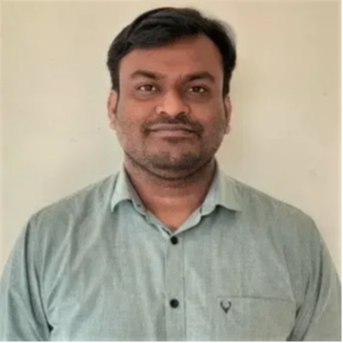
Professor Manoj B R
Assistant Professor
Department of Electronics and Electrical Engineering
Indian Institute of Technology Guwahati
Prof. Manoj B R is an Assistant Professor in the Department of Electronics and Electrical Engineering at the Indian Institute of Technology Guwahati, India. He received a B.E. degree in Electronics and Communication Engineering from the Visvesvaraya Technological University, India, in 2007, a MTech degree in Signal Processing from the Indian Institute of Technology Guwahati, in 2011, and a PhD in Wireless Communications from the Indian Institute of Technology Delhi, in 2019. He has gained a mixed exposure to academic and industrial backgrounds. Before joining IIT Guwahati, he was an Early Doctoral Research Fellow with the Indian Institute of Technology Delhi; a Postdoctoral Researcher with the Division of Communication Systems, Department of Electrical Engineering, Linköping University, Sweden; and a Senior Researcher with the Radio Transmission Technology Lab, Huawei Technologies, Stockholm, Sweden. His research interests include wireless communication and networks, machine learning, deep learning for wireless communications and signal processing, security and robustness of deep learning-based wireless systems, large-scale sensing using radio signals, buffer-aided relaying networks, Markov chains and their applications, diversity combining, and multi-hop communications.
Programme Sample Certificate
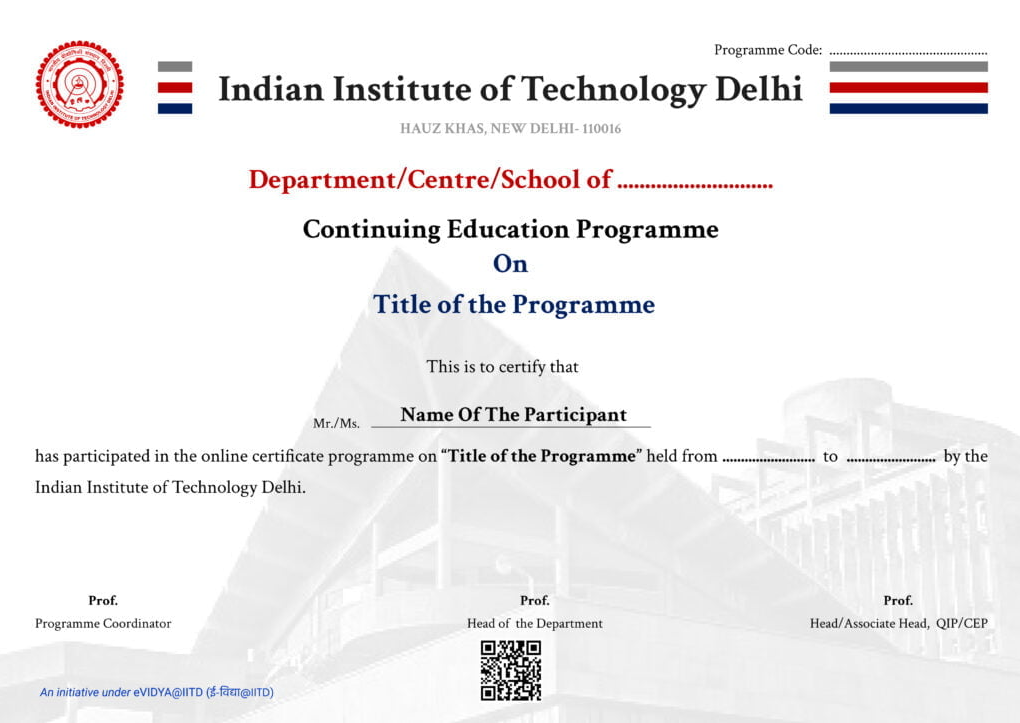
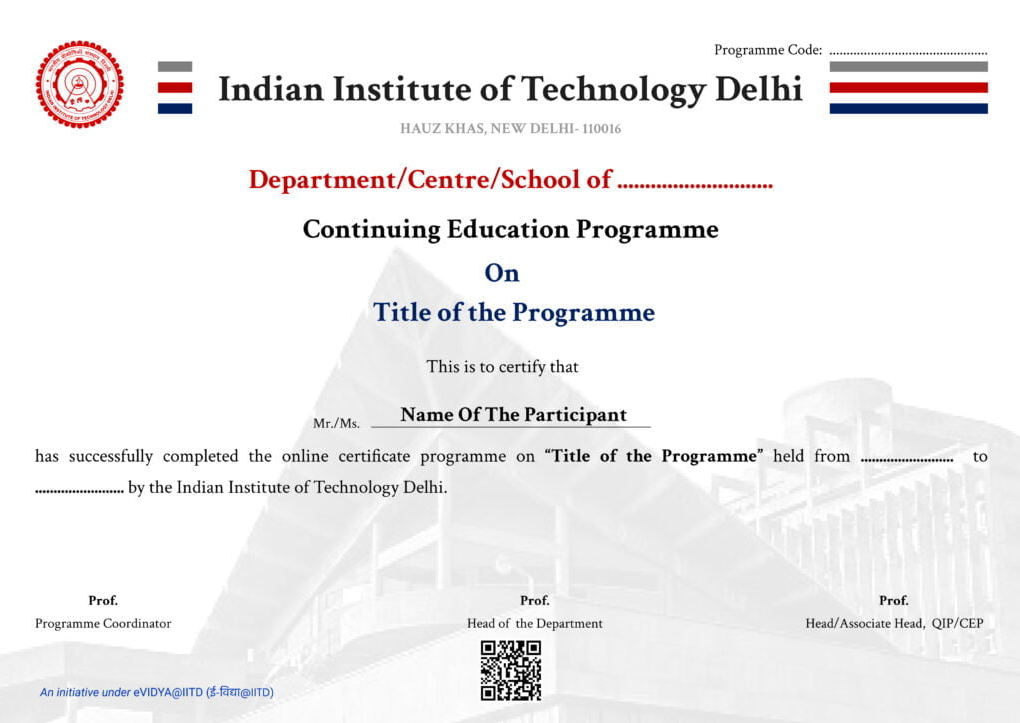
Candidates who score at least 50% marks overall and have a minimum attendance of 50% will receive a ‘Certificate of Successful Completion’ from CEP, IIT Delhi.
Candidates who score less than 50% marks overall and have a minimum attendance of 50% will receive a ‘Certificate of Participation’ from CEP, IIT Delhi.
The organising department of this programme is the Department of Electrical Engineering, IIT Delhi.
Only e-certificates will be issued by CEP, IIT Delhi, for this programme.
Installment Schedule
Programme Fees: 1,95,000 + 18 % GST
Instalment | Date | Amount (₹)** |
Application Fee* | At the time of application | 1,000 GST @ 18% |
1st Instalment | Within 4 days of the offer rollout | 49,500 GST @ 18% |
2nd Instalment | 25th August, 2026 | 48,500 GST @ 18% |
3rd Instalment | 25th September, 2026 | 48,500 GST @ 18% |
4th Instalment | 25th October, 2026 | 48,500 GST @ 18% |
Note:
GST@18% will be applicable.
Application fee is non-refundable and non-transferable.
The application fee will not be adjusted in the total programme fee.
Refund Policy
Candidates can withdraw within 15 days from the programme start date. A total of 80% of the total fee received will be refunded. However, the applicable tax amount paid will not be refunded on the paid amount.
Candidates withdrawing after 15 days from the start of the programme session will not be eligible for any refund.
If you wish to withdraw from the programme, you must email cepaccounts@admin.iitd.ac.in and icare@timespro.com, stating your intent to withdraw. The refund, if applicable, will be processed within 30 working days from the date of receiving the withdrawal request.
Testimonials
Frequently asked questions
The CEP, IIT Delhi Advanced Certificate Programme in AI, ML and DL course is designed to provide candidates with a comprehensive understanding of the motivations, principles, methodologies, and applications of these technologies. It covers essential programming with Python, an introduction to data analytics, applied mathematics, and core modules and applications of machine learning and deep learning in various domains. The programme is designed to equip professionals with the skills and insights needed to navigate the dynamic landscape of ML and DL.
This CEP, IIT Delhi Advanced Certificate Programme in AI, ML and DL course is suitable for graduates from science or engineering backgrounds seeking a career in the ML/DL domain and for professionals in the software and IT industry seeking to upskill with ML/DL expertise. This course is also suitable for professionals who aspire to work as data engineers, data scientists, machine learning engineers, etc.
Candidates must have a BE/B.Tech/ME/MTech/BIT/MIT/BCA/MCA/MCM (any stream), OR BSc/MSc/BS/MS in Mathematics, Statistics, Electronics, Physics, Computer Science, AI, DS to apply for this CEP, IIT Delhi Advanced Certificate Programme in AI, ML and DL.
Secure your spot in the course by clicking the "Enrol Now” button and filling in your details. Our team will swiftly connect with you to provide all the information you need.
The course covers a range of topics such as Foundations of Python Programming, Functional Programming in Python, Data Structures, Loops, and Control Structures, Mathematical Foundations for Machine Learning, Artificial Intelligence Terminologies and Data Analysis, Neural Networks, Fundamentals of Deep Learning, Architectures and Recent Advances, Computer Vision, etc.
The teaching methodology for this CEP, IIT Delhi Advanced Certificate Programme in AI, ML and DL course will be highly interactive, leveraging technology, and deploy diverse pedagogical tools and techniques, including lectures, project work, etc.
The CEP, IIT Delhi Advanced Certificate Programme in AI, ML and DL is a live course that will be delivered in a direct-to-device (D2D) mode.
Completing the CEP, IIT Delhi Advanced Certificate Programme in AI, ML and DL can offer several benefits:
High-Quality Education: IIT Delhi is renowned for its academic excellence and rigorous curriculum. By enrolling in this certificate programme, you gain access to top-tier faculty members, cutting-edge research, and a comprehensive curriculum designed to impart in-depth knowledge of machine learning and deep learning concepts.
Prestigious Credential: Obtaining a certificate from IIT Delhi carries significant weight and recognition in the industry. It serves as a validation of your expertise and commitment to mastering machine learning and deep learning techniques, enhancing your credibility and marketability to potential employers.
Comprehensive Curriculum: The programme covers a wide range of topics relevant to machine learning and deep learning, including algorithms, neural networks, natural language processing, computer vision, and more. This comprehensive curriculum ensures that you acquire a strong foundation in both theoretical principles and practical applications of these technologies.
Hands-On Experience: The programme likely includes practical exercises, projects, and case studies that provide hands-on experience with real-world datasets and tools used in machine learning and deep learning projects. This practical exposure helps reinforce theoretical concepts and equips you with the skills needed to tackle complex data analysis and modelling tasks.
Networking Opportunities: IIT Delhi attracts talented students and industry professionals from diverse backgrounds. Participating in this certificate programme allows you to interact with peers, faculty members, and guest speakers who share a passion for machine learning and deep learning. These networking opportunities can lead to valuable collaborations, mentorship, and career connections in the field.
Career Advancement: With the growing demand for professionals skilled in machine learning and deep learning, completing this certificate programme can significantly enhance your career prospects. Whether you are seeking to advance in your current role, transition to a new career path, or start your own venture in artificial intelligence, the knowledge and credentials gained from this programme can open doors to exciting opportunities in various industries.
The CEP, IIT Delhi Advanced Certificate Programme in AI, ML and DL in India offers a comprehensive curriculum covering key concepts such as supervised and unsupervised learning, neural networks, natural language processing, computer vision and deep learning. With a focus on practical hands-on experience through projects and case studies, the program equips participants with the skills and knowledge required to excel in the rapidly growing fields of machine learning and deep learning. The certification from a prestigious institution like IIT Delhi adds significant value to one's professional profile, opening up opportunities in sectors like technology, finance, healthcare, and more. Overall, this program provides a solid foundation for individuals looking to pursue a career in artificial intelligence and data science.
The CEP, IIT Delhi offers a cutting-edge AI, Machine Learning and Deep Learning course that stands out due to its rigorous academic curriculum, top-notch faculty, and state-of-the-art research facilities. The program emphasises hands-on learning through practical projects and real-world applications, ensuring students gain practical skills alongside theoretical knowledge. Additionally, IIT Delhi's industry collaborations provide valuable networking opportunities and exposure to the latest trends in the field. By choosing IIT Delhi for this course, students can benefit from a holistic learning experience that equips them with the necessary expertise to excel in the rapidly evolving field of artificial intelligence.