Advanced Certification in Data Science and Decision Science (Batch 5)
Features
Programme Overview
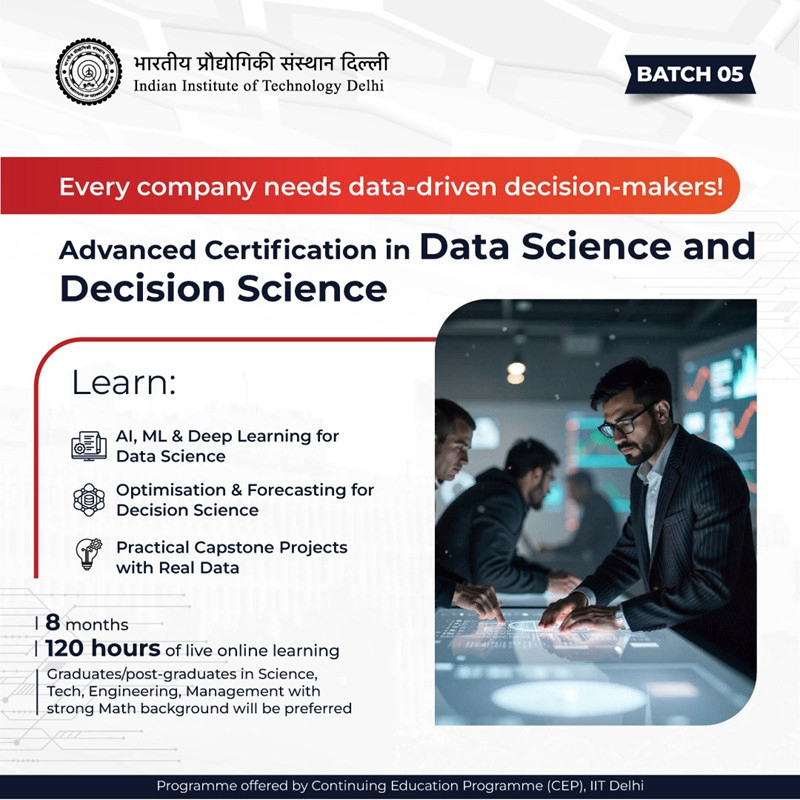
The IIT Delhi Advanced Certification in Data Science and Decision Science addresses the dynamic needs of the industry, equipping participants with advanced skills in data analytics, artificial intelligence, and machine learning. With a strong focus on practical problem-solving for management decision-making, this programme blends rigorous theoretical knowledge with hands-on experience. Graduates are well-prepared to excel in the field of data science and drive substantial career advancements.
Data Scientists: These professionals delve into vast amounts of data, finding patterns and trends that can inform business strategies. They employ techniques such as machine learning, statistical analysis, and data mining to turn raw data into meaningful insights.
Decision Scientists: Building on the insights provided by Data Scientists, Decision Scientists apply a range of analytical tools and techniques to make strategic decisions. Their work involves not just data analysis, but also understanding human behaviour and leveraging cognitive sciences to solve complex business problems.
Registration Closed
Class Schedule
8 Months (Total Learning Hours - 360)
120 Hours of Live Teaching / Interaction
40 Hours across 2 Capstone Projects (Group activity)
200 Hours of Self-paced Learning (50 hours for preparing for quizzes/assignments + 150 hours of Extra Reading Material)
Class Timings: Every Saturdays: 9:30 AM to 1:00 PM 2:30 PM to 5:30 PM
Eligibility Criteria
Applicants who are graduates/post-graduates in Science, Technology, Engineering, Management, or any related disciplines with a strong Mathematical background will be preferred
Programme Highlights
Live Online Lectures By The Esteemed IIT Delhi Faculty And Industry Experts
Holistic Understanding With The Implementation Of Two Capstone Projects
Campus Visit At IIT Delhi
Curriculum Covering Contemporary Concepts And Tools Of Data And Decision Sciences
Sessions On Gen Al And Large Language Models
E-certificate Issued By CEP, IIT Delhi
Programme Modules
Module 1: Python Programming and Machine Learning Model Implementation
Data Management and Manipulation
Central Tendencies, Dispersion and Correlation Analysis
Clustering, Multinomial Regression and Logistic Regression Analysis
Longitudinal Data / Time Dependent Data Analysis
Supervised and Unsupervised Machine Learning Implementation
Natural Language Processing, Topic Modelling, and Sentiment Analysis
Learning outcomes:
Develop knowledge about data manipulation in Python
Learn how to handle large volumes of data
Learn to use different data analysis models on complex data for prediction models and forecasting
Implement supervised and unsupervised machine learning models using Python
Learn to develop managerial inferences from machine learning models
Module 1: Overview to Decision Science
Understanding Main Pillars of Business Decision Science and Heuristics/Meta-Heuristics/AI
Central Limit Theorem, Distributions, Dispersion, Population, Sample, T Test, Z Test, Chi Square Test
Comparing Multiple Groups - ANOVA, MANOVA
Linear Algebra - Matrix Operations, Determinants, Vectors and Eigen values
Learning outcomes:
Understand the main pillars of Decision Science viz. Prescriptive, Predictive and Descriptive Decision Science
To provide basics on Statistics to understand the main pillars of Decision Science.
Module 2: Prescriptive Decision Science
Introduction to Linear Programming (Single Objective) and solving using Solver/ LINGO/ LINDO Systems
Sensitivity Analysis using Solver/LINGO/Linear, Interactive, and Discrete Optimiser
Goal Programming for Divergent Complex Objective (Multiple Objectives) using Solver/LINGO/Linear, Interactive, and Discrete Optimiser
Application of Linear and Non-Linear Programming for Improving Business Decision-making through Case Study
Learning outcomes:
Understand Prescriptive Decision Science
Learn to develop prescriptive models using examples
Learn to solve the prescriptive models
Understand the use of Excel solver and LINGO packages in solving the prescriptive models
Discuss practical cases to learn application of prescriptive decision science
Module 3: Predictive Decision Science and Temporal Data Models
Time Series Analysis (Moving Average, Exponential-based Predictive Model)
Advanced Time Series Analysis (Holtz and Winter-Holts Model)
Auto Regressive Integrated Moving Average Models
Learning outcomes:
Understand Predictive Decision Science
Discuss time series methods in Predictive Decision Science
Discuss regression methods in predictive decision science
Module 4: Multi-Criteria Decision Science
Multi-criteria Decision-making: Interpretive Structural Modelling and DEMATEL
Multi-criteria Decision-making: Interpretive ranking Process and Technique for Order of Preference by Similarity to Ideal Solution
Analytic Hierarchy Process (AHP) and Analytic Network Process (ANP)
Learning outcomes:
Understand Descriptive Decision Science
Discuss popular Descriptive Decision Science using practical examples
Module 5: Decision Science Learning Enrichment and Assessment
Decision Science Case Study Approaches
Decision Science Capstone Project
Individual Evaluation on Decision Science
Learning outcomes:
Participate in group case study presentations
Experience the real-life applications of all pillars of decision science
Participate in individual evaluation
Module 1: Data Analysis Principles and Feature Engineering for ML Application Development
Introduction to Data Science and Types of Data Management Enterprise Systems
Data Visualisation - Methods and Approaches in Computer Human Interaction Principles
Data Model-building and Feature Selection Process for ML and Big Data Applications - Boston City Case Study
Learning outcomes:
Understand the range of data analysis using different methods
Understand different visualisation methods to interpret large volumes of data
Develop aptitude to understand feature selection for building data models for ML applications
Module 2: Artificial Intelligence and Machine Learning
Multidimensional Data Handling, Multinomial and Logistic Regression, Unsupervised Machine Learning for Clustering, and Association Rule Mining
Supervised Machine Learning for Pattern Classification, Distance Based Algorithms, Data Normalisation for Machine Learning, Anomaly Detection, and Sequence Mining Algorithms
Supervised ML - Decision Trees, Random Forest, SVM, Naïve Bayes Classifiers, and Ensemble Learning
Governance of AI/ML – Establishing and Maintaining Fairness, Accountability, Transparency, Ethics, User Experience, and Regulations
Learning outcomes:
Learn the computational background of supervised machine learning algorithms
Understand the feature selection process for model building
Learn the computational background of unsupervised machine learning algorithms
Module 3: Cognitive Deep Learning and Generative Artificial Intelligence
Machine Learning using Artificial Neural Networks, Feed Forward Neural Networks, Back Propagation, and Apriori Algorithm
Machine Learning using Deep Learning and Convoluted Neural Networks, Computer Vision Principles using CNN
Generative Artificial Intelligence and Chatbots, Large Language Models using Deep Learning, and Decoding Transformer Architectures
Generative Artificial Intelligence, Conversational AI, and Prompt Engineering
Reinforcement Learning and Federated learning
Learning outcomes:
Understand different models of Artificial Neural Networks (ANN) for complex data mining objectives
Understand the building blocks for computer vision
Understand how large-scale graphs operate in internet ecosystems
Understand how chatbots are designed
Learn technological modules of generative AI systems
Module 4: AI for Cognitive Science and Big Data
NLP for Social Media and Text Mining - Sentiment Analysis, Opinion Mining, Topic Modelling, Latent Dirichlet Allocation, and Latent Semantic Analysis
Network Science with Graph Theory, Community Analysis, Node Association Analysis, and Hands-on Exercises with Small Networks Data
Using No-code Platforms for Running Advanced ML Applications
Learning outcomes:
Understand how web search and social networks operate on user-generated data
Learn using ML for analysing text and networks data
Understand the evolution of code based to no-code environments for data scientists
Understand emerging ML paradigms for future
Module 5: Data Science Learning Enrichment and Assessment
Data Science Capstone Project Part 1 – Data Descriptives and Feature Selection Models
Data Science Capstone Project Part 2 - Unsupervised and Supervised Machine Learning Implementations
Individual Evaluation on Data Science and Machine Learning
Learning outcomes:
Learn model development for complex and large data sets for business problem-solving
Learn how to deploy AI/ML algorithms for data science projects
Develop an understanding on futuristic issues for data science professionals
Data Science: Learners will be provided with datasets containing large volumes of data. They will first need to demonstrate their proficiency in feature selection. Subsequently, they will apply unsupervised algorithms to the dataset. Finally, learners must implement multiple supervised machine learning algorithms and evaluate their suitability in the context of the given data or case study. The project may be undertaken using a combination of SPSS/PSPP, Python, and Orange.
Decision Science: Learners will be introduced to all three pillars of decision science—prescriptive, predictive, and descriptive decision-making—through various modules. To facilitate the practical application of these concepts, a case study-based capstone project will be used. The relevant tools and techniques will be explored using Excel, Excel Solver, Python, and LINGO.
Learning Outcomes
Gain a strong understanding of data science, AI, ML algorithms, and decision science models.
Master feature selection for effective model building and ML deployment.
Strengthen problem-solving skills for data-driven management decisions.
Develop a systematic, algorithmic approach to complex data analysis.
Analyse large datasets using computational and mathematical algorithms.
Understand deep learning and generative learning for business applications.
Enhance problem-solving through hands-on exercises and capstone projects.
Prepare for a career transition in data and decision science
Tools
Python
Pandas
Excel
PSPP
Vosviewer
Matplotlib
IBMSPSS
Solver
Orange
Lingo
Num Py
Tableau
Programme Coordinator

Professor Arpan Kumar Kar
Professor
Department of Management Studies
Yardi School of Artificial Intelligence
Indian Institute of Technology Delhi
Prof. Arpan Kumar Kar is a Professor in Indian Institute of Technology Delhi, India. He holds the ASG Endowed Chair Professorship in the space of data and decision science. Within IIT Delhi, he holds a joint appointment between Department of Management Studies and Yardi School of Artificial Intelligence. Administratively, he chairs Corporate Affairs, Member of Faculty Search Committee and Advisory Committee for the Overall Curriculum Development Cell. His research and teaching interests are in the domain of data science, artificial intelligence, digital transformation, internet ecosystems, social media and ICT-based public policy. He has supervised over 15 doctoral students and over 75 master's dissertations, and is currently guiding 8 PhD scholars. He is currently holding a Visiting Professorship in TU Delft, Netherlands.
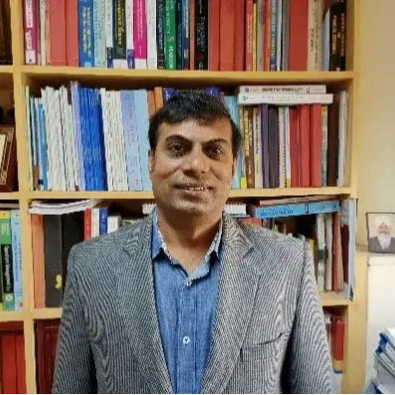
Professor Surya Prakash Singh
Professor
Head of Department of Management Studies
Indian Institute of Technology Delhi
Prof. Surya Prakash Singh is a Dhananjaya Chair Professor in the Department of Management Studies (DMS), Indian Institute of Technology Delhi (IITD), India. He is also serving as chairperson, Operations & Supply Chain group at DMS, IIT Delhi. He holds a Ph.D. from IIT Kanpur. He is also a postdoctoral fellow from NUS Singapore-MIT USA alliance. He has been also a visiting fellow at Newcastle Business School, Newcastle University, UK; and visiting professor at Alborg University, Denmark and IMT Atlantique, Nantes, France. In addition to this, he was also associated in various capacities at some of the B-Schools in the country such as IIM Amritsar, IIM Bodhgaya, IIM Kashipur, IIM Ranchi, IIM Rohtak, IIM Raipur, MDI Gurgaon, SNU Gr. Noida, SCMHRD Pune, XLRI, and XIM Bhubaneswar
Programme Sample Certificate
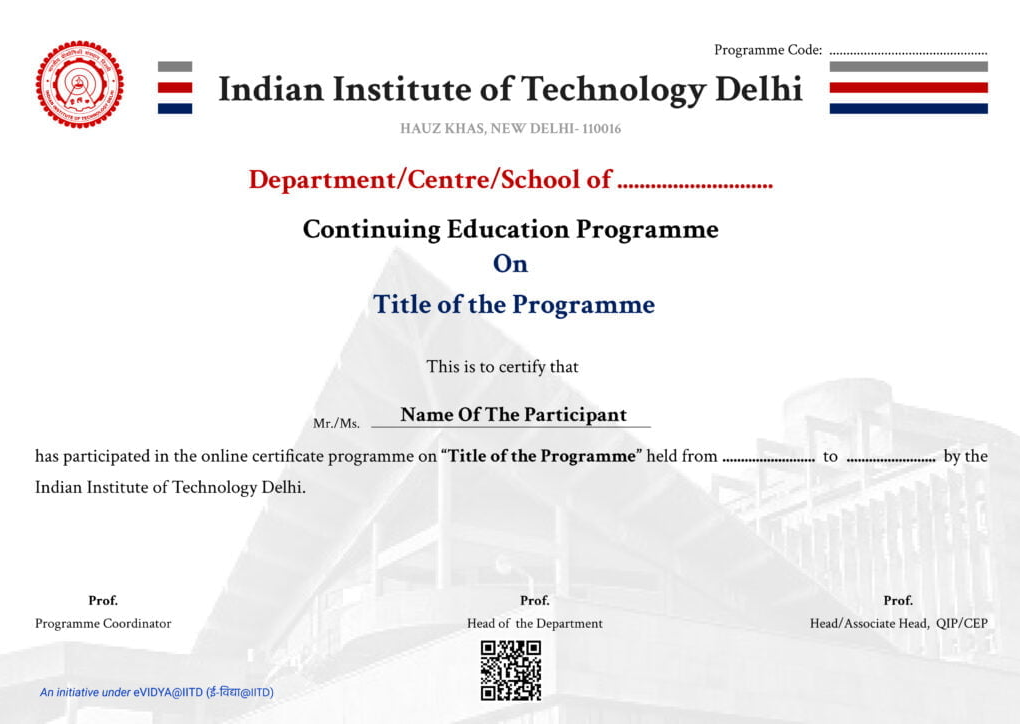
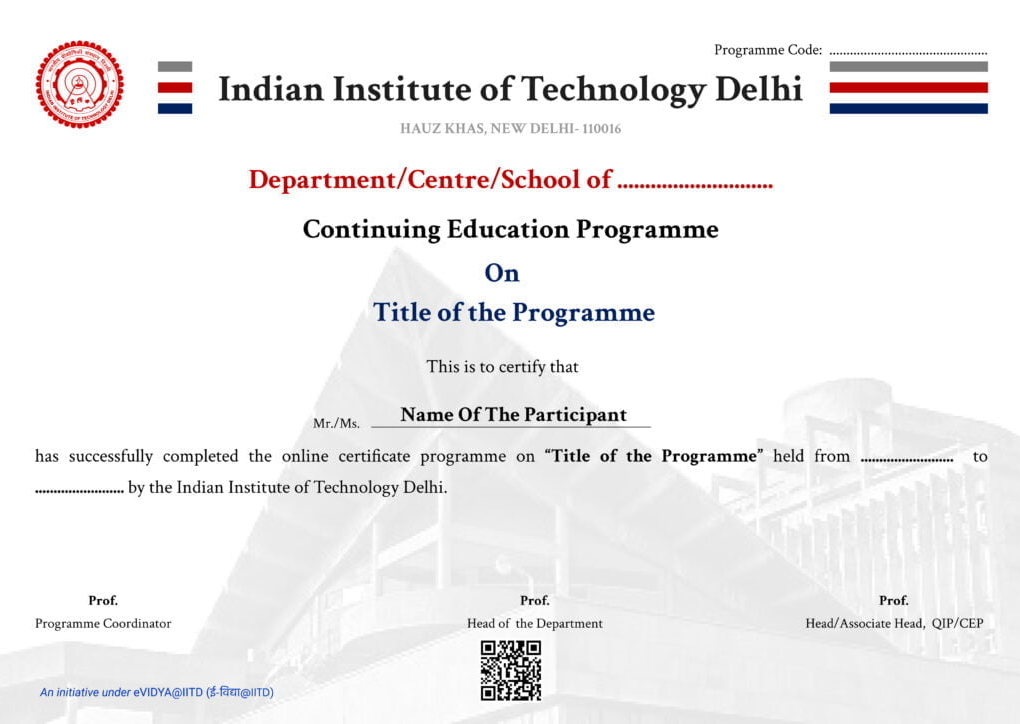
Candidates who score at least 50% marks overall and have a minimum attendance of 40% will receive a ‘Certificate of Successful Completion’.
Candidates who score less than 50% marks overall and have a minimum attendance of 40% will receive a ‘Certificate of Participation’.
The organising department for this programme is the Department of Management Studies, IIT Delhi.
*Only e-certificates will be issued by CEP, IIT Delhi, for this programme.
Installment Schedule
Programme Fee INR 1,89,000 + GST
Instalment | Date | Amount (₹)* |
Application Fee** | At the time of application | 1,000 |
1st Instalment | Within 5 days of the offer rollout | 48,000 |
2nd Instalment | 18th August, 2025 | 47,000 |
3rd Instalment | 19th September, 2025 | 47,000 |
4th Instalment | 19th October 2025 | 47,000 |
Note:
*Application Fee of ₹1,000 is non-refundable and will not be adjusted in the total programme fee.
**GST will be additional as applicable.
Refund Policy
Candidates can withdraw within 15 days from the programme start date. A total of 80% of the total fee received will be refunded. However, the applicable tax amount paid will not be refunded on the paid amount. • Candidates withdrawing after 15 days from the start of the programme session will not be eligible for any refund.
If you wish to withdraw from the programme, you must email cepaccounts@admin.iitd.ac.in and icare@timespro.com, stating your intent to withdraw. The refund, if applicable, will be processed within 30 working days from the date of receiving the withdrawal request.
Programme Related Video
Testimonials
Frequently asked questions
The IIT Delhi Advanced Certification in Data Science and Decision Science is an executive course developed by IIT Delhi that provides professionals with a comprehensive understanding of data science and decision science. The curriculum covers various aspects of data science and decision science, and the course is led by experienced faculty members from IIT Delhi.
Graduates or Postgraduates in Science, Engineering, Business or any related disciplines can apply for this IIT Delhi Advanced Certification in Data Science and Decision Science programme.
The IIT Delhi Advanced Certification in Data Science and Decision Science is suitable for professionals who want to enhance their career prospects in the field of data science and decision science. The programme is designed for working professionals who want to learn the skills and knowledge needed to make data-driven decisions.
To begin the application, click the "Enrol Now" button and provide your full name, phone number, email address, and city to apply for this programme. Press the submit button. Our programme advisors will give you a call with specific instructions.
In case you see an ‘admission closed’ or ‘to be announced’ status, please fill out the Enquiry Form by selecting the "Enquire Now" option. Our course advisers will contact you to provide additional information.
The IIT Delhi Advanced Certification in Data Science and Decision Science is designed to be completed in 8 months.
Yes, IIT Delhi's Advanced Certification in Data Science and Decision Science programme is designed with a flexible schedule that allows students to balance their work and study commitments.
Yes, upon successful completion of the programme, students will receive an e-certificate from IIT Delhi. A "Certificate of Successful Completion" will be awarded to candidates with a minimum attendance requirement of 50% and an overall score of at least 50%. Those who complete the exam with fewer than 50% of the possible points and at least 50% of the required attendance will be awarded a "Certificate of Participation."
This is a live online sessions which will be delivered Direct-to-Device (D2D). Learners can access the classes on their Desktop, Laptop, Tablet, or Smartphone.
The IIT Delhi Advanced Certification in Data Science and Decision Science offers a comprehensive scope tailored for professionals seeking expertise in these cutting-edge fields in India. This certification provides rigorous training in essential areas such as statistical analysis, machine learning, big data analytics, and decision-making frameworks. You gain practical skills to harness data-driven insights for optimising business strategies, improving operational efficiencies, and innovating across diverse sectors, including IT, finance, healthcare, and e-commerce. The program's affiliation with IIT Delhi ensures credibility and recognition in the industry, enhancing career opportunities for roles such as Data Scientist, Machine Learning Engineer, Business Analyst, and Decision Scientist. Participants also benefit from networking opportunities with peers and industry leaders, further enriching their professional growth and potential for impactful contributions in India’s dynamic data science landscape.
After completing the IIT Delhi Advanced Certification in Data Science and Decision Science, various career opportunities open up, including roles such as data scientist, machine learning engineer, business analyst, data analyst, and decision scientist. Graduates can find employment in diverse industries like finance, healthcare, technology, and consulting, leveraging their skills in data analysis, predictive modelling, and decision-making to drive impactful insights and strategies.