
Advanced Programme in Electric Vehicle Technology ( Batch 10 )
Features
Programme Overview
Electric vehicles play a pivotal role in reducing dependence on crude oil, protecting the environment, and advancing sustainable mobility. With major manufacturers investing heavily in EV technologies, the sector is generating significant employment and growth opportunities for professionals equipped with the right expertise.
The E-Mobility ecosystem spans multiple key technologies, including electrochemical energy storage and conversion, electric drivetrains, and power electronics. EVs primarily rely on batteries, fuel cells, and supercapacitors, each requiring sophisticated power-electronic interfaces to integrate with vehicle drivetrains and charging infrastructure.
This programme offers a strong foundational understanding of storage technologies, from single cells to full battery packs, duty-cycle-based sizing, and essential power electronics used for interfacing energy devices with drivetrains. It also covers critical aspects of charging, from device-level mechanisms to grid-level interactions—along with introductions to smart grids, net metering, and system integration.
Designed to deliver a comprehensive view of Electric Vehicle (EV) Technology, the programme equips participants and working professionals with the knowledge, skills, and capabilities needed to thrive in the fast-evolving e-mobility domain and meet the training demands of Industry 4.0.
₹ 1,25,000 + 18 % GST
Registration Closed
Class Schedule
Sunday 9:30 am to 12:30 pm
Eligibility Criteria
For Indian Participants - Graduates or Diploma Holders from a recognised University/Institutes(UGC/AICTE/DEC/AIU/State Government) in any discipline.
For International Participants - Graduation or equivalent degree from any recognised University or Institution in their respective country.
Programme Highlights
E-Certificate Of Completion From CEP, IIT Delhi
Gain Industry-oriented Insights From IIT Delhi Faculty
Live Interactive Sessions By IIT Delhi Faculty
Group Project
Cutting-edge Curriculum Designed By IIT Delhi Faculty
Peer-to-peer Learning
Programme Modules
This module will provide the background and overview of the programme learning. It will introduce the need for electric vehicles, classification of electric vehicles, understanding of electric drivetrain, etc.
Basic scheme of EV drivetrain
Vehicle dynamics and concept of drive cycles
This module is designed to provide a relevant and holistic view of the various terminologies and fundamentals of any electrochemical device.
Electrochemical cell and battery
Influence of battery on EV range and cost
Type of batteries used in EV
Other electrochemical storage relevant to EV: fuel cell, supercap, flow battery
This module will cover the battery types relevant to EVs, their key performance indicators and present the state-of-the-art as well as future directions.
Battery state and rate of discharge: SoC, SoH, C-rate
Key characteristics of battery: Voltage, current-voltage characteristics
Li-ion battery: present state of the art and future directions
Li-ion battery fault diagnosis, safety and testing
The understanding gained from module 3 will be used for designing and building of module and packs from the cells for real application.
Li-ion cell manufacturing process
Electrical design and sizing of the battery pack
Cell balancing
Mechanical and thermal design of battery pack
The charge discharge of the battery pack requires matching of its characteristics with the charger and drivetrain characteristics. This matching is through power electronics devices and this learning module will provide relevant background to power electronics required to understand the design and working of power electronics interface.
Voltage and current levels in EV
Power electronics interface – components and devices
Convertors and invertors
EMI and EMC
Traction motors and their characteristics
The success of the electric vehicle will depend on the suitable charging infrastructure. The module will cover the relevant details related to chargers as well as smart and mini-grids, etc.
Battery management system (BMS)
Power-train architecture
EV charging levels
Charger types and standards
EV charging techniques
This module will discuss various government policies relevant to electric vehicles.
EV Indian scenario and future projections
Total cost of ownership
Indian EV policies
Note: This is an indicative list of course topics and is subject to change as per IIT Delhi's discretion.
Learning Outcomes
Exposure to spectrum of technologies, economic and policy aspects of e-mobility space
Caters to the training and development need of industry 4.0
Comprehensive understanding of storage devices from single cell to pack level
Duty cycles led sizing for storage devices
Power electronics required for drivetrains and charging stations
Charging aspect from device to electric grid level
Programme Coordinator
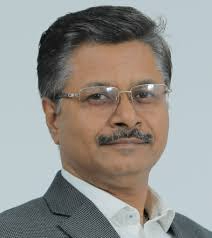
Professor Anil Verma
Professor
Department of Chemical Engineering
Indian Institute of Technology Delhi
Prof. Anil Verma is a Professor in the Department of Chemical Engineering at IIT Delhi, with experience as a Visiting Professor at Washington University in St. Louis and a Visiting Fellow at Newcastle University. He leads the DST-IIT Delhi Centre for Energy Storage Platform on Batteries (ESPOB) and is a member of the Centre for Automotive Research and Tribology (CART). Prof. Verma holds a B.Tech. and M.Tech. from H.B.T.I. Kanpur, a Ph.D. from IIT Delhi, and has industry experience. He also collaborates with organizations like IOCL, BIS, and DST.
Prof. Verma leads an interdisciplinary research group focused on electrochemical systems, including fuel cells and batteries for energy storage and electric vehicle charging. His work involves projects for organizations like DST, CSIR, BRNS, ISRO, and industry partners . Prof. Verma has supervised 12 Ph.D. students and has an extensive portfolio, including 9 patents (6 granted), 85 research papers in peer-reviewed journals, and over 150 conference presentations.
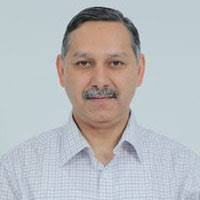
Professor Anupam Shukla
Professor
Department of Chemical Engineering
Indian Institute of Technology Delhi
Prof. Anupam Shukla is a Professor in the Department of Chemical Engineering, IIT Delhi and has been a faculty member of IIT Delhi for the last 15 years. Prof. Shukla completed 5 Year Integrated M. Tech. in Chemical Engineering from IIT Bombay and Ph.D. from IIT Kanpur. He then worked as a faculty member at IIT Guwahati for a little more than 2 years before moving to IIT Delhi. Prof. Shukla works in the area of electrochemical systems with focus on electrochemical energy storage, mainly supercapacitors and batteries. The area of interest also includes membrane electrolysis, electrodialysis, electrochemical route to graphene synthesis, and ion exchange membranes.
Prof. Shukla served as a member of curriculum development for post-graduate programme on E-mobility hosted by Centre for Automobile Research (CART) at IIT Delhi and has also served in a few committees of funding agencies to review proposals for support funding for setting up plants on new electrochemical technologies. Prof. Shukla has completed more than 10 projects sponsored by Government funding agencies and Industries on materials and cells related to electrochemical systems and has several ongoing sponsored projects. Prof. Shukla has supervised 7 Ph.D. theses and currently has 5 Ph.D. students working in different areas of electrochemical energy storage. He has published 50 papers in international journals and several in conference proceedings.
Programme Faculty
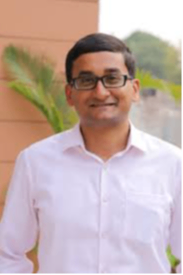
Professor Sumit Kumar Pramanick
Associate Professor
Department of Electrical Engineering,
Indian Institute of Technology Delhi
Prof. Sumit Kumar Pramanick is working as an Assistant Professor in the Department of Electrical Engineering, IIT Delhi. His area of expertise is in the field of design of power electronic converters and its control for applications like machine drives, renewable energy and e-mobility. His research group in IIT Delhi is currently working towards development of high power density power converters for EV battery charging using energy efficient power devices, high bandwidth embedded current sensors, high frequency magnetics design, and wireless power transfer technology. Prof. Pramanick is closely working with a few start-ups in the NCR region to develop products related to power electronics. He has introduced concepts of adaptation of digital controllers in standalone power electronic converters as per industry practice. Separate hands on module has also been developed as a part of the M.Tech. curriculum with Power Electronics and Machine Drives specialisation in IIT Delhi. His contributions to this curriculum was recognized through Teaching Excellence Awards, 2018 in IIT Delhi. He is a recipient of INAE Young Engineer Award, 2020.
He is a Member of IEEE, IEEE Industrial Electronics Society, and IEEE Power Electronics Society. He is a regular reviewer in reputed journals like IEEE Transactions on Industrial Electronics, IEEE Transactions on Power Electronics, IEEE Transactions on Industrial Applications and Sadhana. Prior to joining IIT Delhi, he was a Post Doctoral Fellow in the Cullen College of Engineering at University of Houston, Texas, USA. He finished his doctoral research in the Department of Electronic Systems Engineering, Indian Insti- tute of Science, Bangalore. He completed B.E. in Electrical Engineering from the Indian Institute of Engineering Science and Technology, Shibpur.

Professor Akhil Garg
Associate Professor
School of Mechanical Science and Engineering
Huazhong University of Science and Technology (HUST), China
Prof. Akhil Garg is an Associate Professor at HUST, China, and previously served as Assistant Professor at IIT Delhi (CART) and has also worked at the Vin University, Vietnam. His research expertise includes renewable energy systems, battery pack design for EVs, thermal management of battery systems, intelligent optimisation for engineering design, and energy storage technologies.
He has published 50+ research papers in reputed international journals and serves as Regional Editor for the International Journal of Ambient Energy and International Journal of Green Energy.
Programme Sample Certificate
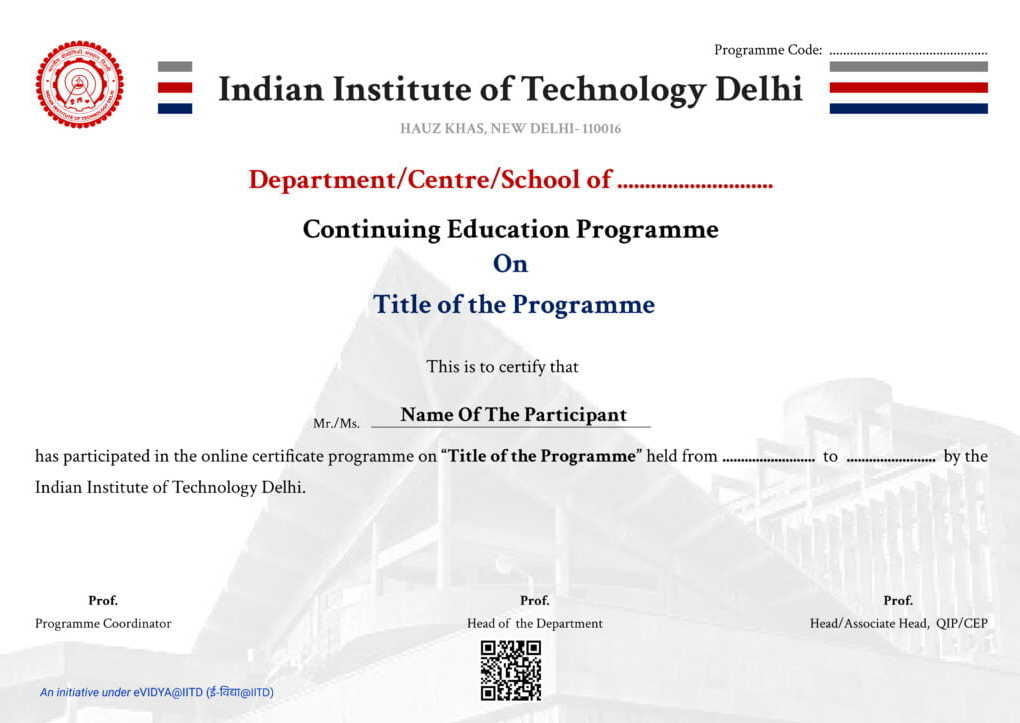
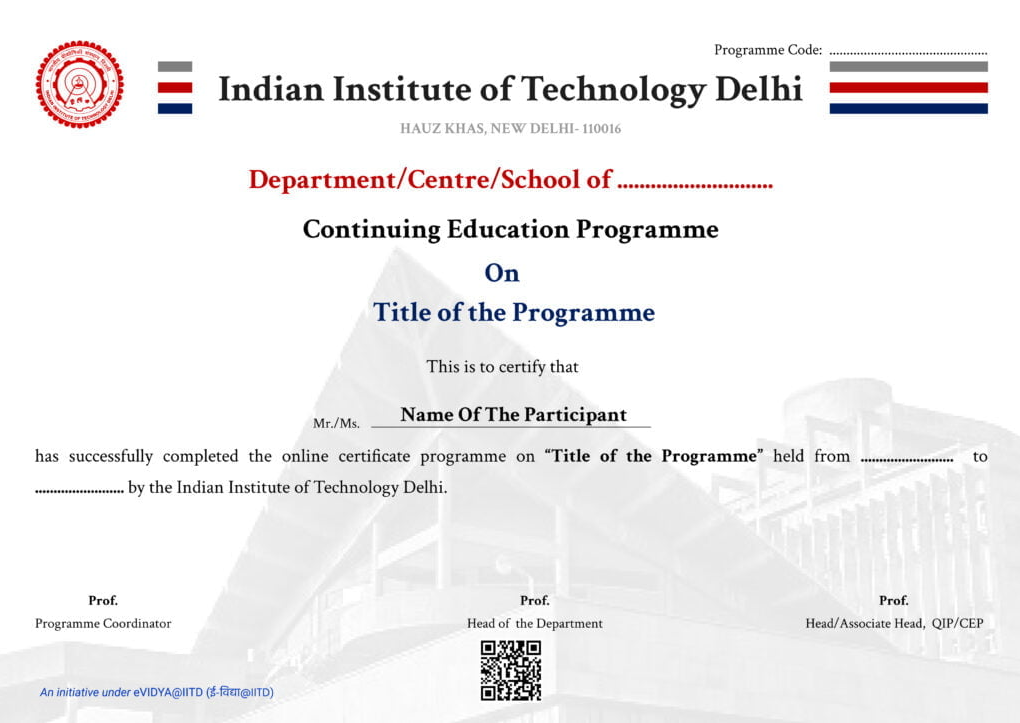
Participants who successfully meet the evaluation criteria (Marks >= 50%) and satisfy the requisite attendance criteria (Attendance >=50%) will be awarded a ‘Certification of Successful Completion’
Participants with attendance >= 50% and marks < 50% will get ‘Participation Certificate’
Installment Schedule
Programme Fees:- 1,25,000 +18% GST
Component | Date | Amount in ₹* |
|---|---|---|
1st Installment | Within 3 days of offer rollout | ₹62,500 + GST |
2nd Installment | 28th August 2026 | ₹62,500 + GST |
Note:
Application fee of INR 1,000/- + GST is non-refundable and will not be adjusted in total programme fee.
Payment of fees should be submitted to the IIT Delhi CEP account only. The receipt will be issued by the IIT Delhi CEP accounts team and can be downloaded from the CEP Portal.
18% GST will be applicable on all fess
Refund Policy
Candidates can withdraw within 15 days from the programme start date. A total of 80% of the total fee received will be refunded. However, the applicable tax amount paid will not be refunded on the paid amount.
Tax amount paid will not be refunded on the paid amount.
Candidates withdrawing after 15 days from the start of the programme session will not be eligible for any refund.
Programme Related Video
Testimonials
Frequently asked questions
IIT Delhi under its Continuing Education Programme (CEP).
6-month programme with live Live Online, Interactive Sessions every Sunday, 9:30 AM – 12:30 PM IST.
Graduates or postgraduates from any discipline; work experience preferred.
Selection is based on application review and verification of submitted documents by IIT Delhi’s programme coordinators.
₹1,25,000 + 18 % GST, payable in two instalments.
Candidates can withdraw within 15 days from the programme start date. A total of 80% of the total fee received will be refunded. However, the applicable tax amount paid will not be refunded on the paid amount.
Candidates with drawing after 15 days from the start of the programme session will not be eligible for any refund.
Yes, all live session recordings are accessible online until the programme concludes.
Participants who successfully meet the evaluation criteria (Marks >= 50%) and satisfy the requisite attendance criteria (Attendance >=50%) will be awarded a ‘Certification of Successful Completion’
Participants with attendance >= 50% and marks < 50% will get ‘Participation Certificate’
EV-focused knowledge including drivetrain fundamentals, battery systems, BMS, chargers, power electronics, policies, and industry-aligned EV technologies.
Yes, the programme includes an offline campus immersion at IIT Delhi toward its completion.