
Applied AI, ML and Decision Science Programme (Formerly known as Advanced Certificate Programme in Data Science and Decision Science - Batch 06)
Features
Programme Overview
The Applied AI, ML and Decision Science Programme from IIT Delhi is designed for professionals looking to build future-ready expertise in Generative AI, Agentic AI, Machine Learning, Predictive Analytics, and Decision Intelligence.
Built on a distinctive dual-pillar approach Applied AI and Decision Science - the programme enables participants to not only develop intelligent AI systems, but also transform AI insights into strategic, scalable, and business-ready decisions.
Across the programme, participants will learn to work with AI-ready data ecosystems, LLMs, no-code AI tools, forecasting models, optimization frameworks, simulation techniques, and multi-criteria decision systems. With a strong focus on real-world business applications, capstone projects, and hands-on learning using Python, Tableau, Solver/LINGO, and modern AI tools, the programme equips learners to build AI-powered, data-driven, and decision-centric business solutions for the evolving digital enterprise.
₹ 1,60,000 + 18 % GST
Registration Closed
Class Schedule
Saturdays - 09:30 am to 01:00 pm
Eligibility Criteria
Graduates or Diploma Holders (10+2+3) in any discipline.
Applicants who are graduates/post-graduates in Science, Technology, Engineering, Honors in Mathematics, or any related disciplines with a mathematical background.
Programme Highlights
Dual-Pillar Programme (Applied AI And Decision Science)
Full AI Spectrum: Classical ML, Deep Learning, Gen AI And Agentic AI
Code And No-code Learning Using Python And Leading No-code AI Platforms
Responsible AI Focus Covering Ethics, Fairness, Transparency, And Explainability
Case-based Learning With Real-world Applications
Industry Tools Including Python, Tableau, Orange, Excel Solver And LINGO
Capstone-driven Outcomes In Both Pillars
100 % Live Online IITD Faculty Sessions
Get E-certified From CEP, IIT Delhi
Programme Modules
Introduction to AI-Ready Data & Modern Data Ecosystems, Sampling and How AI interprets Data
Data Visualisation - Methods and Approaches in Computer Human Interaction Principles (Tableau)
Responsible AI Systems - Design principles, Fairness, Accountability, Transparency, Ethics, UX & Regulations
Multidimensional Data handling, Regression, Model Explainability, Feature Selection, Unsupervised Machine Learning
Advanced Supervised and Unsupervised Machine Learning for Classification, Association Rule Mining, Outlier Detection, and Sequence Mining
Data Model Building for ML and Big Data Feature Engineering applications - Boston Case Study
Machine Learning using Artificial Neural Networks (Concepts of Apriori, Back Propagation, Feedback, Loss Functions)
Supervised ML - Decision Trees, Random Forest, SVM, Naïve Bayes Classifiers, Ensemble Learning, XG Boost
Generative AI and Chatbots: Large Language Models using RNN, LSTM and Transformers (Chain-of-thought, Planning, Reflection)
Deep Learning for Computer Vision Using Convoluted Neural Networks, Gradient functions
NLP in Social Media Analytics - Sentiment Analysis, Text Summarisation, Emotion Analysis, Topic Modelling, LDA, LSA
Network Science for Large Graphs with Graph Theory, Hands-on Exercises with Small Networks Data
No Code Supervised AI - Gradient Boosting, Ensemble Learning, ANN, SVM, RF, DT, NBC
No Code Unsupervised AI - Clustering, NLP, Topic Modeling, Sentiment mining
Network Science, Graph Assisted Rankings and GenAI in Search Ecosystems: The Google Case and BERT
Agentic AI models, Planning, Execution, RAG Workflows
Data Science Capstone Project - Machine Learning Implementations involving NLP/LLM/Large Datasets
Individual Evaluation on Artificial Intelligence and Machine Learning
Understanding Main Pillars of Business Decision Science and Heuristics/Meta-Heuristics/AI
Central Limit Theorem, Distributions, Dispersion, Population, Sample T Test, Z Test, Chi Square Test
Comparing Multiple Groups - ANOVA, MANOVA
Introduction to Linear Programming (Single Objective) and solving using Solver/ LINGO
Sensitivity Analysis using Solver/LINGO
Goal Programming (Multiple Objectives) Using Solver/LINGO
Application of LP/NLP in Business Decisions Through Case Study
Genetic and Memetic Algorithms
Time Series Analysis (Moving Average, Exponential)
Time Series Analysis (Holtz and Winter-Holts Model)
Auto Regressive Integrated Moving Average Models
Multi Criteria Decision Making: ISM, Hands on ISM
Multi Criteria Decision Making: DEMATEL, AHP
Multi Criteria Decision Making: TOPSIS
Descriptive, Predictive and Prescriptive Decision Science
Disclaimer:
This programme is an advanced certification from IIT Delhi, and there is no campus placement or placement assistance provided by IIT Delhi for these programmes.
Evaluation of minor projects is subject to faculty discretion, based on academic guidelines and instructional objectives.
Assessment criteria may vary depending on the nature of the project and its alignment with the course framework.
Note:
Modules/topics are indicative only, and the suggested time and sequence may be dropped/modified/adapted to fit the total programme hours. Case studies, real world examples and numerical illustrations are an integral part of multiple modules included in the course.
The primary mode of learning for this programme is by live online sessions with faculty members. Post session video recordings will be made available until the programme duration.
The sessions will be delivered by IIT Delhi faculty and industry experts, brought by the Programme Coordinator only.
Curriculum is subject to change and modification as per the requirements of the programme. IIT Delhi and the Programme Coordinator's decision will be final.
Learning Outcomes
Prepare, visualise, and govern AI-ready data using modern data practices, ethical AI principles, and human-centric visualisation techniques.
Build and validate machine learning models using supervised and unsupervised methods in Python or no-code tools, including feature engineering and performance evaluation.
Develop cognitive and Generative AI solutions using deep learning, NLP, computer vision, and large language models for real-world use cases.
Deploy AI use cases faster using no-code and agentic AI approaches, including clustering, sentiment analysis, search systems, and RAG workflows.
Apply predictive decision-science methods to test hypotheses, quantify uncertainty, and forecast outcomes using time-series and simulation models.
Optimise and prescribe business decisions using linear and goal programming, intelligent optimisation techniques, and multi-criteria decision frameworks.
Deliver end-to-end AI and decision-science projects that translate insights into actionable recommendations using industry-standard tools.
Tools
Matplotlib
Python
Pandas
Num Py
Scikit-learn
Hugging Face
MATLAB
Seaborn
GNU PSPP
IBM
Lingo
Orange
Solver
SPSS
Tableau
VOSviewer
Programme Coordinator

Professor Surya Prakash Singh
Professor
Department of Management Studies
Indian Institute of Technology Delhi
Prof. Surya Prakash Singh is a Dhananjaya Chair Professor and Ex-Head in the Department of Management Studies (DMS), Indian Institute of Technology Delhi (IITD), India. He also served as Chairperson, Operations & Supply Chain group at DMS, IIT Delhi. He holds a Ph.D. from IIT Kanpur. He is also a postdoctoral fellow from NUS-MIT alliance, Singapore. He has been also a visiting professor/ fellow at China; Denmark; France; and UK. Recently, he awarded fellowship by the Otto Monsted foundation, Denmark for his work. He works in the area of Operations & Supply Chain and published papers in leading international journals of repute with h-index of 51 and total citation more than 10000. Prof. Singh also carried out projects and consultancies at domestic and international level for private/ public entities. Prof. Singh also authored a text book on Production & Operations Management published by Vikas Publishing House, New Delhi
Programme Faculty

Professor Arpan Kumar Kar
Professor
Department of Management Studies
Indian Institute of Technology Delhi
Prof. Arpan Kumar Kar is a Professor and Chair of Information Systems group in IIT Delhi. He works in Artificial Intelligence, Digital Transformation and Governance of Deep Technologies. He supports multiple ministries, universities, thinktanks and startups providing high level advisory on technology development, governance frameworks, search committees, scientific staff selection / promotion and capacity building. He has authored over 250 publications and his research has been cited over 35,000 times (H index 75). He is the Editor of Analytics Department in Applied Operations and Analytics (T&F). He is also Associate Editor for multiple ABDC A ranked journals in Information Systems and Data Science. In the past, he was also the Editor in Chief of IJIM Data Insights (2020-2024). In total, he has received over 20 awards from globally reputed organisations like IFIP, Clarivate Analytics, AIS, ACM, Birla foundation, AIIMS, Elsevier, TCS, PMI, Ivey, Harvard, etc.
Programme Sample Certificate
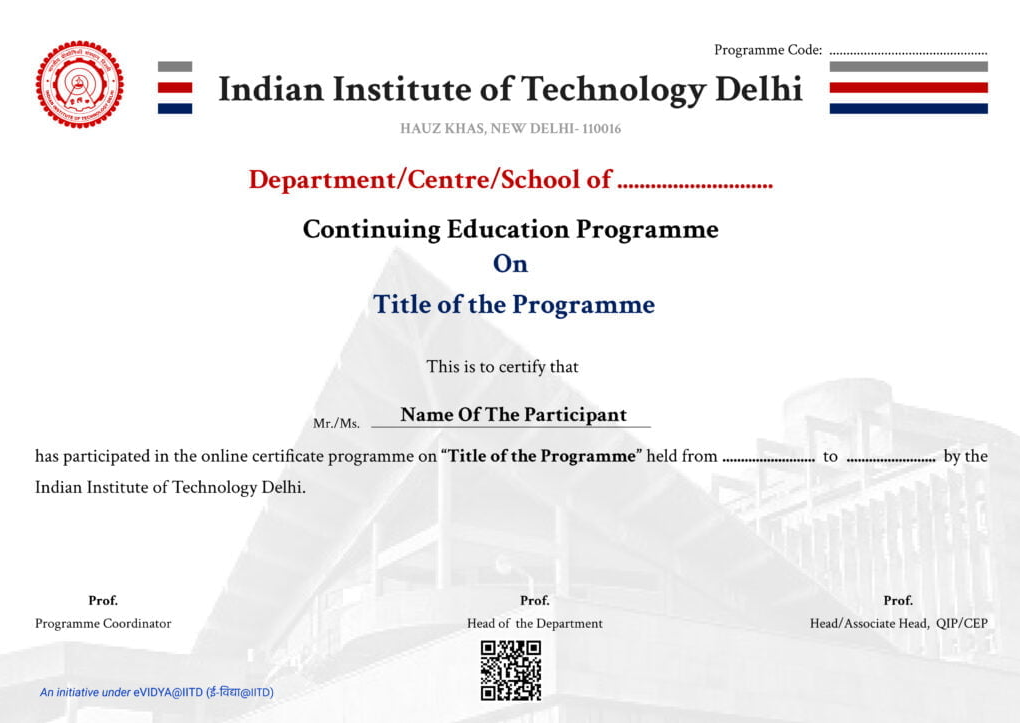
A minimum of 50% attendance is required to qualify for the Certificate of Participation.
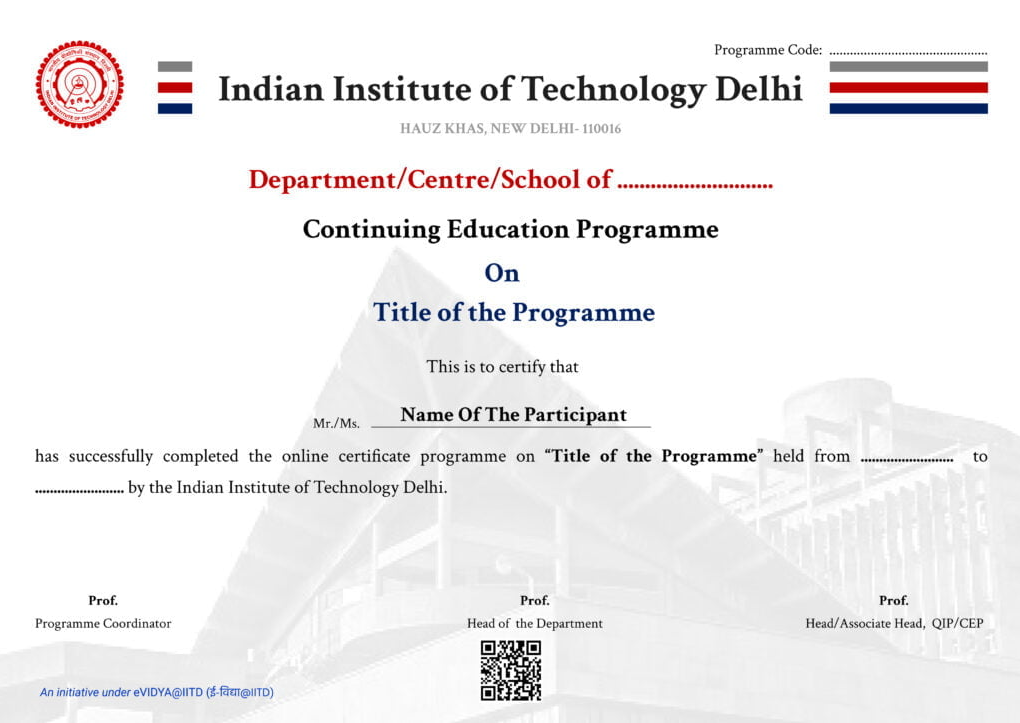
A minimum of 50% attendance, along with at least 50% aggregate marks in quizzes and the capstone project, is required to qualify for the Certificate of Successful Completion.
The organizing department for this is the Department of Management Studies, IIT Delhi.
The above certificate is for illustrative purposes only, and the format of the certificate may be changed at the discretion of IIT Delhi.
The Organizing Department of this programme is Department of Management Studies
Installment Schedule
Programme Fee INR 1,60,000 + 18 % GST
Instalment | Remarks | Amount |
Instalment 1 | Within 5 days post-selection | INR 32,000 + 18 % GST |
Instalment 2 | September 24, 2026 | INR 64,000 + 18 % GST |
Instalment 3 | November 24, 2026 | INR 64,000 + 18 % GST |
Notes:
GST (currently 18%) will be applicable.
The actual programme schedule will be announced closer to the programme start.
Postage charges for books and study materials (if provided) sent to locations outside of India will be paid for by the student.
All fees should be submitted in the IITD CEP account only. Details will be shared post-selection. Receipts will be issued by IIT Delhi CEP and can be downloaded from the CEP Portal.
Loan and EMI options are services offered by Emeritus. IIT Delhi is not responsible for the same.
Refund Policy
Candidates can withdraw within 15 days from the Programme Start Date. A total of 80% of the total fee received will be refunded. However, the applicable tax amount paid will not be refunded on the amount paid.
If you wish to withdraw from the programme, you must email cepaccounts@admin.iitd.in and iitd.execed@emeritus.org, stating your intent to withdraw. The refund, if applicable, will be processed within 30 working days from the date of receiving the withdrawal request.
Testimonials
Frequently asked questions
Yes. The programme is delivered through live, interactive online sessions led by IIT Delhi faculty. Classes will be mostly scheduled on Saturdays from 9:30 AM to 1:00 PM. In some weeks, there may also be sessions scheduled in the second half of the day. The detailed session calendar is shared with learners in advance via programme communication.
All examinations and evaluations will be conducted by IIT Delhi's faculty members.
It is upon the faculty's discretion if any re-attempt would be allowed of the quiz or assignment, and the evaluation methodology.
LIVE masterclasses are done by the esteemed faculty members of IIT Delhi who have real-world experience in the domain. The programme is offered by CEP and the organising department for this programme is the Department of Management Studies, IIT Delhi. Doubt-clearing sessions are carried out by the Programme leaders, as they monitor individual student progress.
If, after starting the sessions, you feel that the course is not appropriate for you, you may seek a refund within 15 days from the Programme Start Date. In such cases, 80% of the total fee paid will be refunded. However, the applicable tax amount paid on the fee will not be refundable.
On successful completion based on candidate attendance and performance in assessments of the programme, the participants will be awarded an e-certificate by CEP, IIT Delhi.
Yes. Recordings of LIVE sessions will be available. However, learners are expected to attend most LIVE online sessions, since attendance is required as part of the programme completion requirement.
Learners should plan for a typical weekly commitment of 6–9 hours, which includes: 3 hours/week of LIVE lectures, and ~3–6 hours/week for readings, practice, assignments, and tool-based exercises.