
Applied Quantum Computing and AI
Features
Programme Overview
The Certification in Applied Quantum Computing and AI from IIT Delhi is designed for engineers, scientists, and quantitative professionals looking to build genuine technical depth in quantum computing, quantum algorithms, post-quantum cryptography, and quantum-AI convergence — one of India's first applied quantum programmes of its kind.
Built on a rigorous four-phase curriculum developed and taught by leading faculty from the Department of Computer Science and Engineering, IIT Delhi — including recipients of the Shanti Swarup Bhatnagar Prize for Mathematical Sciences — the programme moves participants from mathematical foundations and qubit programming through to NISQ hardware, quantum error correction, and quantum-AI hybrid systems.
Across the programme, participants will learn to think and code in quantum using Qiskit on real IBM Quantum hardware, design and implement core quantum algorithms including Shor's, Grover's, QAOA, and VQE, apply post-quantum cryptography standards under the NIST PQC framework, and build quantum-AI hybrid systems using quantum kernels and QSVM. With a strong focus on real hardware execution, progressive capstone builds, and cross-domain applications spanning finance, cybersecurity, healthcare, and logistics, the programme equips learners to step into quantum computing roles, post-quantum security practice, and quantum-AI development tracks — in the organisations building India's quantum future.
₹ 2,50,000 + 18 % GST
Class Schedule
Weekend Classes
Eligibility Criteria
Graduation in any of these disciplines: B.Tech/BE; BCA/MCA; B.Sc in all streams; BA/MA in mathematics
Programme Highlights
One Of India's First Applied Quantum Programmes
Hands-on Qiskit Labs On Real IBM Quantum Hardware
Taught By IIT Delhi CSE Faculty; Supported By Industry Experts
Mini-capstones At Every Phase; Portfolio-grade Final Project
Optional 2 -day Campus Immersion At IIT Delhi
Weekend Format Designed For Working Professionals
16 Modules Across 4 Structured Learning Phases
156 Hours Of Live And Recorded Learning
Post-quantum Cryptography And NIST PQC Migration Included
Quantum-AI Convergence: QSVM, Quantum Kernels, Circuits
E-certificate From CEP, IIT Delhi On Successful Completion
AI Mock Interviews And Career Readiness Layer Included
Programme Modules
Maths, Qubits, Gates, and the First Quantum Programs
• MODULE 1 • 12 HRS
Title: Mathematical Foundations for Quantum & AI
Details: Linear algebra, probability, complex numbers + AI/ML maths bridge.
• MODULE 2 • 8 HRS
Title: Quantum Computing Foundations
Details: Qubits, superposition, entanglement, Dirac notation, measurement, no-cloning.
• MODULE 3 • 10 HRS
Title: Quantum Gates & Circuit Design
Details: Single- and multi-qubit gates, universality, circuit composition.
• MODULE 4 • 10 HRS
Title: Quantum Programming Lab Qiskit
Details: Structured lab with real execution on IBM Quantum free tier (127-qubit).
MINI-CAPSTONE 1
Project: Quantum Coin Flipper + Bell State Explorer - fair vs. biased coin
Core Quantum Algorithms, Search, Optimisation, Advantage
• MODULE 5 • 12 HRS
Title: Core Quantum Algorithms I
Details: Deutsch-Jozsa, Simon's, QFT, Phase Estimation, Shor's.
DELIVER • MODULE 6 • 8 HRS
Title: Quantum Search & Estimation
Details: Grover's, amplitude amplification - executed on a real dataset on IBM Quantum.
• MODULE 7 • 8 HRS
Title: Quantum Random Walks, Graphs & Networks
Details: Discrete and continuous walks, graph algorithms, routing, graph-based AI.
DELIVER • MODULE 8 • 10-12 HRS
Title: Quantum Optimisation & Variational Methods
Details: QAOA, VQE, Max-Cut - portfolio optimisation versus classical baseline.
• MODULE 9 • 8 HRS
Title: Quantum Complexity & Quantum Advantage
Details: BQP, QMA, query complexity, what quantum can and cannot solve - the honest picture.
MINI-CAPSTONE 2
Project: Ansatz Zoo - design, compare and characterise 3-4 ansatz families
From NISQ Constraints to Quantum-Safe Migration
DELIVER • MODULE 10 • 12 HRS
Title: Quantum Hardware, NISQ Systems & Cloud Stack
Details: Hardware classes, qubit implementations, superconducting versus trapped-ion versus photonic.
DELIVER • MODULE 11 • 8 HRS
Title: Quantum Error Correction
Details: Bit/phase-flip errors, surface codes, ML for noise modelling.
DELIVER • MODULE 12 • 10 HRS
Title: Quantum Cryptography & QKD Systems
Details: Quantum key exchange, BB84, applied QKD
DELIVER • MODULE 13 • 8 HRS
Title: Post-Quantum Cryptography & Quantum-Safe Migration
Details: Lattice/code-based crypto, NIST PQC standards, crypto-agility, enterprise PQC migration audit.
MINI-CAPSTONE 3
Project: QAOA on a real combinatorial problem - noiseless vs. noisy vs. mitigated
Where Quantum and AI Converge
OWN • MODULE 14 • 10 HRS
Title: AI Foundations for Quantum-AI Systems
Details: Classical ML refresher, deep learning intuition, transformers/LLMs at a high level.
OWN • MODULE 15 • 14 HRS
Title: Quantum-AI Convergence
Details: Quantum kernels, QSVM, parametrised circuits + ML for circuit synthesis and error decoding.
MINI-CAPSTONE 4
Project: Quantum Kernel + Classical ML hybrid on a real dataset
Industry Applications + Portfolio-Grade Final Capstone
Details: Case studies across AI/ML, cybersecurity, finance, drug discovery, materials, and logistics - your own portfolio-grade final project, integrating the full quantum-AI stack.
Domains: AI/ML • Cyber • Finance • Healthcare • Logistics
Learning Outcomes
Think & code in quantum with qubit programming, algorithms, quantum foundations
Run on real quantum hardware and execute with Qiskit
Solve real problems with quantum optimisation, AI/ML pipelines and NISQ engineering
Engineer quantum-safe security; QKD, post-quantum cryptography, PQC migration
Make results reliable with error correction and AI-driven noise mitigation on real devices
Build a portfolio capstone; integrate the quantum-AI stack, defend to an expert panel
Tools
Scikit-learn
Num Py
Python
Jupyter
Qiskit
Programme Coordinator
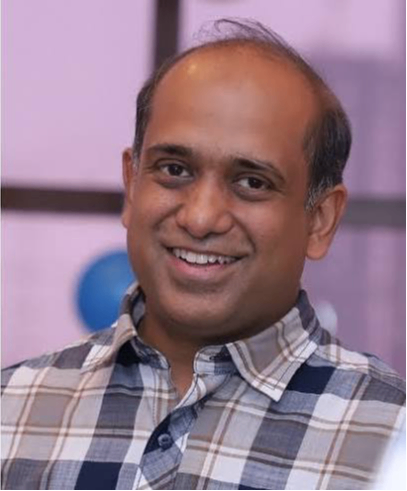
Professor Amit Kumar
Professor
Department of Computer Science & Engineering
Indian Institute of Technology Delhi
Research in combinatorial optimization, online algorithms, and algorithmic fairness. Recipient of the Shanti Swarup Bhatnagar Prize for Mathematical Sciences.
Keywords Combinatorial Optimization, Online Algorithms, Algorithmic Fairness
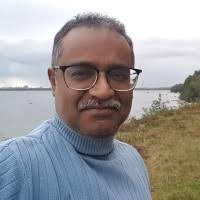
Professor Kolin Paul
Professor
Department of Computer Science & Engineering
Indian Institute of Technology Delhi
Research in embedded systems, reconfigurable computing, accelerators for AI, QCA and CAD for quantum computing.
Keywords: Quantum Computing | Embedded Systems | Near Data Computing | Accelerators | Healthcare
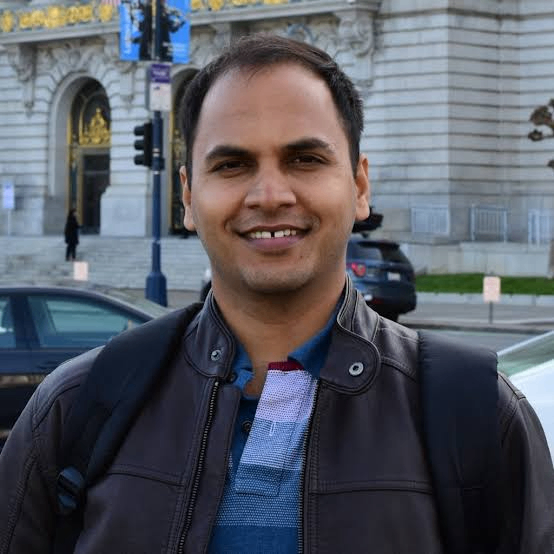
Professor Rajendra Kumar
ASSISTANT PROFESSOR
Department of Computer Science & Engineering
Indian Institute of Technology Delhi
Research spans quantum computing, cryptography, fine-grained complexity, and lattice-based post-quantum security
Keywords: Quantum Computing | Post-Quantum Security | Lattice Cryptography
Programme Sample Certificate
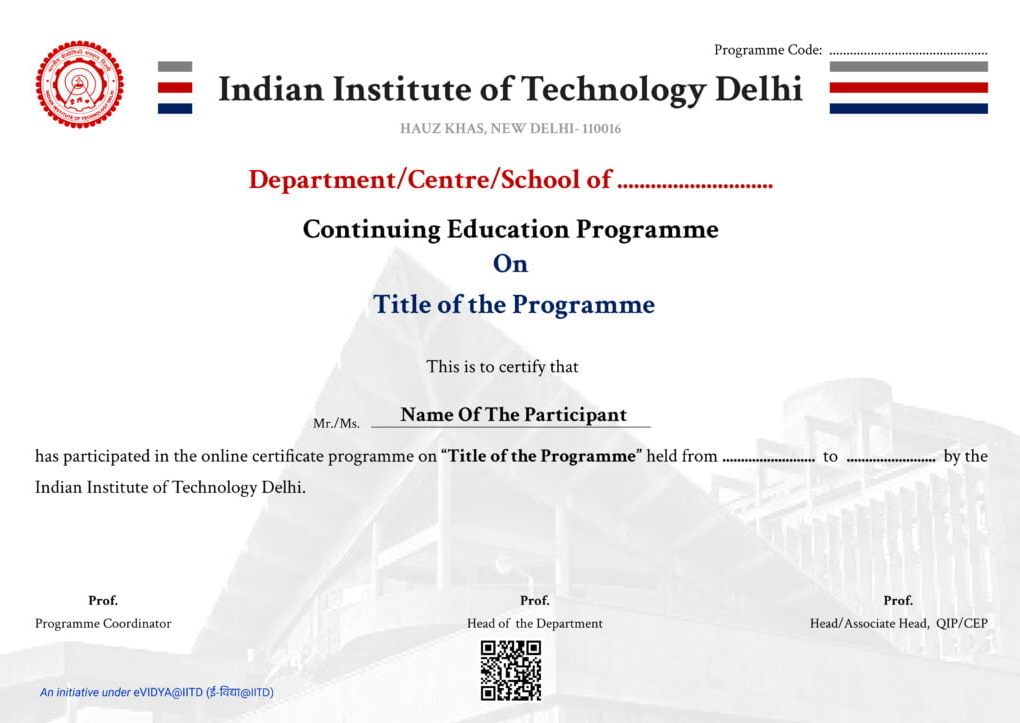
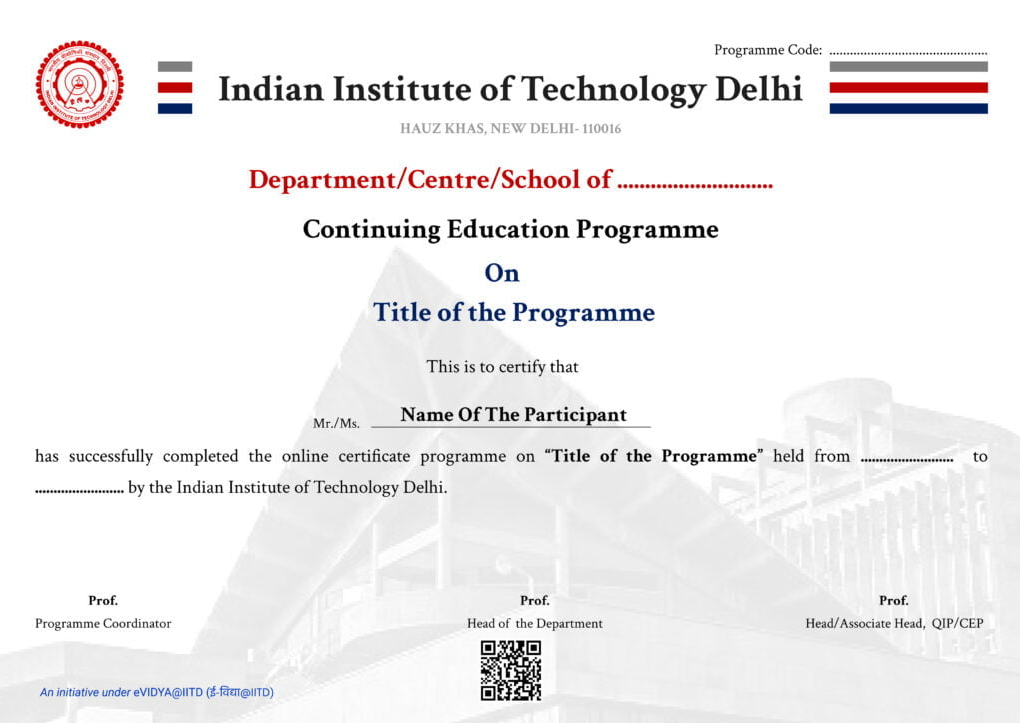
On completion, participants receive an e-certificate from the Continuing Education Programme (CEP), IIT Delhi. Two e-certificate types are issued, based on attendance and assessment performance. Department of Computer Science and Engineering (CSE) is the organizing department for the programme.
Certificate of Successful Completion: Minimum 50% attendance and a minimum score of 50% in the evaluation component..
Certificate of Participation: Minimum 60% attendance is required to qualify for the E-Certificate of Participation.
Verifiable e-certificate only. No printed copy is issued.
Issued by Continuing Education Programme (CEP), Indian Institute of Technology Delhi.
Installment Schedule
Programme Fee INR 2,50,000 + 18% GST
Instalment | Date | Amount (₹)** |
Application Fee | Application Fee | 1,000 + 18 % GST |
1st Instalment | Within 3 days of the release of an offer letter | 15,000 + 18 % GST |
2nd Instalment | 16th October, 2026 | 2,35,000 + 18 % GST |
Note:
*GST @ 18% will be charged extra in addition to the fees
The application fee of INR 1,000/- + 18% GST is non-refundable and non-transferable. This fee is in addition to the programme fee and will not be adjusted against the total programme fee.
Refund Policy
Candidates can withdraw within 15 days from the programme start date. 80% of the total fee received is refunded. The applicable tax amount paid is not refunded.
Candidates withdrawing after 15 days from the start of the programme session are not eligible for any refund.
To withdraw, email cepaccounts@admin.iitd.ac.in and refunds_varsity_iitd@interviewbit.com. Refunds, if applicable, are processed within 30 working days.
Frequently asked questions
It's a rigorous, applied programme, not a survey. Taught by IIT Delhi CSE professors, extended with applied AI/ML, hands-on labs and a portfolio-grade capstone.
Yes, a certificate from IIT Delhi's Continuing Education Programme (CEP) on completion, as per institute criteria.
No. We build quantum and ML depth from applied foundations; comfort with one programming language is enough.
Yes, you execute on the IBM Quantum free tier (127-qubit) and tools like Qiskit
Yes, NIST PQC standards (FIPS 203/204/205), crypto-agility and an enterprise PQC migration audit.
Plan for live weekend sessions plus a few hours of project work, we've built for working professionals.