
Artificial Intelligence and Machine Learning for Industry (Batch 09)
Features
Programme Overview
Imagine standing at the crossroads of innovation, where Artificial Intelligence (AI) and Machine Learning (ML) are reshaping industries at an unprecedented pace. Whether it's predicting customer behavior in marketing, diagnosing diseases with precision in healthcare, or optimizing game strategies in sports, AI/ML is the driving force behind transformative change. Now, picture yourself not just witnessing this revolution—but leading it.
CEP IIT Delhi's AI & ML for Industry programme is your gateway to mastering these powerful technologies.
Designed for both tech enthusiasts and professionals from non-computer science backgrounds, this course demystifies complex algorithms and turns them into practical, real-world solutions. Through a perfect blend of theory and hands-on experience, you'll gain the skills to apply AI/ML techniques in sectors ranging from e-commerce and engineering to power and policy-making. But learning AI/ML isn't just about theory—it's about application. That's why this programme immerses you in real industry case studies, From predictive analytics to intelligent automation, you'll experience first-hand how these technologies are shaping the world.
₹ 1,90,000 + 18 % GST
Class Schedule
Every Saturday: 8:30 am - 12:30 pm
Eligibility Criteria
Any science, engineering, or commerce graduate.
Diploma holders (10+3) or (10 + 2 + 3) are also eligible.
Preference will be given to applicants with experience.
Programme Highlights
A Programme From CEP IIT Delhi. IIT Delhi Is Ranked # 1 As Per QS World University Rankings: Southern Asia 2027 In India.
E-Certificate From CEP, IIT Delhi
Extensive TA Support
Building Mathematical Foundations.
Industry Specific Projects
Collaboration Opportunities With The Lecturers And Co-ordinators
Networking Opportunities Of Participants From Leading AI/ML Industry
Extensive Use Of Different ML Libraries Throughout The Course
Guest Lectures From Leading Industry And Academia Personnel
Contemporary Case Studies And Hands-on Practice Sessions
Optional 1 -day Campus Immersion
Programme Modules
Foundations of Python Programming
Motivations and Introduction to Different ML Paradigms
Linear Algebra for ML
Vectors and Matrices
Vector Space and Subspace
System of Linear Equations
The Concept of Rank and Independent Vectors
Inner Product Space
Norms
Positive Definite Matrix
Matrix Factorisation (EVD, SVD, QR, LR, etc.)
Projection and Orthogonality
Probability and Statistics for Data Science
Random Variables
Distribution and Density Functions
Conditional Probability
Bayes' Theorem
Joint Distribution
Concept of Independence Covariance and Correlation
Introductory Statistical Inference (Likelihood, MAP, etc.)
Concept of Entropy
Mutual Information and KL Divergence
Optimisation
Function and Derivatives
Gradient Descent
Stochastic Gradient Descents
Convex Optimisation
Formulation and Optimality Conditions
ADAM Optimiser
Hands-on Demo 1: Linear Algebra using NumPy
Concepts of Linear Algebra and Probability Basics
Optimisation with Practical ML Applications
Simple and Multiple Linear Regression
Hands-on Demo 2: SLR/MLR
Least Squares Approach
Moving Beyond Linearity: Non-linear Regression
Hands-on Demo 3: NLR
Model Selection
Model Selection, Regularisation, and Bias-Variance Trade-off
M2 Project: Regression Application
Motivation and Introduction to Classification Problems
Logistic Regression
Logistic Regression
Hands-on Demo 4: Logistic Regression
Decision Tree
Introduction to Decision Trees
Random Forests, Bagging, and Boosting
Hands-on Demo 5: Random Forests
Interpretability of Machine Learning Models
Hyperplanes
- Concept of Hyperplane Classifier
SVM
Support Vector Machines, Kernel SVM
Hands-on Demo 6: SVM
Multi-class Classifiers
Clustering
Clustering Methods
Hands-on Demo 7: Clustering
Model Selection
Model Selection, Regularisation, and Bias-Variance Trade-off
M2 Project: Regression Application
Convolutional Neural Networks
Fundamentals of Convolution
Convolutional Neural Network Architecture
Hands-on Demo 9: CNN
Recurrent Neural Networks/LSTM
Introduction to Time Series and Sequential Data
Introduction to Language Modelling and NLP
Recurrent Neural Network and LSTM/GRU
Hands-on Demo
IIT_Delhi_AIMLI09_Brochure.pdf
IIT_Delhi_AIMLI09_Brochure.pdf
Graph Neural Networks
Introduction to Graph Data
Graph Neural Network Architecture
Hands-on Demo
Transformers
Core mechanics — self-attention, positional encodings, causal mask
Efficiency & fine-tuning — Flash/linear attention, LORA-FT/adapters
Multimodal extensions - vision-language models
Generative AI
Autoencoder, Variational Autoencoders, Generative Adversarial Networks (GANs)
Diffusion for images and text modalities
LLM Alignment
Alignment pipeline - SFT → reward model → RLHF/DPO/PPO
Alternative approaches - Constitutional AI, RLAIF
Introduction to Agentic AI Concepts: tools, memory, functions, and frameworks. (Will be covered in one lecture)
01. Linear Regression Lab
Is there a connection between sales and different types of ad expenditure? In this lab, we try to forecast the sales of a product assuming ad sales are available.
02. Logistic Regression Lab
Sentiment analysis of consumers. Can we directly infer the quality of any product based on its reviews?
03. Decision Tree, Random Forest, XGBoost
In-depth analysis of algorithms on benchmark datasets.
04. Support Vector Machines (SVM)
Image classification on fashion MNIST dataset, intuition of soft margin, hard margin, solving SVM using CVXPY.
05. Neural Networks
Basic understanding and implementation of each layer of NN. Writing and understanding gradient descent/backpropagation algorithm in Python.
Comparison of Neural Networks and SVM on image classification datasets.
06. Convolutional Neural Network (CNN)
Ever wondered how computers identify faces? We will see how CNN has revolutionised the field of computer vision.
Understanding layers, visualisation of the learning process, occlusion, and GRADCAM.
07. Sequential Model (Recurrent Neural Network/Long Short-Term Memory)
Implementation of RNN/LSTM. Hands-on implementation for caption/summary generation from images/videos.
08. Variational AutoEncoder
Understanding and implementation of Variational AutoEncoder on MNIST dataset. We will see how to encode images in a latent space of lower dimensions.
09. Generative Adversarial Networks
Is it possible to generate new images which never existed? Understanding and implementation of Generative Adversarial Networks on benchmark datasets.
10. Graph Neural Networks (GNN)
Are you ready to take your machine learning to the next level? Whether you want to build a recommender system for social media platforms or do drug prediction in biomedical, GNN has your back. We will see the extension of Deep Learning on Graphs (GNN). Introduction to several GNN variants like, GCN, GraphSage, etc.
11. Natural Language Processing
Text summarisation.
12. Generative AI
Fine-Tuning SLMs and LLMs and Their Integration with Downstream Tasks.
13. Course Project
Build your own recommender system using any of the discussed techniques (GNN, CNN, LSTM, classical ML, etc.).
IIT_Delhi_AIMLI09_Brochure.pdf
Learning Outcomes
Master machine learning tools, algorithms, and their industrial applications.
Gain hands-on experience with advanced ML techniques through case studies and exercises.
Understand neural networks and learn to design and implement them using various tools.
Develop the skills to apply AI and ML techniques across diverse real-world scenarios.
Explore cutting-edge topics like Generative AI.
Tools
Python
Py Torch
Pandas
Num Py
Tensor Flow
Scikit-learn
Seaborn
Programme Coordinator

Professor Sandeep Kumar
Associate Professor
Department of Electrical Engineering
Associate Faculty
Yardi School of Artificial Intelligence & Bharti School of Telecommunication Technology and Management
Indian Institute of Technology Delhi
Prof. Sandeep Kumar is an associate professor in the Department of Electrical Engineering, Yardi School of Artificial Intelligence, an associate faculty at Bharti School of Telecommunication Technology and Management at the Indian Institute of Technology Delhi (IIT Delhi), and is honored with the DST Inspire Faculty Fellowship Award and the TCS Doctoral Fellowship. At IIT Delhi, he leads the Machine Intelligence Signals and Networks (MISN) lab. His research explores the intersection of machine learning, graphical models, and deep learning, addressing complex data challenges.
Prof. Kumar is deeply committed to nurturing the next generation of AI enthusiasts. He imparts knowledge through an array of courses, including Mathematical Foundations for Machine Learning, Advanced Machine Learning, Software Fundamentals, and Optimization Methods. Beyond the confines of academia, he champions accessibility to AI education for all, extending his expertise to industry professionals, college students, and government officials through online classes, workshops, and bootcamps. Prof. Kumar's efforts extend beyond the classroom as he spearheads multiple projects funded by government and industry entities.
Programme Faculty

Professor Manabendra Saharia
Associate Professor
Department of Civil Engineering
Associate Faculty Yardi School of Artificial Intelligence
Indian Institute of Technology Delhi
Prof. Manabendra Saharia is an Associate Professor in the Department of Civil Engineering and an Associate Faculty of the Yardi School of Artificial Intelligence at the Indian Institute of Technology Delhi. Previously, he worked in the hydrology labs of the NASA Goddard Space Flight Center and the National Center for Atmospheric Research (NCAR). Prof. Saharia received his Ph.D. in Water Resources Engineering from the University of Oklahoma. At IIT Delhi, his HydroSense research lab focuses on developing physics and AI/ML-based techniques to monitor and mitigate natural hazards such as floods and landslides.
He has been recognised for his scientific contributions, having received Young Scientist awards from both the National Academy of Sciences, India (NASI) and the International Society for Energy, Environment and Sustainability (ISEES). He is also a Visiting Scientist at NCAR (USA) and a Global Guest Professor at Keio University (Japan).

Professor Ashutosh Rai
Assistant Professor
Department of Mathematics
Indian Institute of Technology Delhi
Prof. Ashutosh Rai is an Assistant Professor in the Department of Mathematics at the Indian Institute of Technology (IIT) Delhi. Before joining IIT Delhi, he was briefly an Assistant Professor in the Computer Science Department at IIIT Delhi.
Prior to that, he was a postdoctoral fellow at the Department of Applied Mathematics, Charles University in Prague, and later at the Department of Computing, Hong Kong Polytechnic University, working with Prof. Yixin Cao and his group. He completed his master's and Ph.D. at the Institute of Mathematical Sciences (IMSc), Chennai, under the supervision of Prof. Saket Saurabh and Prof. Venkatesh Raman.
/
Prof. Rai's research focuses on Theoretical Computer Science, particularly tackling NP-complete problems through algorithmic approaches such as fixed-parameter tractability and kernelization. He is also interested in the connections between parameterized complexity and classical complexity, exploring the hardness theory that emerges from these relationships.
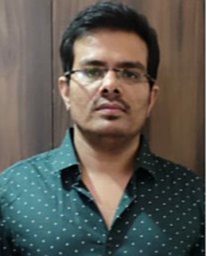
Professor Manoj Kumar
Assistant Professor
Mehta Family School of Data Science and Artificial Intelligence
Prof. Manoj Kumar is currently working as an Assistant Professor at IIT Roorkee in the Mehta Family School of Data Science and Artificial Intelligence. Prior to this, he worked as an Assistant Professor at IIT (ISM) Dhanbad and at LNMIIT Jaipur in the Department of Communication and Computer Engineering. He earned his PhD from IIT Delhi under Prof. Sandeep Kumar, where he developed graph dimensionality reduction techniques to improve the scalability of graph neural networks, with applications in medical and epidemic datasets. His current research spans graph machine learning, federated learning, KV caching compression, and graph-based medical data analysis, with a focus on building efficient, scalable, and interpretable ML models for complex graph-structured data.
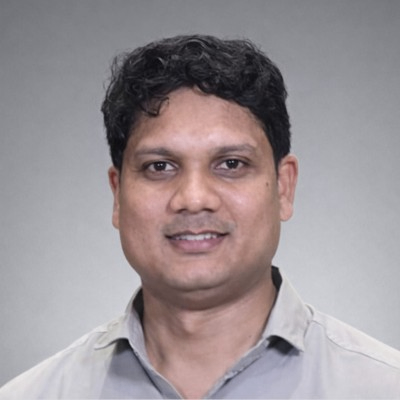
Professor Anil Kumar
Assistant Professor
Department of Applied Geophysics IIT (ISM) Dhanbad
Prof. Anil Kumar is an Assistant Professor in the Department of Applied Geophysics at IIT (ISM) Dhanbad. He received his Joint Ph.D. from Monash University (Australia) and Indian Institute of Technology Bombay (India) and previously served as a Principal Project Scientist at IIT Delhi. His research focuses on advancing AI for Earth Systems by integrating scientific machine learning, geospatial analytics, numerical simulation, and high-performance computing. His works primarily involve developing next-generation computational frameworks for large-scale inverse problems. His current interests include physics-guided AI, foundation models for scientific discovery, and reduced-order methods for accelerating complex simulations.

Professor Amrit Singh Bedi
Assistant Professor
Computer Science Department University of Central Florida
Prof. Amrit Singh Bedi is an Assistant Professor in the Computer Science Department, jointly appointed with the Electrical and Computer Engineering Department at the University of Central Florida (UCF), USA. Before joining UCF, he served as an Assistant Research Professor/Scientist at the University of Maryland (UMD), collaborating with Prof. Dinesh Manocha, Prof. Pratap Tokekar, and Prof. Furong Huang. Prior to UMD, he gained practical research experience at the US Army Research Laboratory with Dr. Alec Koppel and Dr. Brian Sadler. He holds a Ph.D. in Electrical Engineering from the Indian Institute of Technology (IIT) Kanpur, where his research under Prof. Ketan Rajawat focused on distributed and online learning with stochastic gradient methods.
At UCF, Prof. Bedi's research spans AI alignment, reinforcement learning from human feedback, and the safety of generative AI systems. His work emphasizes optimization and data efficiency in machine learning, addressing challenges in secure and ethical AI development. Beyond academia, he is committed to mentoring students and advancing AI education, contributing to interdisciplinary projects that tackle real-world challenges in autonomous systems and ethical AI governance.
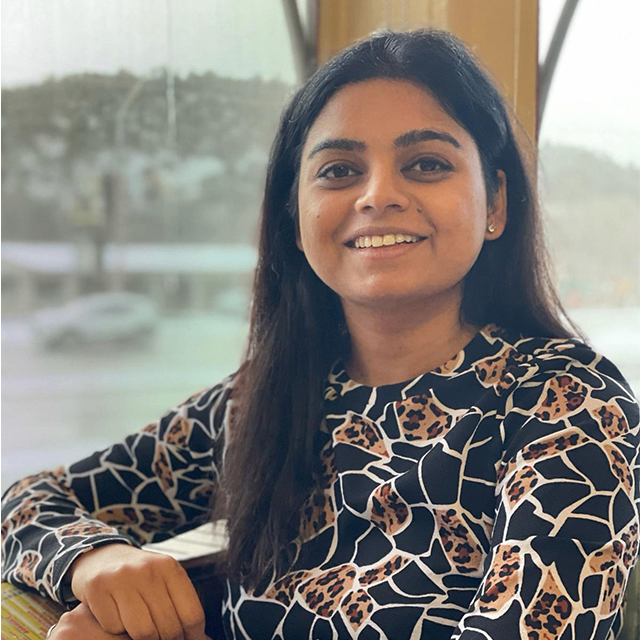
Professor Ankita Shukla
Assistant Professor
Computer Science & Engineering Department University of Nevada Reno
Prof. Ankita Shukla is an assistant professor of artificial intelligence (AI) in the Computer Science & Engineering Department at University of Nevada Reno. Before joining the University, she was a postdoctoral researcher at Arizona State University, working in Geometric Media Lab of Professor Pavan Turaga.
Prof. Shukla received her Ph.D. and master's degree from Indraprastha Institute of Information Technology Delhi (IIIT Delhi), where she was awarded the best thesis award for her master's research.
Her research interests include deep learning and machine learning techniques for vision and multimodal data, topological data analysis and geometry-driven approaches for learning. From an application perspective, she focuses on AI for Science and AI for Social Good, specifically targeting wildlife conservation and human health.
Programme Sample Certificate
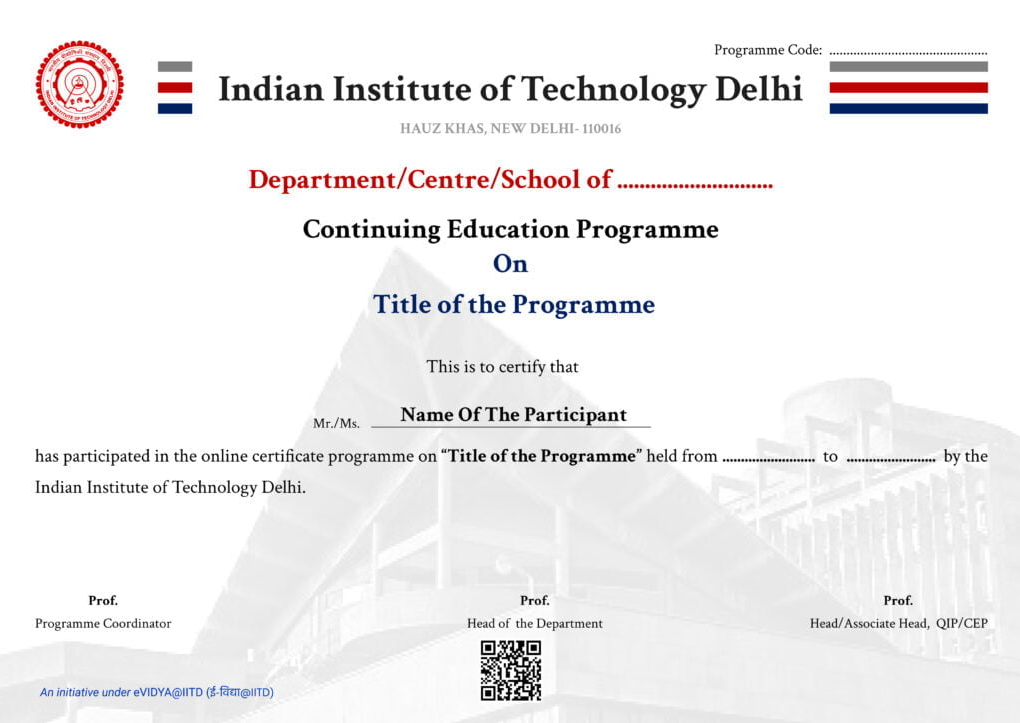
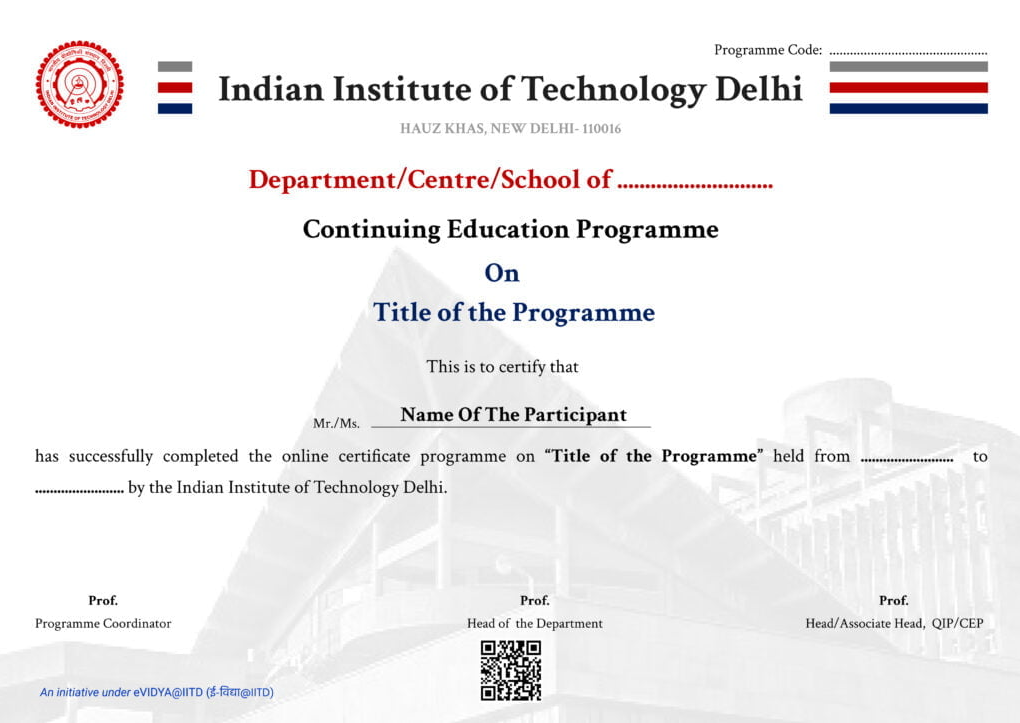
Candidates need to secure minimum 50% overall to be eligible for the ‘Certificate of Successful Completion’ certificate from CEP, IIT Delhi.
Candidates who are not able to secure 50% overall to be eligible for the ‘Certificate of Participation’ certificate from CEP, IIT Delhi.
The organizing department of this programme is Yardi School of Artificial Intelligence, IIT Delhi.
Only e-certificates will be issued by CEP, IIT Delhi for this programme.
Installment Schedule
Programme Fees: 1,90,000 + 18 % GST
Instalment | Instalment Date | Amount (₹)* |
Application Fee* | To be paid at the time of Application | 1,000 |
1st Installment | Within 4-days of offer letter rolled out | 60,000 |
2nd Installment | 06th February, 2027 | 65,000 |
3rd Installment | 06th March, 2027 | 65,000 |
Note:
| ||
Refund Policy
Candidates can withdraw within 15 days from the programme start date. A total of 80% of the total fee received will be refunded. However, the applicable tax amount paid will not be refunded on the paid amount.
Candidates withdrawing after 15 days from the start of the programme session will not be eligible for any refund.
If you wish to withdraw from the programme, you must email cepaccounts@admin.iitd.ac.in and icare@timespro.com, stating your intent to withdraw. The refund, if applicable, will be processed within 30 working days from the date of receiving the withdrawal request.
Testimonials
Frequently asked questions
The CEP, IIT Delhi AI and Machine Learning for Industry is a comprehensive course that provides participants with a foundational understanding of machine learning tools, algorithms, and their industrial applications. The course will equip participants with the knowledge and practical skills necessary to proficiently apply machine learning techniques to tackle complex problems across diverse domains such as sales and marketing, medical diagnostics, and sports analytics.
Any science, engineering, or commerce graduate/Diploma holders (10+3) or (10+2+3) are eligible to apply for this CEP, IIT Delhi AI ML course. Preference will be given to applicants with experience.
This CEP, IIT Delhi Artificial Intelligence and Machine Learning for Industry programme is designed for any fresh graduates from a science or engineering background seeking a career in the AI/ML domain, any professionals in the IT industry seeking to gain AI/ML expertise and become AI/ML specialists or any professionals seeking to upskill themselves and apply it in their strategic decision-making.
This CEP, IIT Delhi AI ML course is thoughtfully crafted with a special focus on learners from non-CS backgrounds. Contemporary case studies and practice sessions have been curated to provide hands-on experience in applying advanced machine-learning techniques to solve real-world problems.
The CEP, IIT Delhi Artificial Intelligence and Machine Learning for Industry is a Live course, and online sessions are delivered Direct-to-Device (D2D).
Yes, participants who score at least 50% marks overall and have a minimum attendance of 50% will receive a ‘Certificate of Completion’ and those who score less than 50% marks overall and have a minimum attendance of less than 50% will receive a ‘Certificate of Participation’ from CEP, IIT Delhi.
Here are some potential benefits of participating in this CEP, IIT Delhi AI and Machine Learning for Industry programme
In-Depth Knowledge
Practical Skills Development
Industry-Relevant Curriculum
Networking Opportunities
Certification from a Prestigious Institution
Career Advancement
Access to Resources
Knowledge of Industry Trends
Opportunity for Collaborative Learning
Access to Alumni Network
The scope of the CEP, IIT Delhi AI and Machine Learning for Industry in India is vast and transformative. With AI and ML driving innovations across sectors like healthcare, finance, e-commerce, and manufacturing, graduates are equipped to harness data-driven insights for business growth and efficiency. The programme emphasises practical applications through hands-on projects, industry collaborations, and mentorship by experts. Graduates are poised for roles in AI research, data science, consultancy, and leadership positions in companies adopting AI technologies. By leveraging, IIT Delhi's academic excellence and industry partnerships, the program prepares professionals to spearhead transformative AI initiatives in India's evolving market.
The IIT Delhi stands out as a premier choice for studying Artificial Intelligence and Machine Learning due to its esteemed faculty, cutting-edge research facilities, and industry collaborations. The programme blends theoretical foundations with hands-on practical experience, preparing students to tackle real-world challenges in AI and ML applications across diverse sectors. With access to state-of-the-art labs, collaborative projects, and mentorship from leading experts, you gain valuable skills and insights that are highly sought-after in India's tech-driven economy. By choosing IIT Delhi for the AI and ML course, you open doors to a wealth of knowledge, resources, and career prospects in this rapidly evolving field.
If a student chooses to withdraw, they can do so within 15 days from the start of the programme. In such cases, 80% of the total fee received will be refunded, excluding any applicable taxes paid. However, if the withdrawal occurs after this 15-day period, no refund will be applicable. To initiate withdrawal, students must email cepaccounts@admin.iitd.ac.in and icare@timespro.com stating their intent.