
Certificate Programme in Applied Data Science & Artificial Intelligence: From Fundamentals to Deployment (Batch 04)
Features
Programme Overview
"With AI and data, we're not just solving problems; we're creating possibilities."
CEP IIT Delhi's Certificate programme in Applied Data Science and Artificial Intelligence: From Fundamentals to Deployment (Batch 04) offers a comprehensive grounding in Machine Learning (ML) and Artificial Intelligence (AI) principles and applications. Starting with Python programming, data manipulation, and exploratory data analysis, participants progress through supervised learning (regression, classification) and unsupervised learning (clustering, dimensionality reduction) techniques. Advanced topics include deep learning, reinforcement learning, and natural language processing (NLP), with hands-on projects to apply skills in real-world scenarios.
The programme culminates in model deployment strategies, using tools like Docker and cloud platforms, alongside best practices in MLOps and responsible AI. Through real-world case studies and a capstone project, participants are prepared to develop and deploy data-driven AI solutions ethically and effectively across diverse sectors.
₹ 1,94,000 + 18 % GST
Class Schedule
Every Sunday: 10 AM to 1 PM
Eligibility Criteria
Graduates/Diploma Holders (only 10+2+3) from a recognized university.
Preference will be given to graduates in Computer Science/IT, Electronics, Electrical, Physics or relevant stream.
Candidates pursuing the graduation degree in any discipline are also eligible.
Programme Highlights
8 Months, Online Programme Tailored For Working Professionals
75 Hours Of Engaging Live Sessions By Eminent IIT Delhi Faculty
Comprehensive Curriculum Covering The Full Spectrum Of Data Science And AI
Interactive Sessions With Industry Experts For Real-world Insights
Model Deployment Training Using Docker, Cloud Platforms, And MLOps Practices
E-Certificate Issued By CEP, IIT Delhi
Capstone Project For Applying AI Skills In Real-world Scenarios
Industry Case Studies In Healthcare, Finance, VLSI, And E-commerce
Advanced Tools And Platforms Including Tensor Flow, Google Colab And Docker.
Practical Applications Of Concepts With More Than 40 Hours Of Hands-on Tutorials.
Programme Modules
Introduction to Python
Control Flow (Conditionals, Loops)
Functions and Modules
Data Structures (Lists, Dictionaries, Sets, Tuples)
Object-Oriented Programming
Error Handling
Libraries Overview (NumPy, Pandas, Matplotlib)
Scientific Computing and Graphing
Real-world scripting use-cases (e.g., file parsing, web scraping)
Projects like "Python Web Scraper" or "Data Cleaner Script"
Learning Objectives:
Develop proficiency in writing Python programs to solve computational problems.
Understand core programming concepts such as data types, control flow, functions, and OOP principles.
Manipulate data structures such as lists, dictionaries, and sets efficiently.
Utilise key Python libraries (NumPy, Pandas, Matplotlib) for data manipulation and visualisation.
Debug and handle errors in Python programs effectively.
file parsing and web scraping for real-world data collection
Complete hands-on mini-projects like a Python Web Scraper and Data Cleaner Script
Topics Covered:
Linear Algebra:
Learning Objectives:
Fundamentals of Optimization
Least-square Approximation
Eigenvalues and Eigenvectors
Special Matrices
Singular Value Decomposition
Gradient Calculus
Statistics
Learning Objectives:
Introduction to Probability
Descriptive statistics
Foundations of Probability
Probability Distribution
Descriptive statistics
Foundations of Probability
Probability Distribution
Inferential statistics
Topics Covered:
Data Cleaning Techniques
Data Normalisation & Standardisation
Feature Selection
Dimensionality Reduction
Handling Categorical Variables
Feature Engineering
Balancing Datasets
Include SQL for dataset querying
Learning Objectives:
Clean and preprocess raw datasets by handling missing values and outliers
Normalize and standardize data for consistent model input
Apply feature selection and dimensionality reduction techniques
Encode categorical variables and engineer new features
Balance imbalanced datasets to improve model fairness
Use basic SQL queries to extract, filter, and join data from structured databases
Topics Covered:
Supervised Learning (Linear, Logistic Regression)
Classification Algorithms (Decision Trees, KNN, Naive Bayes, SVM)
Ensemble Methods (Random Forest, Gradient Boosting)
Clustering Algorithms (K-means, DBSCAN)
Model Evaluation Metrics
Cross-Validation
Hyperparameter Tuning
XGBoost, LightGBM, stacking/blending
Focused mini-project: "Credit Risk Classifier using ML"
Learning Objectives:
Build supervised models for regression and classification tasks
Implement popular ML algorithms like Decision Trees, SVM, KNN, Naive Bayes
Use ensemble methods including Random Forest and Gradient Boosting
Apply advanced models like XGBoost and LightGBM for high performance
Combine models using stacking and blending for better accuracy
Evaluate models using metrics like accuracy, F1-score, and ROC-AUC
Tune models using cross-validation and hyperparameter search
Apply concepts in a real-world mini-project: Credit Risk Classifier
Topics Covered:
Neural Networks Basics
Training Neural Networks
Convolutional Neural Networks (CNNs)
Recurrent Neural Networks (RNNs)
Transfer Learning (e.g., ResNet, BERT, Transformers)
Hands-on with TensorFlow/Keras in Google Colab
Learning Objectives:
Understand the architecture and training of neural networks
Build and train CNNs for image tasks and RNNs for sequence data
Apply Transfer Learning using pre-trained models like ResNet (vision) and BERT (text)
Develop and train deep learning models using TensorFlow/Keras in Google Colab
Gain hands-on experience in building scalable, real-world DL solutions
Topics Covered:
Opencv:
Image processing,
face detection,
contour analysis,
object tracking,
real-time video apps.
NLP
Generative AI and LLMs
Prompt engineering
Using OpenAI APIs
Building Q&A bots with LLMs
Langchain Framework
Dspy
AI project
AI in Healthcare
Forecasting using Time Series
E-commerce Recommender System
Learning Objectives:
Apply OpenCV for image processing, face detection, object tracking, and real-time video analysis.
Use NLP and LLMs for prompt engineering, Q&A bots, and text generation with OpenAI APIs.
Build smart applications using LangChain, Dspy, and Generative AI techniques.
Develop AI solutions for healthcare, time series forecasting, and recommender systems.
Gain hands-on experience in building real-world AI/ML projects across multiple domains.
Topics Covered:
Introduction to Model Deployment
Containerisation with Docker
Deployment Frameworks (Flask, FastAPI)
Cloud Deployment (AWS, GCP, Azure)
Model Monitoring and Management
CI/CD for ML Models
Detecting and diagnosing faults
MLOps Principles
MLflow or W&B for model tracking
Real deployment demo (e.g., Streamlit app + backend API)
Learning Objectives:
Understand the end-to-end process of deploying machine learning models in production.
Containerise machine learning models using Docker for scalable deployment.
Deploy models as APIs using frameworks such as Flask and FastAPI.
Implement cloud-based deployment solutions using AWS, GCP, or Azure.
Monitor model performance in production and manage updates to deployed models.
Integrate CI/CD pipelines for continuous model deployment and scaling using MLflow or W&B.
Apply MLOps principles to manage the entire machine learning lifecycle from development to deployment.
Build real-world apps with Streamlit and backend APIs
Learning Outcomes
Master foundational programming skills and utilize libraries like NumPy and Pandas for large dataset handling.
Clean, normalize, and optimize data to improve model performance, ensuring accuracy and efficiency.
Implement industry-standard algorithms, including decision trees, random forests, and logistic regression.
Design neural networks, such as CNNs for image recognition and RNNs for sequence prediction.
Gain hands-on experience deploying models using Docker, Flask, and cloud platforms like AWS.
Tools
Python
Matplotlib
Pandas
Num Py
Tensor Flow
Scikit-learn
Spyder
Programme Coordinator
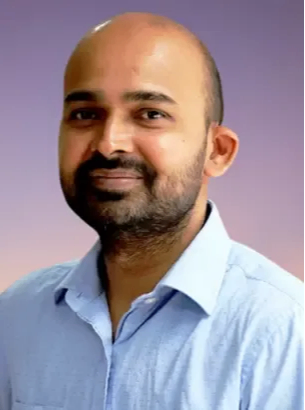
Professor Ankur Gupta
Associate Professor
Centre for Applied Research in Electronics
Indian Institute of Technology Delhi
Prof. Ankur Gupta is an Associate Professor at the Centre for Applied Research in Electronics (CARE), IIT Delhi, and a core member of the VLSI Design Tools and Technology (VDTT) program, a joint initiative of the Electrical Engineering and Computer Science departments at IIT Delhi. With over 15 years of experience spanning academia and industry, Prof. Gupta has worked for more than six years with global leaders such as Intel, Texas Instruments, and GlobalFoundries.
Prof. Gupta's research and technical expertise lie at the intersection of electronic design and advanced computational methods. His work focuses on leveraging artificial intelligence (AI) and machine learning (ML) to address challenges in device modeling and the development of electronic design automation (EDA) tools. In addition to his technical expertise, Prof. Gupta is deeply passionate about translating theoretical advancements into tangible solutions. He actively explores opportunities to apply AI and ML technologies to create innovative, real-world products that have practical and impactful applications across industries.
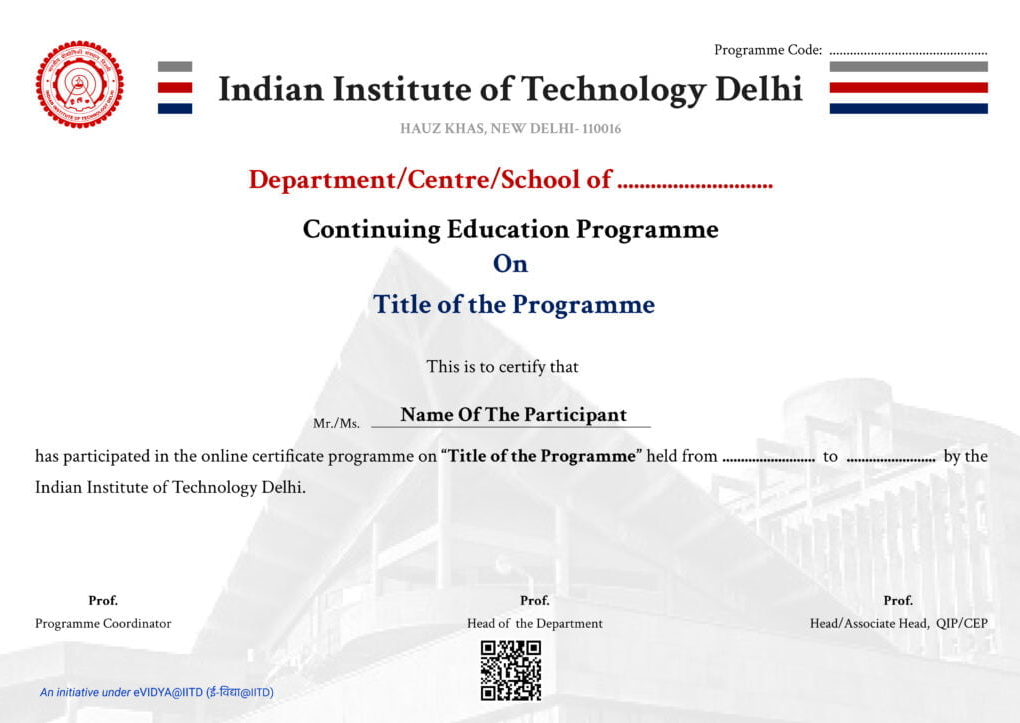
Programme Sample Certificate
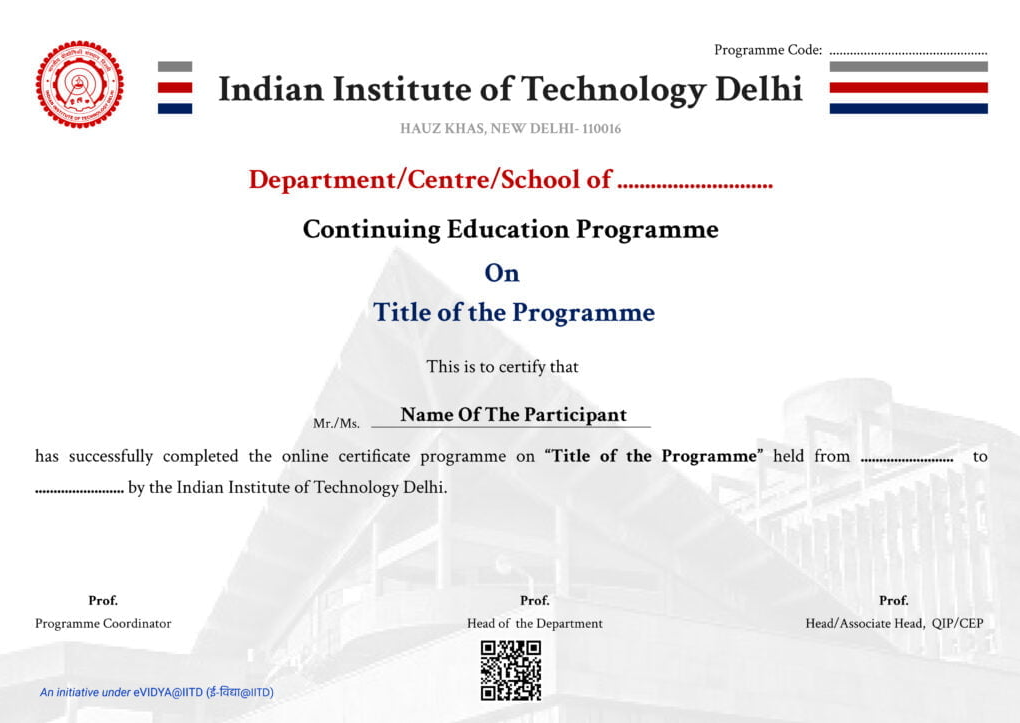
Successful Completion Certificate: Candidates who have at least 50% attendance and a minimum of 50% marks overall.
Participation Certificate: Candidates who have at least 50% attendance.
The organizing department for this programme is the Centre for Applied Research in Electronics, IIT Delhi.
*Only e-Certificates will be issued by CEP, IIT Delhi for this programme.
Installment Schedule
Programme Fees: 1,94,000 + 18 % GST
Instalment | Instalment Date | Amount** |
Application Fee* | To be paid at the time of application | 1,000/- |
1st Instalment | Within 4 days of offer letter rollout | 65,000/- |
2nd Instalment | 6th December, 2026 | 64,500/- |
3rd Instalment | 6th January, 2027 | 64,500/- |
Note:
| ||
Refund Policy
Candidates can withdraw within 15 days from the programme start date. A total of 80% of the total fee received will be refunded. However, the applicable tax amount paid will not be refunded on the paid amount.
Candidates withdrawing after 15 days from the start of the programme session will not be eligible for any refund.
If you wish to withdraw from the programme, you must email cepaccounts@admin.iitd.ac.in and icare@timespro.com, stating your intent to withdraw. ▪ The refund, if applicable, will be processed within 30 working days from the date of receiving the withdrawal request
Frequently asked questions
This CEP, IIT Delhi Certificate Programme in Applied Data Science and Artificial Intelligence: From Fundamentals to Deployment runs for 8 months and includes live online sessions, tutorials, capstone project, and optional campus immersion. It offers a structured path for building applied AI and data science skills while managing work or academic commitments.
Anyone with a Graduate or Diploma (10+2+3) qualification from a recognised university can apply for the data science course offered by CEP, IIT Delhi. Preference is given to those with backgrounds in Computer Science, IT, Electronics, Electrical, Physics, or related fields.
This CEP, IIT Delhi Certificate Programme in Applied Data Science and Artificial Intelligence: From Fundamentals to Deployment course is delivered online through live lectures, supported by tutorials and hands-on projects. Classes are held every Sunday that allow working professionals or students to engage with the course without interrupting their weekly schedules.
This CEP, IIT Delhi Certificate Programme in Applied Data Science and Artificial Intelligence: From Fundamentals to Deployment course includes Python programming, data cleaning, supervised and unsupervised learning, neural networks, natural language processing, and model deployment using cloud tools, Docker, and industry-relevant MLOps practices.
The applied data science and artificial intelligence programme offered by CEP, IIT Delhi, uses live online sessions, real case studies, hands-on tutorials, and a capstone project. It supports application-focused learning guided by expert faculty and supplemented by interactive tools and collaboration opportunities.
Yes, the CEP, IIT Delhi Certificate Programme in Applied Data Science and Artificial Intelligence: From Fundamentals to Deployment online course offers an optional one-day campus immersion. This six-hour visit gives you a chance to interact in person with IIT Delhi faculty and peers, complementing your online learning experience.
This CEP, IIT Delhi Certificate Programme in Applied Data Science and Artificial Intelligence: From Fundamentals to Deployment course offers a flexible learning format with practical exposure to AI tools, real-world datasets, and deployment frameworks. It prepares you for roles requiring both technical depth and hands-on ability.
Yes. Upon meeting the minimum requirements, you will receive a certificate issued by CEP, IIT Delhi. The CEP IIT Delhi data science certification is awarded based on attendance, project completion, and performance in the end-of-programme assessment.