
Certificate Programme in Cybersecurity and AI
Features
Programme Overview
"Master cybersecurity and AI security - together. The programme built for professionals securing the modern enterprise."
Most cybersecurity programmes ignore AI. Most AI programmes ignore security. This one treats them as what they actually are - one discipline. Built for working professionals who need both, grounded in India's regulatory landscape, delivered by IIT Delhi, in 6 months.
1,40,000 + 18 % GST
Class Schedule
Every Saturday: 10:00 AM – 1:00 PM.
Eligibility Criteria
Graduation with minimum 50% marks. Familiarity with any programming language preferred.
Programme Highlights
Threat-first, Build-second
End-to-end Curriculum Across 5 Modules
5 Frontier Agentic Attack Surfaces
India Regulatory Depth
IIT Delhi And Industry Expert Delivery
Hands-on Capstone Projec
Hands-on In Every Session
Campus Immersion At IIT Delhi Campus
Programme Modules
2 weeks · 6 hrs · Self-paced + live
Python for security automation | ML workflow integration | Wireshark · Nmap · Burp Suite · Kali Linux · Cloud setup (AWS / Azure / GCP) | MITRE ATT&CK introduction
3 weeks · 9 hrs
STRIDE threat modelling | MITRE ATT&CK deep-dive | Penetration testing · CVSS 4.0 | OWASP Top 10 · API security | Identity attacks: OAuth, JWT, SAML | India threat landscape: APTs, UPI fraud | Vulnerability management
In this module you will
Produce a STRIDE threat model for a BFSI or enterprise SaaS application with assets, trust boundaries, and abuse cases
Conduct a scoped penetration test with CVSS 4.0 scoring and ATT&CK technique mapping
Deliver a prioritised top-5 remediation roadmap with implementation effort estimates
5 weeks · 15 hrs
ML for threat detection: malware, phishing, fraud | Security-grade model evaluation | Sigma rule authoring + ATT&CK mapping | SIEM with Elastic Stack | Detection-as-code · SOAR playbooks | MLOps: experiment tracking, model registry
In this module you will
Build a production-ready security classifier (malware or fraud) with documented threshold trade-offs and model card
Write 5 validated Sigma detection rules with ATT&CK technique mapping, unit tests, and tuning evidence
Build a SIEM dashboard in Elastic Stack with log ingestion, correlation, and severity scoring
5 weeks · 15 hrs
Adversarial ML: evasion, poisoning, extraction | OWASP LLM Top 10 (2025) | LLM red teaming: PyRIT · Garak · PromptBench | Secure RAG pipelines | Multimodal jailbreaks | MCP prompt injection | Memory poisoning | Tool-calling exploitation | Model hub supply chain attacks
In this module you will
Execute an end-to-end LLM red team engagement with PyRIT, Garak, and PromptBench producing quantified metrics
Reproduce at least 2 of the 5 frontier agentic AI attack surfaces in a controlled lab environment
Build a repeatable evaluation harness measuring before/after robustness delta
4 weeks · 12 hrs
DevSecOps + MLSecOps pipelines | ModelScan · Sigstore · AI-BOM | Policy-as-code (OPA) · Runtime detection (Falco) | DPDP Rules 2025 artifacts | SEBI CSCRF 2024 audit format | RBI Master Directions 2024
In this module you will
Implement a DevSecOps + MLSecOps pipeline with OPA policy-as-code, Falco runtime detection, Sigstore signing, and AI-BOM generation
Produce auditor-ready DPDP Rules 2025 artifacts: breach notification workflow, Consent Manager integration, Data Fiduciary checklist
Map security controls to SEBI CSCRF 2024 structured audit format with RE classification tier assignment
4 weeks · 12 hrs
NIST AI RMF · ISO/IEC 42001 | EU AI Act phased enforcement | FAIR risk quantification + Monte Carlo | Board-level executive communication | AI ethics: bias, dual-use, explainability | Post-quantum readiness: NIST PQC standards
In this module you will
Apply NIST AI RMF and ISO/IEC 42001 to produce governance workflow artifacts and map EU AI Act risk tiers
Quantify cyber risk using FAIR methodology with Monte Carlo simulation and present as a board-level executive narrative
Produce an EU AI Act risk classification memo with GPAI obligation checklist for an India-facing MNC
3 weeks · 9 hrs
Production-grade AI security solution | IIT Delhi faculty evaluation panel | IEEE-format technical report (8-12 pages) | Campus Immersion at IIT Delhi campus
The capstone projects are indicative and may be modified to suit the requirements of the programme and the batch at the discretion of the Programme Coordinator.
Learning Outcomes
STRIDE-based threat modelling
Translate threat models into test cases, detection signals, prioritized mitigations, and a top-5 remediation roadmap.Detection engineering
Author and validate Sigma detection rules with ATT&CK mapping, false positive analysis, and tuning evidence.LLM red teaming
Execute end-to-end red team exercises using PyRIT, Garak, and Prompt Bench against LLM apps and agents.Agentic AI attack surfaces
Identify and exploit 5 frontier attack vectors: multimodal jailbreaks, MCP prompt injection, memory poisoning, tool calling, model hub supply chain.Secure LLM/RAG/agent systems
Mitigate OWASP LLM Top 10 (2025) and agentic risks, demonstrating mitigation of at least 5 risk categories.MLSecOps pipelines
Implement Model Scan, Sigstore signing, AI-BOM, and secure CI/CD pipelines with policy-as-code enforcement.India regulatory compliance artifacts
Produce operational artifacts aligned to DPDP 2025, SEBI CSCRF 2024, RBI 2024, and EU AI Act enforcement timeline.FAIR risk quantification
Quantify cyber risk in board-level financial language using Monte Carlo simulation and present as executive narrative.
Programme Coordinator

Professor Subodh Vishnu Sharma
Associate Professor
Department of Computer Science and Engineering
Indian Institute of Technology Delhi
Research Focus
Formal Verification · Program Analysis · AI/ML Robustness · Blockchain Security · Security & Reliability of AI Systems
Education
PhD (Computer Science) - University of Utah (2012)
· Postdoc - Systems Verification Lab, University of Oxford (2012-2015)
Prof. Sharma leads the VerTeCS research group at IIT Delhi. His work applies formal methods to establish security and reliability of real-world systems - including neural network robustness analysis, privacy-preserving electoral rolls (IEEE CSF 2024), traceable mixnets (PETS 2024), and Aadhaar security architecture. His research informs Modules 3, 5, and the governance and compliance threads throughout the programme.
Formal Verification | Neural Net Robustness (PRDC '23) | Privacy-Preserving Elections (IEEE CSF '24) | Blockchain Security AI Governance

Professor Vireshwar Kumar
Assistant Professor
Department of Computer Science and Engineering
Indian Institute of Technology Delhi
Research Focus
Security & Privacy of Cyber-Physical Systems · Applied Cryptography · Adversarial Machine Learning
Education
B.Tech - IIT Delhi · PhD (Computer Engineering) - Virginia Tech, under Prof. Jerry Park · Postdoc - Purdue University, under Prof. Dongyan Xu
Prof. Kumar's research focuses on anatomizing communication protocols in cyber-physical systems for security and privacy vulnerabilities, and then mitigating them with innovative defense mechanisms. His work spans smart vehicles (CAN protocol), smart homes, IoT security, and adversarial ML attacks - directly informing Modules 1, 3, and 4 of this programme.
Adversarial ML | CAN Security (USENIX '23) | IoT Privacy | Applied Cryptography | Cyber-Physical Systems
Programme Sample Certificate
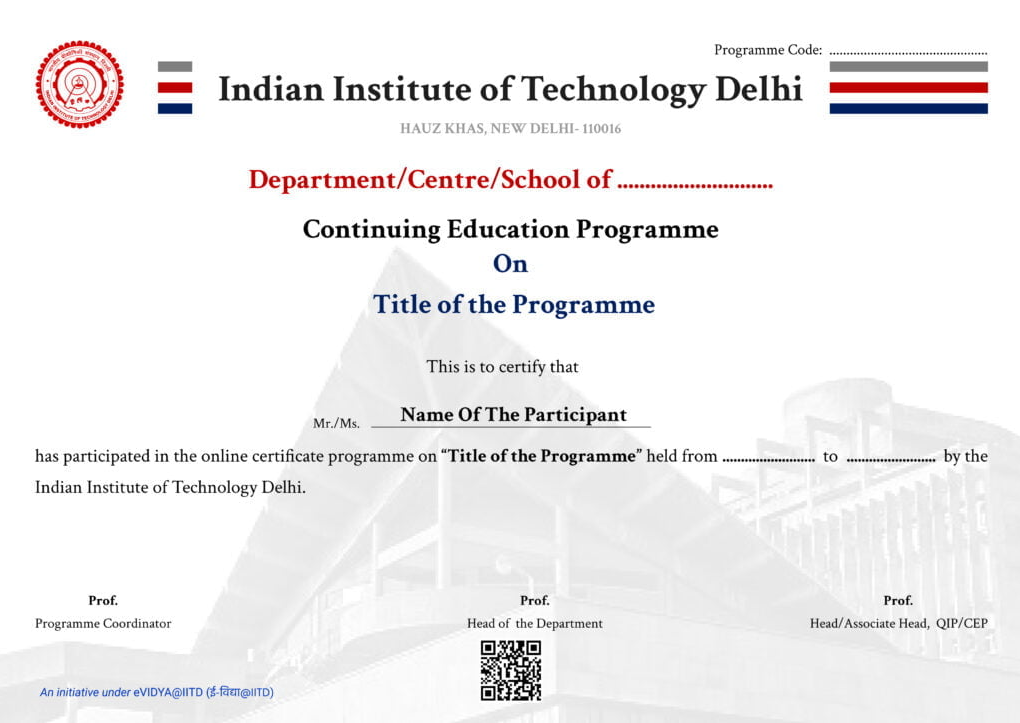
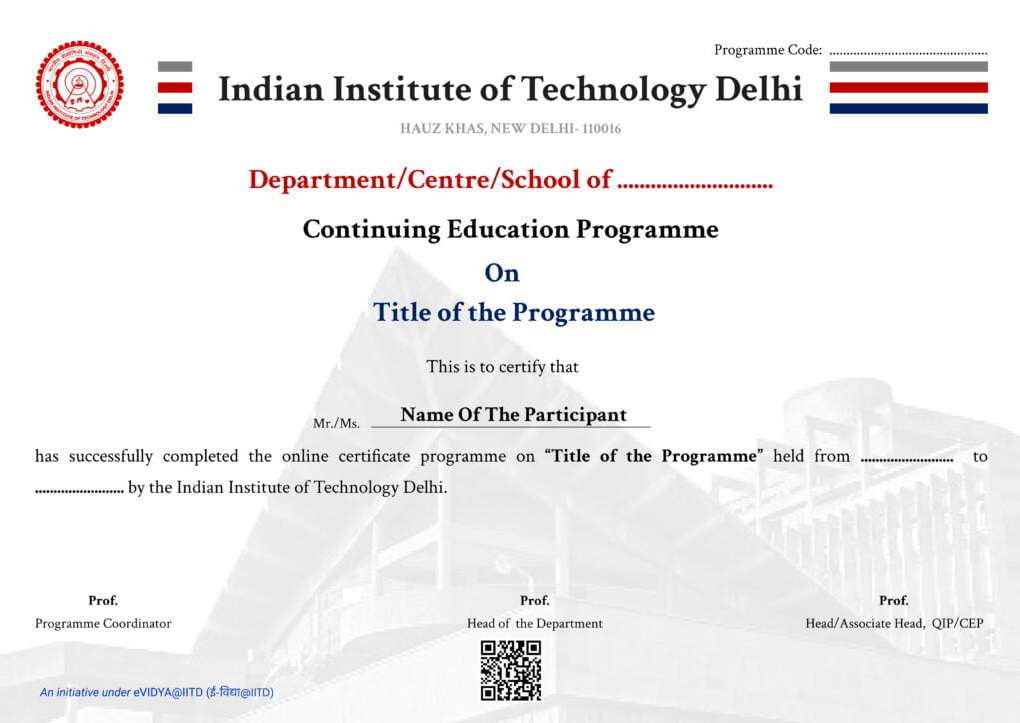
Upon successful completion, participants receive an e-Certificate of Completion issued directly by the Continuing Education Programme (CEP), Indian Institute of Technology Delhi.
Candidates who score at least 50% attendance plus 50% marks in evaluation will receive a 'Certificate of Completion'.
Candidates who score at least 50% attendance will receive a 'Certificate of Participation'.
The organizing department of this programme is the “Department of Computer Science and Engineering (CSE)”, IIT Delhi.
*Only e-Certificates will be issued by CEP, IIT Delhi.
Installment Schedule
Programme Fees: ₹ 1,40,000 + 18 % GST
Instalment | Instalment Date | Amount (₹)* |
1st Instalment | Within one day of issue of offer letter | 10,000/- |
2nd Instalment | 30th November, 2026 | 45,000/- |
3rd Instalment | 15th January, 2027 | 45,000/- |
4th Instalment | 15th March, 2027 | 40,000/- |
Note:
GST (currently 18%) will be applicable - total payable is approximately ₹1,65,200.
All fees should be submitted in the IITD CEP account only; details will be shared post-selection. Receipts will be issued by IIT Delhi CEP and can be downloaded from the CEP Portal.
Refund Policy
Candidates can withdraw within 15 days from the programme start date. A total of 80% of the total fee received will be refunded. However, the applicable tax amount paid will not be refunded on the paid amount.
Candidates withdrawing after 15 days from the start of the programme session will not be eligible for any refund.
If you wish to withdraw from the programme, you must email to cepaccounts@admin.iitd.ac.in and admissions@upgrad.com, stating your intent to withdraw. The refund, if applicable, will be processed within 30 working days from the date of receiving the withdrawal request.