
Certificate Programme in Design Thinking and Innovation (Batch - 10)
Features
Programme Overview
Design Thinking is a human-centred approach to problem-solving that fosters innovation across businesses, organisations, and society. It is an iterative process that involves understanding challenges, brainstorming solutions, prototyping, testing, and refining ideas to develop effective outcomes. By encouraging creativity and structured problem-solving, Design Thinking has become a powerful tool for driving meaningful innovation and accelerating the development of new concepts.
The IIT Delhi Design Thinking and Innovation (DTI) Programme is a 20-week online programme designed to provide a comprehensive understanding of Design Thinking principles and their real-world applications. Taught by esteemed faculty from IIT Delhi and industry experts, and complemented by GenAI modules, the programme covers key methodologies, tools, and frameworks to help professionals develop innovative solutions in dynamic business environments.
Participants will also gain hands-on experience through real-world projects with industry partners, applying structured problem-solving techniques to practical challenges. Whether you aim to enhance your creative problem-solving skills, drive innovation within your organisation, or develop user-centric solutions, this programme equips you with the expertise to make a meaningful impact.
₹ 1,20,000 + 18 % GST
Registration Closed
Class Schedule
Duration | 20 Weeks | Online Sessions |
First Academic Session | March 27, 2026 |
Eligibility Criteria
Graduates (10+2+3) or Diploma holders (only 10+2+3) from a recognised university in any discipline.
A minimum of 50% marks in the most recent qualification. Minimum 1 year of work experience (Private Sector / Government / NGO / Entrepreneur / Self-Employed) as on March 27, 2026.
Programme Highlights
150 + Engaging Video Lectures
15 + Innovative Assignments
10 + Short Quizzes
1 Capstone Adventure Project
2 Generative AI Modules
1 Optional Campus Immersion
Programme Modules
The Paradox of Our Age
The Principles of Co-Learning
A Shift in Being
What Design is Not
What is Design
Key Concepts of Design
A Simplified Understanding of Design
A Simplified Process of Design
Understanding Purpose
Letting Go of What Holds Us Back
What is Creativity?
Thinking Differently
Basic Rules of Design Thinking
The Creativity Heart Set
Everyone is a Designer
Double Diamond and Abstract-Tangible Cycle
Review - Double Diamond and Abstract-Tangible Cycle
Ethnographic Research
Participatory Research
Evaluative Research
Clean Team Case Study
Effective Research for HCD
Design in the World
User Context
Mis-design Around Us
Who are your Users?
Visible and Invisible Users
Hybrid Model of Research
Re-defining the Problem
Empathy Map Canvas
Hearing the Unsaid
Designing for Extreme Users
Why is Creativity Becoming More Important?
PLATOS Case Study
Understanding Uncommunicative Users
Waterless Urinal Case Study
The Changing Wish-List
The User Value Proposition
Doing the Homework - Ecosystem
Needs vs. Wants
Creative Ideation and Pattern Recognition
Developing Creative Habits
Creative Thinking Techniques
SCAMPER
Brainstorming Tools
The Importance of True Immersion
Immersive Learning
Immersive Experience in the Design Process
Mindful Design
Automobile Design Process
Design DNA and Moodboards
Introduction to AI
Fundamentals of Machine Learning and Deep Learning
Natural Language Processing and Computer Vision
Fundamentals of Generative AI
Generative AI, Ethics and Future
Stories vs. Narrations
Storytellers Across Time and Cultures
Experimental Storytelling
Storytelling in Research
Rural Storytelling Case Study
Storytelling in Design
Brand Stories
The Importance of Visuals and Visualisation
Visualising Human Experiences
Storyboarding or Image Boarding
Iterative Design Process
Waterless Urinal Cubicle Case Study
Research as a Tool
Handloom Case Study
Types of Sustainability
Sustainability in Action
Immersive Research Case Study
Non-Immersive Research Case Study
What is Minimum Value?
Identifying the MVP
Rural ATM Case Study
Prototyping as a Tool
Critical Stages in Prototyping
Stages in New Product Development
Types of Prototypes
Case Study - Children during the Covid-19 Lockdown
What is Lean and Agile?
Agile within Design
Designing Agile Processes
Electric Motor Case Study
What is Data-driven Innovation
Data-driven Innovation and Design
ML Lifecycle vs. Design Lifecycle
Generative Design and Nature-inspired Computing
Project Management Methodologies
Scrum, Kanban, and Scrumban
Example from UI/UX Industry
Example from Finance Industry
Customer Segmentation and Innovation
Design and Systems Thinking
Design and Systems Thinking Working Harmoniously
Business Design
Contributions of a Business Designer
Fundamentals of Agentic AI
Agentic AI in Practice
Building Prompts for Agentic Behaviour
RAG and ReAct Frameworks
Evaluation, Scaling and Ethics
Logical and Creative Thinking
Product Implementation Lifecycle
Types of Innovation
Roadblocks to Idea Generation and Implementation
Strategies for Whole Brain Thinking
Design Management
Entrepreneurship in Organisations
Innovation Strategies
Frugal Innovation Strategies
Challenging Assumptions
Safeguarding Your Innovation
Elements of Organisational Culture
Organisational Change Through Design
Storytelling for Organisational Transformation
Context Canvas
Defining the Challenge - Technical vs Adaptive
What are Rituals?
Co-designing Rituals
Celebrating Rituals and Sustaining Rituals
What Leadership is Not
Leadership and Commitment
The Triad of Leadership
Operating from your Being
Leading with Purpose
Inspiring People
The World is Your Playground
Learning Outcomes
Develop a human-centric mindset while designing, innovating, developing, and testing solutions for new products, services, and processes.
Understand the role of innovation in the digital era, and drive disruptive innovation.
Create a design thinking culture to drive innovation in an organisational set-up.
Effectively integrate GenAI into the design thinking process to enhance creativity, streamline prototyping, and produce innovative solutions.
Develop the ability to create and test prototypes that are customer-centric and innovative.
Tools
Msoffice
Figma
Canva
Programme Coordinator

Professor Vijayaraghavan M. Chariar
Professor
Centre for Rural Development & Technology,
Indian Institute of Technology Delhi
Prof. Vijayaraghavan M. Chariar has worked in diverse areas, including Design for Sustainability, Frugal Innovation, Traditional Knowledge Systems, and Joyous Leadership. He has been awarded the Teaching Excellence Award by IIT Delhi and has taught and conducted research at Arizona State University as a Fulbrighter. Prof. Chariar is the author of several patents and publications on innovative technologies. A passionate entrepreneur, he serves as the chairman of the IIT Delhi partnered venture Ekam Eco Solutions, and serves as a mentor and advisor to many start-ups, incubators, and accelerators
Programme Sample Certificate
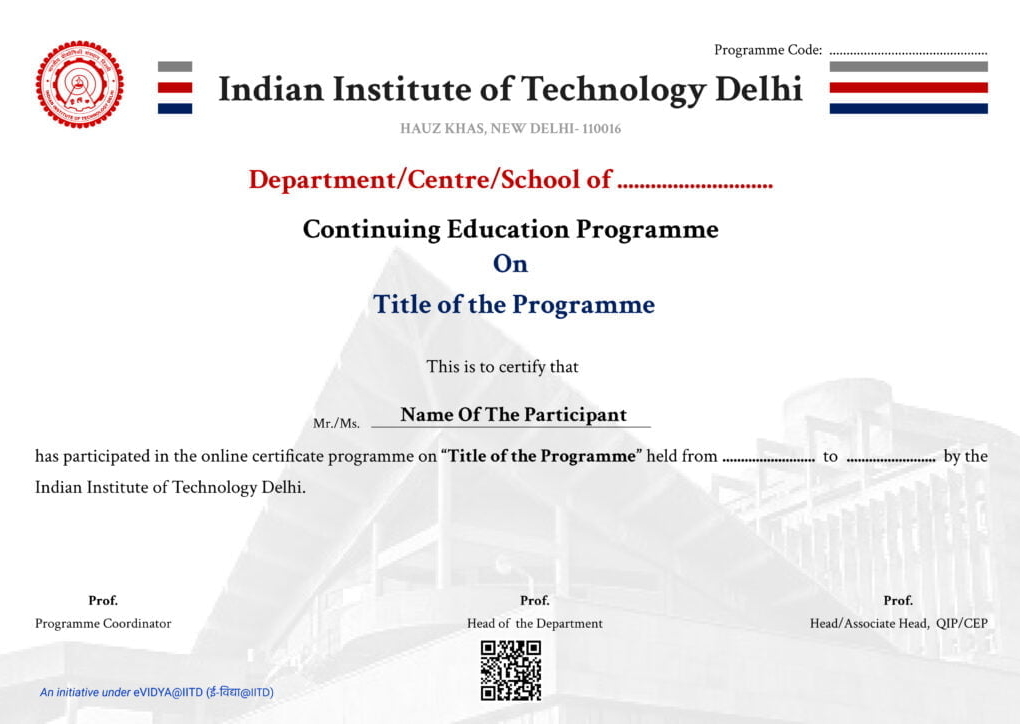
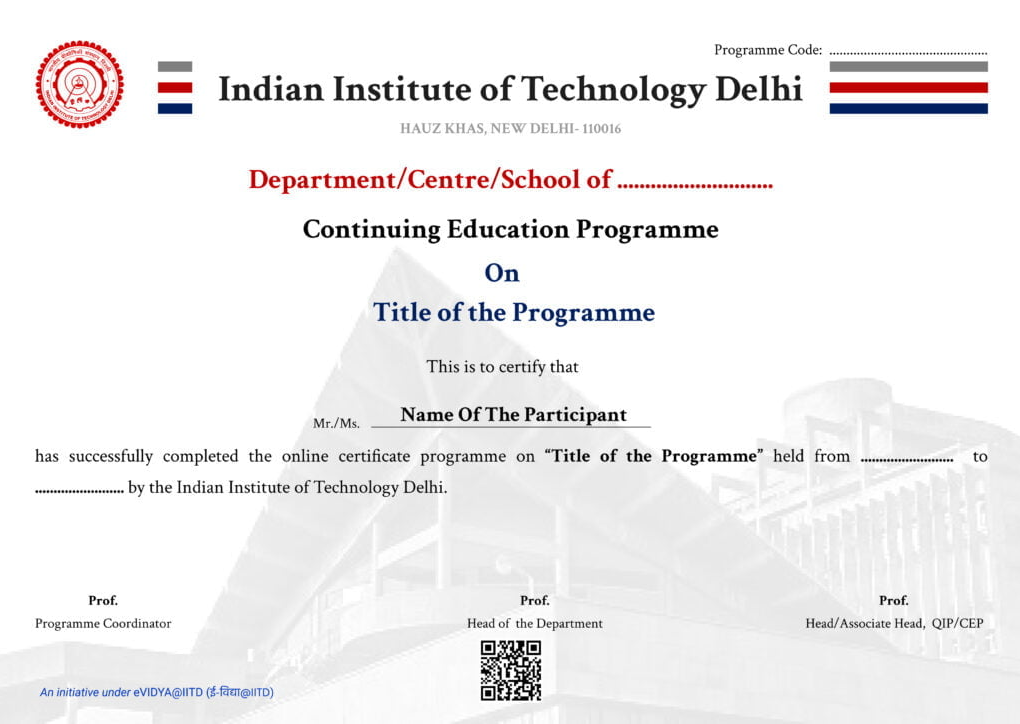
Participants will be awarded a successful completion certificate from IIT Delhi upon scoring a mark of at least 60% in each of the evaluation components (Assignments, Quizzes & Capstone) and upon completion of the capstone project.
Participants who are unable to score a mark of at least 60% in each of the evaluation components (Assignments, Quizzes & Capstone) will only be eligible for a participation certificate.
Note:
All certificate images are for illustrative purposes only and may be subject to change at the discretion of IIT Delhi.
Only e-certificates will be issued by CEP IIT Delhi.
The organising department for this programme is the CRDT, IIT Delhi.
Installment Schedule
Programme Fee INR 1,20,000 + GST
Installment | Date | Amount |
|---|---|---|
1st Installment | Within 7 days from selection | ₹60,000 + 18 % GST |
2nd Installment | March 28, 2026 | ₹60,000 + 18 % GST |
Note:
**GST (currently @ 18%) will be charged extra on these components.
Refund Policy
Candidates can withdraw within 15 days from the Programme Start Date. A total of 80% of the total fee received will be refunded. However, the applicable tax amount paid will not be refunded on the amount paid.
If you wish to withdraw from the programme, you must email cepaccounts@admin.iitd.in and iitd.execed@emeritus.org, stating your intent to withdraw. The refund, if applicable, will be processed within 30 working days from the date of receiving the withdrawal request.
Programme Related Video
Testimonials
Frequently asked questions
This programme offers a comprehensive introduction to design thinking principles and their application in innovation. It equips participants with the skills to solve complex problems using human-centered and iterative design approaches.
Design thinking is a problem-solving approach that focuses on understanding user needs, brainstorming innovative solutions, prototyping, and iterating based on feedback. It’s widely used in businesses, education, healthcare, and entrepreneurship to drive innovation and improve processes.
The syllabus includes:
Fundamentals of design thinking
Human-centered design approaches
Prototyping and testing methodologies
Innovation strategies in business
Application of design thinking in training and development
Advanced tools and techniques for design thinking
A keen interest in innovation, creativity, and problem-solving will help participants maximize their learning experience. Graduates (10+2+3) or Diploma holders (only 10+2+3) from a recognized university in any discipline. A minimum of 50% marks in a most reason qualification (desirable). Minimum 1 year of work experience (Private Sector / Government / NGO / Entrepreneur / Self Employed).
Yes, the programme is designed to empower professionals with design thinking skills applicable in diverse fields such as business, product design, strategy, and training development. It is particularly valuable for aspiring leaders and innovators.
Participants earn a professional certificate in Design Thinking and Innovation from IIT Delhi upon successfully completing the course.
Absolutely. The programme includes modules on entrepreneurial design thinking, emphasizing innovation strategies and practical implementation for startups and businesses.
IIT Delhi's programme stands out due to its blend of academic rigor, practical applications, mentorship by top faculty, and a certificate from a prestigious institution.
Yes, the programme provides focused modules on human-centered design and innovation strategies, allowing participants to tailor their learning to their interests.