
Certificate Programme in Generative AI (Batch 3)
Features
Programme Overview
Generative AI moved from research lab to enterprise core faster than any recent technology cycle.
The gap between organisations that can build AI and those that can only buy it is widening. And the professionals who can build it are the scarcest resource in the market.
₹ 1,69,000 + 18 % GST
Class Schedule
Academic Orientation date 31st October 2026.
Every Sundays Timing 09:00 AM to 12:00 PM.
Eligibility Criteria
Core engineering & computing students
Final or pre-final year, or graduates in CSE, IS, EIE, ECE, EE, IT and related disciplines.B.Sc / BCA students
In Mathematics, Statistics, Computing, or Data Science.STEM graduates / post-graduates with programming exposure
Graduates or post-graduates in any STEM field with demonstrated programming exposure. Professionals with coding or programming experience are also welcome. No prior AI/ML experience required; the curriculum builds from foundational mathematics upward.
Programme Highlights
6 -month, Online Programme For Working Professionals
Understand The Mathematics
Master The Architectures
Fine-tune & Align
Build RAG & Agents
Go Multimodal & Efficient
Deploy Responsibly
Programme Modules
MATHS FOR GENAI (5 SESSIONS)
Linear Algebra & Probability Basics: Vectors, matrices, matrix multiplication, dot product, idea of rank, SVD (high level); basic probability definitions.
Probability & Optimization: Bayes theorem, idea of a distribution; first and second order conditions, idea of gradient descent.
Introduction to ML: ML intro and terminology; linear regression; classification with logistic regression.
Evaluation & Unsupervised Learning: Overfitting and regularization; evaluation measures; high-level ideas of K-Means and PCA.
Neural Networks: Neural networks and backpropagation.
NATURAL LANGUAGE PROCESSING (4 SESSIONS)
Introduction to NLP: Stemming, Porter stemmer, lemmatization, edit distance.
Statistical Language Models: Language modelling, n-grams, smoothing, evaluation, perplexity.
POS Tagging & Parsing: POS tagging with HMM, Viterbi, evaluation; constituency vs dependency parsing, CFG, PCFG, CKY algorithm.
Semantics: Lexical & Distributional: Lexical similarity: words and senses; distributional similarity, vector space model, PMI, MI, TF-IDF.
NEURAL LANGUAGE MODELS (2 SESSIONS)
Word Representation: One-hot encoding, Word2Vec, GloVe, evaluation.
CNN & RNN++: CNNs for text; RNN, LSTM, GRU.
TRANSFORMER ARCHITECTURE (2 SESSIONS)
Transformer I: Seq2Seq, Beam Search & Attention: Seq2Seq, beam search, attention mechanism.
Transformer II: Encoder-Decoder: Transformer encoder and decoder.
LM PRETRAINING & FINE-TUNING (2 SESSIONS)
Transformer III: Pretraining Strategies: Pretraining strategies for effective domain adaptation.
Fine-Tuning Strategies: Fine-tuning strategies for task-specific performance.
INSTRUCTION TUNING, PREFERENCE TUNING & PROMPTING (4 SESSIONS)
IFT & Alignment: I: SFT and instruction tuning.
Prompt Engineering: Prompt engineering, LangChain.
Alignment: II: Value and policy optimization, classical reward model.
RLHF: RLHF with the TRL framework.
AUGMENTED LLM (1 SESSION)
RAG & Tool Augmentation: Methods to improve an LLM's ability to solve complex problems; Toolformer.
AGENTIC AI (3 SESSIONS)
Agentic AI: I: Foundations of LLM agents: planning, reasoning, tool use, memory.
Agentic AI: II: Multi-agent systems, orchestration frameworks.
Agentic AI: III: Agent evaluation, safety & deployment.
GENERATIVE AI FOR VISION (3 SESSIONS)
Vision LM: I: CNNs for image classification and segmentation, Vision Transformers, CLIP.
Vision LM: II: BLIP, LLaVA, Masked Autoencoder (MAE), Segment Anything Model (SAM).
Vision LM: III: SAM extensions, object detection basics, open-vocabulary object detection (OVOD).
ADVANCED TOPICS (2 SESSIONS)
Advanced Topic I: Small Language Models: Design of SLMs: pruning, distillation, and quantization.
Advanced Topic II: Responsible LLM: Bias and fairness, hallucination, safety and alignment, privacy, evaluation and governance of LLMs.
Learning Outcomes
01 Neural net from scratch
A fully connected network in PyTorch/TF with accuracy/loss curves.
02 Fine-tune a Transformer
Pre-trained transformer, task-specific fine-tune, precision/recall eval.
03 Transformer from first principles
Self-attention + positional encoding, benchmarked head-to-head.
04 PEFT at scale
Parameter-efficient fine-tune on an LLM, compared to full fine-tune.
05 Reward model & RLHF loop
Human-labelled reward model, applied via RL to improve LLM outputs.
06 RAG + agentic pipeline
Retrieval over your documents, then an agent that plans and acts.
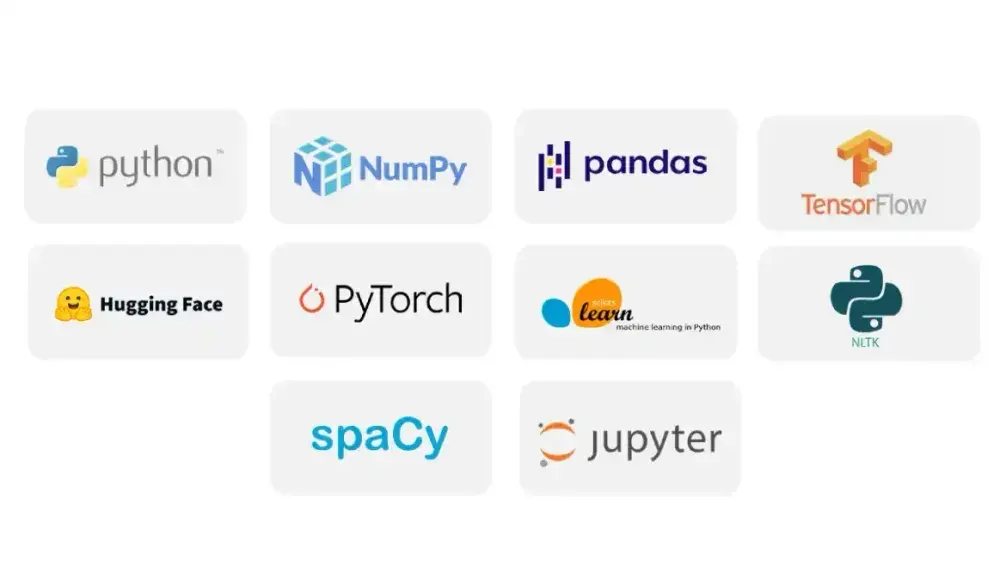
Tools
Python
Num Py
Pandas
Py Torch
Tensor Flow
Scikit-learn
Hugging Face
NLTK
Spa Cy
Jupyter Notebooks
Programme Coordinator

Professor Tanmoy Chakraborty
Rajiv Khemani Young Faculty Chair Professor in AI
Professor
Department of Electrical Engineering & Yardi School of Artificial Intelligence
Indian Institute of Technology Delhi
Prof. Tanmoy Chakraborty holds the Rajiv Khemani Young Faculty Chair in Al and is a Full Professor in the Department of Electrical Engineering and the Yardi School of Artificial Intelligence at the Indian Institute of Technology Delhi. He leads the Laboratory for Computational Social Systems (LCS2), a research group focusing on building economical, interpretable, and adoptable language models.
Tanmoy has held prestigious international positions, including DAAD Visiting Professor at MPI Saarbrücken, PECFAR Visiting Professor at TU Munich, and Alexander von Humboldt Fellow at TU Darmstadt. His work has been recognized through numerous honors, including being the youngest recipient of the ACM India Outstanding Contribution to Computing Education Award, Indian National Science Academy Young Associate, the Ramanujan Fellowship, and faculty awards from Microsoft, Google, LinkedIn, JP Morgan, and Adobe.
He has authored two textbooks — Social Network Analysis and Introduction to Large Language Models — and currently serves as Editor-in-Chief of ACL Rolling Review and Associate Editor of Computational Linguistics, TACL, and ACM Computing Surveys. He also served as Program Chair of EMNLP 2025 and Organising Chair of AACL'25.
HONOURS ACM India Outstanding Contribution to Computing Education Award • INSA Young Associate • Ramanujan Fellowship • DAAD Visiting Professor, MPI Saarbrücken • Alexander von Humboldt Fellow, TU Darmstadt
EDITORIAL Editor-in-Chief, ACL Rolling Review • Associate Editor, Computational Linguistics, TACL & ACM Computing Surveys • Program Chair, EMNLP 2025 • Organising Chair, AACL'25
MORE For more details, visit tanmoychak.com.
Programme Sample Certificate
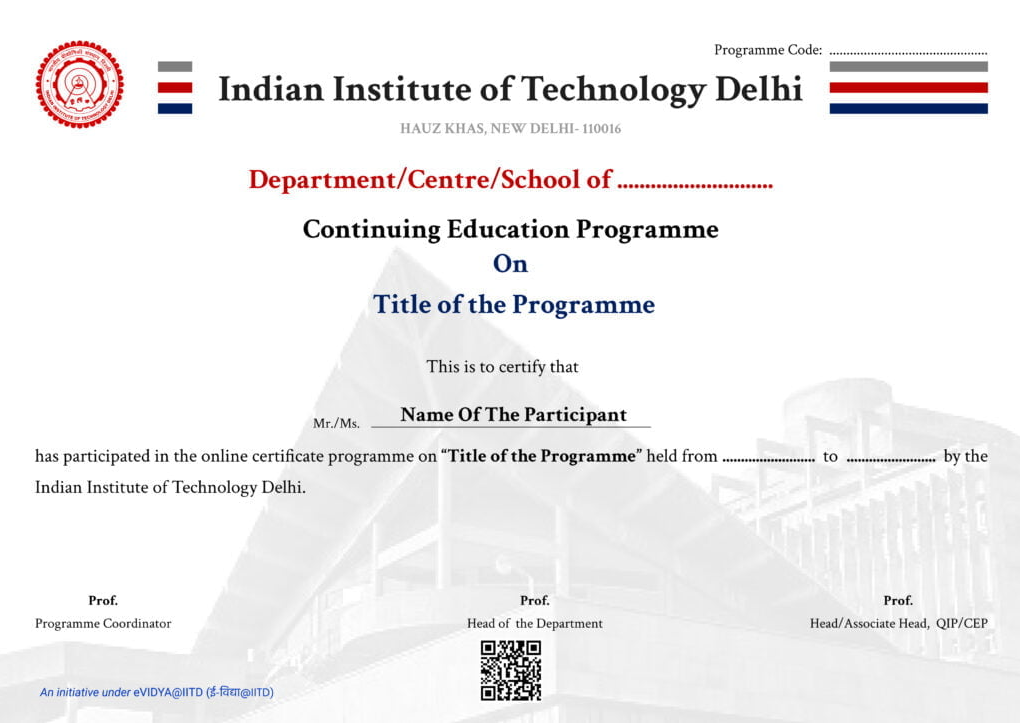
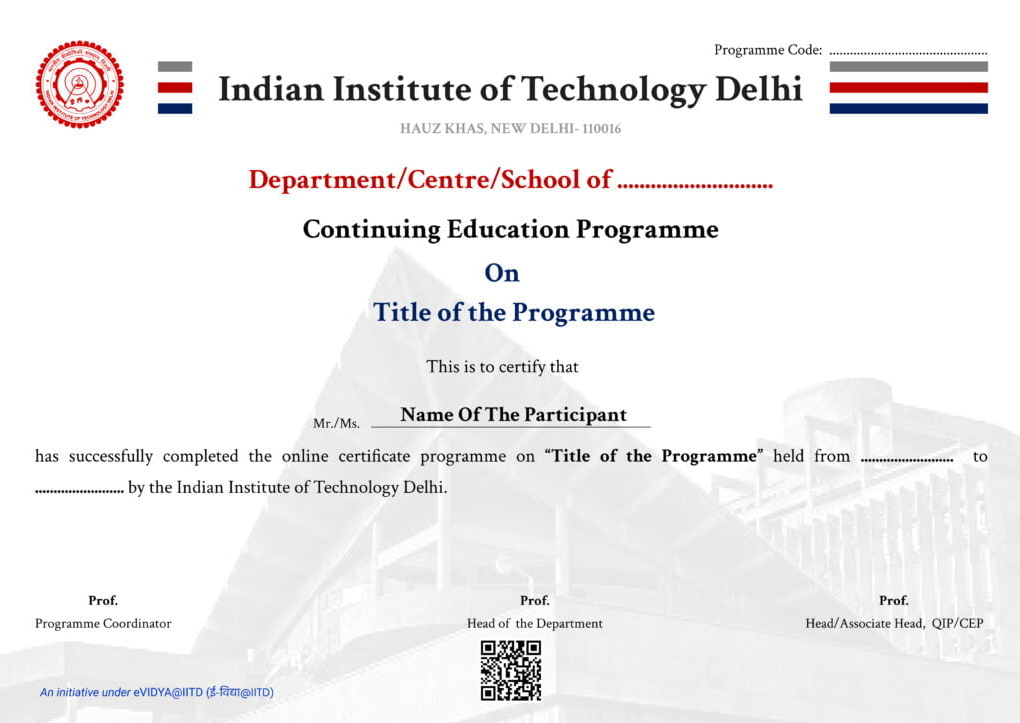
On completion, participants receive a certificate from the Continuing Education Programme (CEP), IIT Delhi. Two certificate types are issued, based on attendance and assessment performance.
TWO CERTIFICATE TYPES
Certificate of Successful Completion
ELIGIBILITY: Awarded to candidates who score at least 60% marks overall and have a minimum attendance of 80%.
Certificate of Participation
ELIGIBILITY: Awarded to candidates who score less than 60% marks overall and have a minimum attendance of 80%.
FORMAT & WHAT IS ON IT
Issued by: Continuing Education Programme (CEP), Indian Institute of Technology Delhi.
Format: Only e-certificates will be issued by CEP, IIT Delhi, for this programme.
Organizing Department: The organizing department of this programme is the Department of Electrical Engineering, IIT Delhi.
Installment Schedule
Programme Fees: ₹ 1,69,000 + 18 % GST
Instalment | Instalment Date | Amount (₹)* |
Application Fee | To be paid at the time of Application | 1,000/- |
1st Instalment | Within 4 days of offer roll-out | 30,000/- |
2nd Instalment | 30th October, 2026 | 1,39,000/- |
Note:
| ||
Refund Policy
Candidates can withdraw within 15 days from the programme start date. 80% of the total fee received is refunded. The applicable tax amount paid is not refunded.
Candidates withdrawing after 15 days from the start of the programme session are not eligible for any refund.
To withdraw, email cepaccounts@admin.iitd.ac.in and refunds_varsity_iitd@interviewbit.com. Refunds, if applicable, are processed within 30 working days.
Frequently asked questions
It is built for engineering and computing students and graduates (CSE, IS, EIE, ECE, EE, IT), B.Sc/BCA students in Mathematics, Statistics, Computing or Data Science, and STEM graduates or professionals with programming exposure who want to build Generative AI systems — not just use them.
Six months, delivered online with live lectures and tutorials — 86 learning hours across 4 phases and 10 modules, plus an optional in-person immersion at IIT Delhi.
Six shipped projects — from a neural network built from scratch to a reward model with an RLHF loop and an LLM prompting benchmark — plus a final capstone: a client-ready GenAI/Agentic AI application you build end-to-end and present with demo, architecture, prompt flow, evaluation logic and business impact.
From the mathematics under modern AI through NLP, neural language models and Transformers, into pretraining, fine-tuning, instruction tuning and RLHF, then RAG and agentic AI, and finally generative AI for vision, small language models and responsible AI.
Yes — an optional campus immersion at IIT Delhi, where the final capstone is presented live. Travel and accommodation are borne by the learner, and a hybrid option is available for those who cannot attend in person.
The programme is led by Programme Coordinator Prof. Tanmoy Chakraborty, Rajiv Khemani Young Faculty Chair Professor in AI at IIT Delhi and founder of the Laboratory for Computational Social Systems (LCS2) — an award-winning NLP and LLM researcher and author of Introduction to Large Language Models.
A certificate from the Continuing Education Programme (CEP), IIT Delhi. Two types are issued: a Certificate of Successful Completion (at least 60% marks and minimum 80% attendance) or a Certificate of Participation (less than 60% marks and minimum 80% attendance). Only e-certificates are issued.
You can withdraw within 15 days of the programme start date for an 80% refund of the total fee received (applicable tax is not refunded). No refund is available after 15 days.
Build-first roles across AI engineering, research and product — including AI Research Scientist, Machine Learning Engineer, Data Scientist (Generative AI), NLP Engineer, Generative AI Specialist, Conversational AI Developer, Autonomous Systems Engineer and Vision Engineer. Roles are indicative of where GenAI skills apply and are not a guarantee of employment; CEP, IIT Delhi does not provide placement assistance.