
Certification in Quantum Computing and Machine Learning (Batch 09)
Features
Programme Overview
Quantum Computing and Machine Learning merge in a powerful convergence, unlocking the boundless potential of quantum mechanics and data-driven algorithms. Quantum computing propels computations to unimaginable speeds, while machine learning fuels intelligence through data. Together, they amplify processing capabilities, ignite faster training, and unveil transformative insights. This dynamic discipline revolutionizes finance, healthcare, cryptography, and beyond.
₹ 1,79,000 + 18 % GST
Class Schedule
Every Saturday and Sunday 8:30 am to 11.30 am
Eligibility Criteria
Graduation in any of these disciplines:
B.Tech/BE; BCA/MCA; B.Sc in all streams; BA/MA in mathematics
Programme Highlights
Comprehensive Coverage Of Quantum Computing And Quantum Machine Learning
Live Tutorials And Lab Practice Sessions
Taught By Renowned IIT Delhi Faculty
Doubt Clearing Sessions
Optional One-day Campus Immersion
Programme Modules
Quantum Bits
Dirac Notation
Single and Multiple Qubit Gates
No Cloning Theorem
Quantum Interference
Students will be equipped with a thorough understanding of the key topics covered in Module 1, enabling them to work with qubits, quantum gates, Dirac notation, and understand the foundational principles of quantum computing.
Quantum State
Quantum Evolution
Quantum Measurement
Bell’s Inequality Test Density Coding
Quantum Teleportation, BB84 Protocol
Quantum Error Correction
By the end of this module, students will have a solid grasp of the foundational concepts in quantum computing and be able to apply these principles to solve real-world problems and design quantum algorithms.
Qiskit
Deutsch-Jozsa Algorithm Implementation
Bernstein-Vazirani Algorithm
Simon’s Algorithm
By the end of this module, students will have a solid foundation in quantum algorithms. They will be proficient in using Qiskit and have hands-on experience in implementing key quantum algorithms, including Deutsch-Jozsa, Bernstein-Vazirani, and Simon’s algorithms. This knowledge will enable students to apply quantum algorithms to solve problems efficiently and understand their quantum advantage in specific use cases.
Quantum Fourier Transform
QFT Implementation in Qiskit
Quantum Phase Implementation
Quantum Phase Estimation in Qiskit
Shor’s Period Finding Algorithm
Grover’s Search Algorithm
By the end of this module, students will have a comprehensive understanding of the Quantum Fourier Transform and its applications in quantum algorithms. They will be proficient in using Qiskit to implement these algorithms and tackle real-world problems in quantum computing, including cryptography and search tasks.
Data Encoding
HHL Algorithm
HHL Algorithm Implementation
Quantum Linear Regression
Quantum Swap Test Subroutine
Swap Test Implementation
Quantum Euclidean Distance Calculation
Quantum K-Means Clustering
Quantum Principal Component Analysis
Quantum Support Vector Machines
SVM Implementation Using Qiskit
By the end of this module, students will have a solid grasp of quantum machine learning techniques and their practical implementation. They will be equipped with the skills to use quantum algorithms for data encoding, linear system solving, regression, clustering, dimensionality reduction, and classification, ultimately enhancing their ability to address complex machine learning challenges.
Hybrid Quantum-classical Neural Networks
Classification Using Hybrid Quantum-classical Neural Network
Quantum Neural Network for Classification on Near-term Processors
By the end of this module, students will have a strong understanding of quantum deep learning concepts and practical implementation. They will be able to design, train, and evaluate hybrid quantum-classical neural networks for classification tasks, especially on near-term quantum hardware, enhancing their capabilities in quantum-enhanced machine learning and deep learning.
Variational Quantum Eigensolver
Expectation Computation
Implementation of the VQE Algorithm
Quantum Max-cut Graph Clustering
Quantum Adiabatic Theorem
Quantum Approximate Optimisation Algorithm
Quantum Algorithm for Finance
By the end of this module, students will have a comprehensive understanding of quantum variational optimisation techniques and adiabatic methods. They will be able to implement quantum algorithms like VQE, QAOA, and apply them to solve problems in quantum chemistry, graph clustering, optimization, and finance. This knowledge will empower students to leverage quantum computing for practical problem-solving across various domains.
Hybrid Quantum Neural Networks for Remote Sensing Imagery Classification
Analysis and Implementation of Quantum Encoding Techniques
Quantum Convolutional Neural Network for Classical Data Classification
Prediction of Solar Irradiation using Quantum Support Vector Machine Learning Algorithm
To Solve any Combinatorial Optimization Problem (Like Knapsack) using a Quantum Annealing Approach
Comparative Study of Data Preparation Methods in Quantum Clustering Algorithms
To Calculate the Ground State Energy of a Simple Molecule
(H2, LiH, or H2O) using VQE
Variational Quantum Classifier
Implementing Grover's Algorithm and Proving Optimality of Grover's Search (Bounded Error and Zero Error)
To Implement Grover’s Search Algorithm Where 101 is the Marked State
Quantum Computing for Finance
To Solve Crop-Yield Problem using QAO and VQE, and Run the Same on Real Quantum Computer
Analysis of Solving Combinatorial Optimization Problems on Quantum and Quantum-like Annealers
Quantum Convolutional Neural Network for Classical Data Classification
Implementing Grover's algorithm and proving optimality of Grover's search bounded error and zero error
Research on Quantum Computing Usage to Expedite the Drug Discovery Process (Life Sciences).
To Implement Shor’s Code in Qiskit with Noise Models
To Understand and Implement Quantum Counting
Enterprise Intelligence - Managed Services with Quantum ComputingOn-ground Implementation of Quantum Key Distribution in Indian Navy
Implementing MC Simulations using Quantum Algorithm (Financial domain)
To Design and Build an Educational Game using Fundamentals of Quantum Computing
Solving Travelling Salesman Problem using QAOA
Implementing Clinical Data Classification by Quantum Machine Learning (QML)
To Understand and Implement Quantum Carry-Save Arithmetic
Implementing any one quantum algorithm and understanding classical vs. quantum hardness of problems
To Implement Shor’s Algorithm to Factor 49
To Understand and Implement Grover Search-Based Algorithm for the List Coloring Problem
Optimization Problem where We Try to Find the Best Solution to Coal Overburden Problem with Depth and Coal Quantity Mined
Implementing HHL Algorithm and Proving BQP-completeness of Matrix Inversion
Quantum Convolutional Neural Network-based Medical Image Classification
Quantum Convolutional Neural Network
Quantum Computing for Finance
Differential Detection of Internal Fault of an Electrical Network. A Comparison with Classical vs Quantum Approach
Major Area: Implementing any One Quantum Algorithm and Understanding Classical vs Quantum Hardness of Problems
Quantum Computing and Information Security
To solve the travelling salesman problem using QAOA
Feature Selection in Machine Learning using Quantum Computing
Learning Outcomes
Learn the principles and nuances of quantum computing
Get equipped with various quantum computing algorithms
Understand the differences between conventional computing and quantum computing
Build a strong foundation in the applications of Quantum Computing and Machine Learning
Access to the latest industry insights
Tools
Qiskit Based Programming
Programme Coordinator

Professor Abhishek Dixit
Associate Professor
Department of Electrical Engineering
Indian Institute of Technology Delhi
Prof. Abhishek Dixit received his M.Tech. degree in Opto-electronics and Optical Communication from the Indian Institute of Technology (IIT) Delhi in 2010 and his Ph.D. degree in Computer Science Engineering from the Department of Information Technology (INTEC), Ghent University, Belgium, in 2014. Since 2015, he has been an Assistant Professor at IIT Delhi, where he has taught courses related to Optical Communications, Signal Processing, Communications Engineering, and Networking. Recently, he started actively researching the use of Machine Learning to improve the performance of conventional and quantum communications systems. He has also taken an NPTEL course on the Principles of Digital Communications.
Before joining IIT Delhi in December 2015, he served for a semester (July 2015 – December 2015) as an Assistant Professor at IIT Mandi and as a Post-doctoral Researcher (December 2014 – June 2015) at Ghent University, Belgium. He is leading research activities at IIT Delhi in the area of Optical Communications and Networking. In this context, he has been involved in a large number of Indian projects. He has also carried out several consultation projects in the area of railway signaling. He has published over 30 international journal articles (IEEE JSAC, IEEE Communications Magazine, Journal of Lightwave Technology, Journal of Optical Communications and Networking, IEEE Networks, IEEE Transactions on Network and Service Management, IEEE Access, IEEE Sensors, IEEE Open Journal of the Communications Society, etc.) and over 50 publications in international conferences.
Programme Sample Certificate
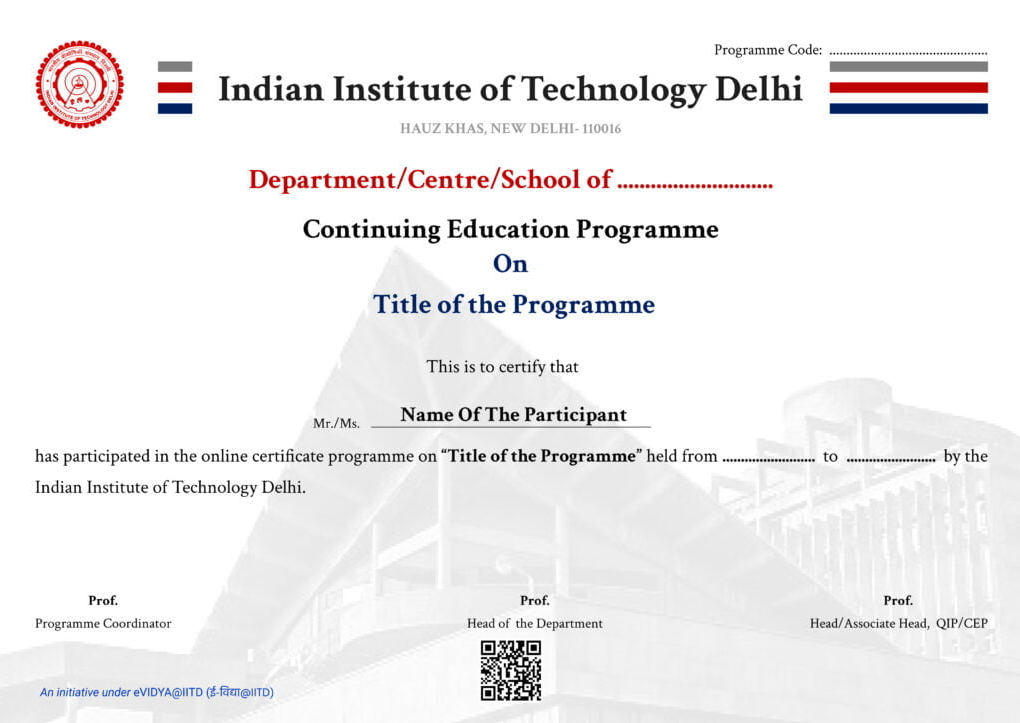
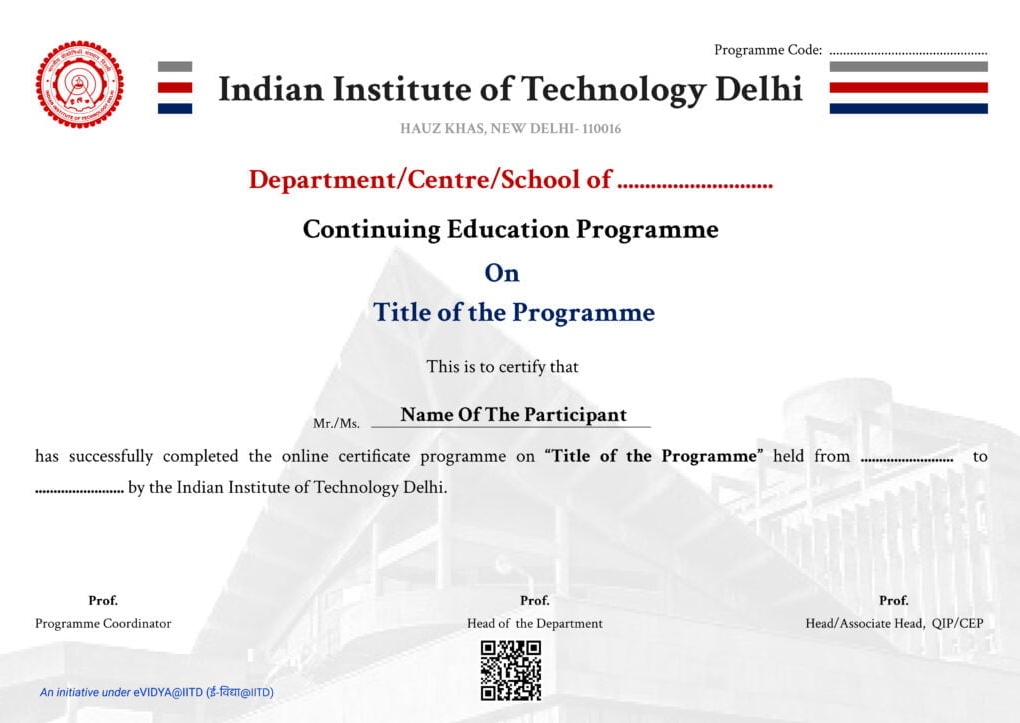
Candidates who score at least 50% in evaluation, will receive a ‘Certificate of Successful Completion’ from CEP, IIT Delhi.
Candidates who score attendance of 50% will receive a ‘Certificate of Participation’ from CEP, IIT Delhi.
The organizing department of this programme is the Bharti School of Telecommunication Technology and Management, IIT Delhi.
*Only e-Certificates will be issued by CEP, IIT Delhi for this programme.
Installment Schedule
Programme Fee INR 1,79,000 + 18% GST
Instalment | Date | Amount (₹)** |
Application Fee | Application Fee | 1,000 + 18 % GST |
1st Instalment | Within 5 days of offer letter rollout | 59,650 + 18 % GST |
2nd Instalment | 6th February, 2027 | 59,650 + 18 % GST |
3rd Instalment | 6th March, 2027 | 59,700 + 18 % GST |
Note:
*GST @ 18% will be charged extra in addition to the fees
The application fee of INR 1,000/- + 18% GST is non-refundable and non-transferable. This fee is in addition to the programme fee and will not be adjusted against the total programme fee.
Refund Policy
Candidates can withdraw within 15 days from the programme start date. A total of 80% of the total fee received will be refunded. However, the applicable tax amount paid will not be refunded on the paid amount.
Candidates withdrawing after 15 days from the start of the programme session will not be eligible for any refund.
If you wish to withdraw from the programme, you must email to cepaccounts@dmitt.iitd.ac.in and icare@timespro.com, stating your intent to withdraw. The refund, if applicable, will be processed within 30 working days from the date of receiving the withdrawal request.
Testimonials
Frequently asked questions
The CEP, IIT Delhi Certification in Quantum Computing & Machine Learning is a six-month online programme that covers quantum algorithms, Qiskit, and machine learning applications through structured modules, practical labs, and real-world projects.
No prior quantum computing experience is required. The CEP, IIT Delhi Certification in Quantum Computing & Machine Learning course begins with foundational topics, making it accessible for professionals with basic programming and mathematics knowledge interested in quantum machine learning and algorithm development.
The CEP, IIT Delhi certification in quantum computing and machine learning covers quantum bits, gates, Qiskit, quantum machine learning, hybrid networks, optimization algorithms, clustering, and classification models using quantum computing frameworks.
The CEP, IIT Delhi Certification in Quantum Computing & Machine Learning course includes projects in finance, healthcare, drug discovery, image classification, and optimization using quantum computing and machine learning approaches like Grover’s algorithm, VQE, and quantum SVMs.
The CEP, IIT Delhi Certification in Quantum Computing & Machine Learning course uses Qiskit, a leading quantum programming platform. Students implement algorithms and models using simulators and hybrid classical-quantum tools.
Participants completing this CEP, IIT Delhi Certification in Quantum Computing & Machine Learning in India, with required scores, receive a Certificate of Successful Completion from CEP, IIT Delhi. Others receive a Certificate of Participation.
The total fee for the CEP, IIT Delhi Certification in Quantum Computing & Machine Learning course is ₹1,79,000 plus taxes. Payment is made in four scheduled instalments, with optional EMI and loan support provided via TimesPro.
Yes, this CEP, IIT Delhi Certification in Quantum Computing & Machine Learning course includes an optional one-day immersion at IIT Delhi. This allows learners to interact with faculty, clarify concepts, and experience the academic environment firsthand.