Design Thinking with AI for Innovation-Based Entrepreneurship (Batch 1)
Features
Programme Overview
The CEP, IIT Delhi Design Thinking with AI for Innovation-Based Entrepreneurship (Batch 01) programme brings together human-centred problem-solving, artificial intelligence and entrepreneurial strategy to create a comprehensive approach to innovation. Participants learn to identify unmet user needs, define the right problems, leverage AI for research, ideation and prototyping, and develop solutions that address real-world challenges.
This programme further explores business model innovation, financial planning and go-to-market strategies, enabling participants to assess the commercial potential of their ideas. Through practical learning and a dedicated capstone project, participants progress from identifying opportunities to developing, validating and pitching an AI-enabled business venture.
₹ 1,59,000 + 18 % GST
Class Schedule
Every Saturday: 9:00 AM to 1:00PM (IST)
Eligibility Criteria
Graduates from any discipline
Programme Highlights
Learn From IIT Delhi
An End-to-End Capstone Project
AI Across The Innovation Journey
Optional Campus Immersion*
60 % Practical Learning
From Innovation To Business Viability
Design Thinking At The Core
Programme Modules
The Intersection of Design Thinking & AI, Foundations of AI, ML & Generative AI
Prompting, No-code AI & Agentic tools, Empathy at Scale (Generative AI for User Research), Real User Validation
Defining the Problem Space, Assumption Mapping
Creative Ideation Process – Creative Confidence, Habits & Pattern Recognition, Idea Funnel, Selection & Prioritization
Rapid Prototyping Fundamentals, Usability Testing & User Feedback
AI-Driven Innovation
AI Evolution Process
Ethics, Bias, and Responsible AI, Accessibility, Inclusion & Equitable Design, Sustainable & Circular Design
Entrepreneurship and Role of AI
Refining the Value Proposition with AI
Mid-Term Project Milestone
AI Business Model Canvas, Revenue Models & Unit Economics
Go-To-Market (GTM) Strategies, Branding & Positioning
Financial Modeling for AI Ventures, Funding Sources: Debt & Equity
Intellectual Property & Data Moats
Agile Operations & Team Architecture
Pitch Simulation & Investor Feedback
Future-Proofing Innovation Culture
- Capstone Presentations & Graduation
Assignments/Case-Projects
Tentative List of Capstone Projects
Broad Sector in India | Core Socio-Economic Challenge | AI Innovation Opportunity | Design Thinking & Human-Centric Focus |
|---|---|---|---|
Agriculture & Agritech | Fragmented landholdings, unpredictable monsoons, heavy reliance on middlemen for crop pricing and credit. | Precision farming via satellite data, predictive weather modelling, computer vision for early pest detection. | Trust & Simplicity: Low-bandwidth, voice-first interfaces in local dialects that marginal farmers can trust and operate. |
Healthcare & Public Health | Severe doctor-to-patient ratios in rural areas, massive diagnostic backlogs, out-of-pocket health expenditures. | AI-driven diagnostic triage tools, automated symptom checkers via vernacular chat, predictive tracking. | Dignity & Accessibility: Privacy, work within PHCs, complement rather than alienate ASHA/ANM workers. |
Education & Skill Development | High student-teacher ratios, uneven foundational learning outcomes, language barriers in higher/technical education. | Vernacular LLMs (leveraging Bhashini), adaptive learning tutors, automated content localization. | Equity & Inclusion: Shared community devices/offline setups in rural classrooms/government schools. |
Assignments/Case-Projects
Tentative List of Capstone Projects
Broad Sector in India | Core Socio-Economic Challenge | AI Innovation Opportunity | Design Thinking & Human-Centric Focus |
|---|---|---|---|
Financial Inclusion & MSMEs | Millions of micro-entrepreneurs and informal workers lack formal credit histories or collateral for loans. | Alternative credit-scoring models using digital footprint data, automated voice-based micro-loan applications, fraud detection. | Anti-Bias & Transparency: Explainable credit engines to prevent systemic exclusion of unorganized sector workers. |
Climate Action & Sustainable Cities | Rapid urbanization pressures, extreme weather events, severe air/water pollution in tier-1 and tier-2 cities. | IoT-enabled smart city resource mapping, predictive flood/drought warning systems, localized carbon footprint tracking. | Behavioral Change: Intuitive public interfaces and community feedback loops that incentivize sustainable local habits. |
Public Service Delivery & Governance | Bureaucratic friction, red tape, complex eligibility verification for central/state welfare schemes. | Multimodal generative AI chatbots integrated into Digital Public Infrastructure (DPI) to automate grievance redressal and scheme discovery. | Citizen-Centricity: Low digital literacy citizens, complex forms, ensuring government schemes reach last-mile seamlessly. |
Disclaimer: The list of tools and topics mentioned is indicative and may be modified as per programme requirements and at the discretion of the Programme Coordinator.
Learning Outcomes
Solve Real-World Challenges
Apply Design Thinking and AI to address complex business and societal challenges through human-centred problem-solving.
Leverage AI for Innovation
Use Generative AI, effective prompting and AI-enabled tools to support research, ideation, solution validation and rapid prototyping.
Identify Innovation Opportunities
Evaluate AI-driven opportunities and develop differentiated value propositions that address unmet needs.
Build Viable Business Models
Design AI-enabled business models incorporating revenue strategies, unit economics and go-to-market planning.
Champion Responsible Innovation
Integrate responsible AI principles, accessibility, inclusion and sustainability into the design and development of solutions.
Pitch with Purpose
Present and pitch innovative solutions to industry experts and stakeholders, supported by a clear roadmap for implementation and scale.
Develop AI-Enabled Ventures
Build and validate an end-to-end venture, assessing its business model, financial viability and growth potential.
Programme Coordinator
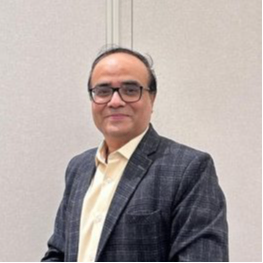
Professor Jitender Madaan
Professor
Department of Management Studies,
Operations and Supply Chain Management
Indian Institute of Technology Delhi
Academic Excellence
Earned his PhD from IIT Delhi on a full scholarship.
Teaches at doctoral, postgraduate and undergraduate levels.
Contributed to entrepreneurship and professional education.
Research & Industry Expertise
Operations Management: Improving operational performance and efficiency.
Sustainable Supply Chains: Exploring sustainability in business operations.
Product & Packaging Recovery: Researching recovery practices and their wider impact.
Technology & Sustainability: Examining the role of information technology in sustainable business operations.
Entrepreneurship & Mentorship
Founding member of the Entrepreneurship Programme at DMS, IIT Delhi.
Supervised the successful completion of 9+ doctoral degrees.
Guided numerous master's and undergraduate student projects.
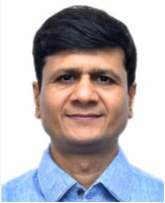
Professor Jyoti Kumar
Professor
Department of Design
Indian Institute of Technology Delhi
Academic Excellence
Specialises in UX Design, Design Thinking, Human Experience and Design Education.
Integrates design, psychology, neuroscience and technology to understand human experiences.
Research & Industry Expertise
UX Lab, IIT Delhi: Leads research into the cognitive, affective and aesthetic experiences associated with digital and physical products using neurophysiological approaches.
DIVINE Social Innovation Lab: Explores entrepreneurial opportunities and design-led innovation in rural Indian contexts.
Research Focus
UX design education in the Indian cultural context.
Design Thinking for rural entrepreneurship.
Yogic neuroscience and value-based design.
Human Consciousness: Empathy, aesthetics and their influence on design and decision-making.
Design in Practice: Engages in design consultancy, product design and interdisciplinary collaborations to create meaningful, human-centered experiences.
Programme Sample Certificate
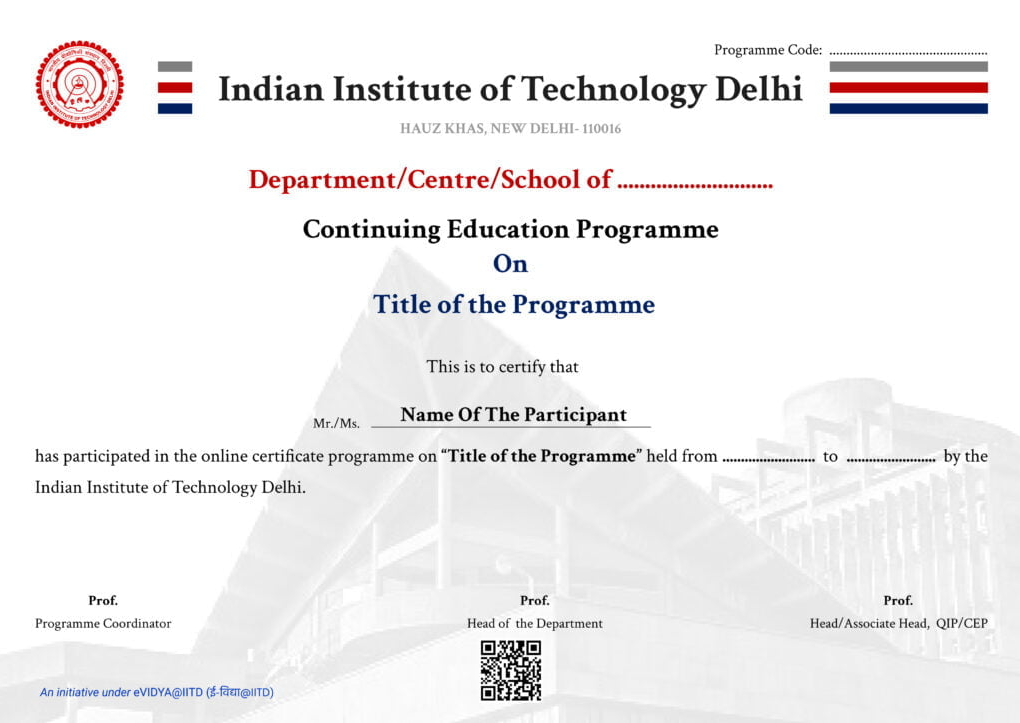
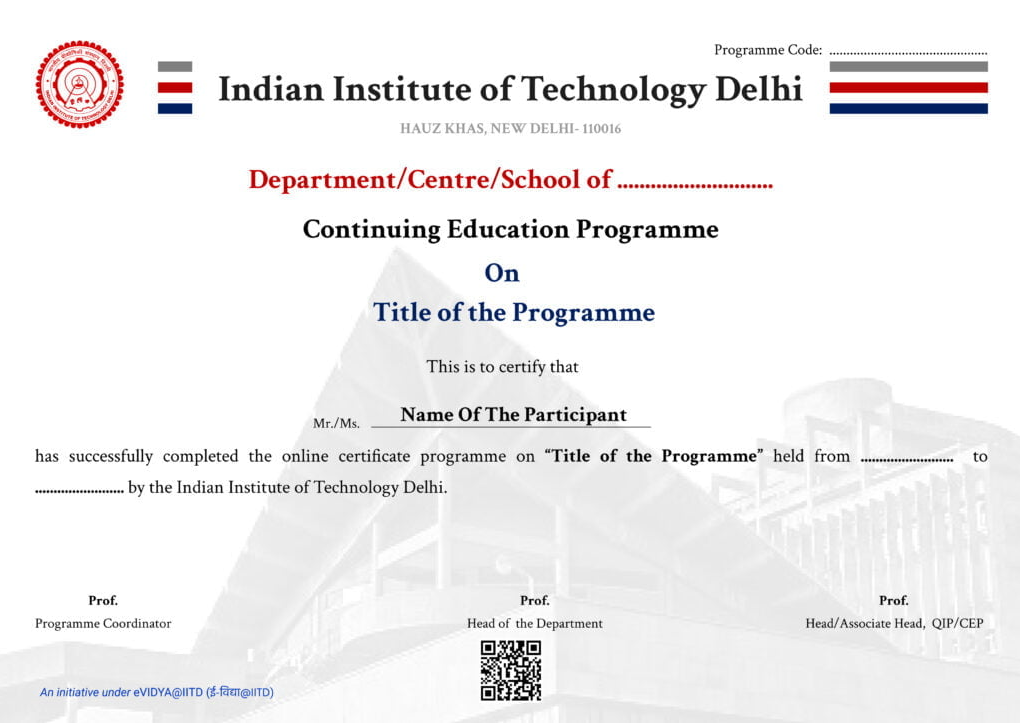
- Candidates who score at least 70% marks in assignments and have a minimum attendance of 70% will receive a Certificate of Successful Completion.
- Candidates who score at least 40% marks in assignments and have a minimum attendance of 70% will receive a Certificate of Participation.
- The organising department of this programme is the Department of Management Studies, IIT Delhi.
Note: Only e-Certificates will be issued by CEP, IIT Delhi for this programme.
Installment Schedule
Programme Fees: 1,59,000 + 18 % GST
Instalment | Instalment Date | Amount** |
Application Fee* | To be paid at the time of application | 1,000/- |
1st Instalment | Within 4 days of offer letter rollout | 53,000/- |
2nd Instalment | 6th May, 2027 | 53,000/- |
3rd Instalment | 6th June, 2027 | 53,000/- |
Note:
| ||
Refund Policy
Candidates can withdraw within 15 days from the programme start date. A total of 80% of the total fee received will be refunded. However, the applicable tax amount paid will not be refunded on the paid amount.
Candidates withdrawing after 15 days from the start of the programme session will not be eligible for any refund.
If you wish to withdraw from the programme, you must email cepaccounts@admin.iitd.ac.in and icare@timespro.com, stating your intent to withdraw.
The refund, if applicable, will be processed within 30 working days from the date of receiving the withdrawal request.
Frequently asked questions
The programme runs for five months and includes more than 80 learning hours, comprising live sessions, self-paced content, capstone work and campus immersion.
Graduates from any discipline are eligible to apply. Selection will be based on application review.
The programme includes live online sessions and an optional two-day campus immersion at IIT Delhi towards the end of the programme.
Live sessions are scheduled every Saturday from 9:00 AM to 1:00 PM IST.
The programme fee is ₹1,59,000 plus 18% GST of ₹28,620, taking the total to ₹1,87,620. A separate application fee of ₹1,000 plus 18% GST is payable at the time of application.
The pedagogy comprises 40% theory and 60% practical learning. The programme includes practical activities, prototyping, testing, project-based learning and a dedicated capstone project.
The curriculum covers Design Thinking foundations, AI and Generative AI, prompting, AI-driven innovation, responsible AI, business model innovation, financial modelling, go-to-market strategies and venture pitching.