
Executive Certificate in Agentic AI Systems (Foundation to Deployment)
Features
Programme Overview
The Executive Certificate in Agentic AI Systems (Foundation to Deployment) from CEP, IIT Delhi is designed to equip professionals with the knowledge and practical skills required to design, develop, and deploy autonomous AI systems for enterprise applications. Moving beyond conventional Generative AI, the programme offers a comprehensive learning journey across large language models (LLMs), autonomous AI agents, multi-agent orchestration, Retrieval-Augmented Generation (RAG), AI TRiSM (Trust, Risk & Security Management), and production-ready deployment frameworks.
Through live faculty-led sessions, hands-on learning, and an industry-relevant capstone project, participants gain the expertise to build intelligent, secure, and scalable AI solutions that address real-world business challenges while enabling responsible enterprise AI adoption.
₹ 1,45,000 + 18 % GST
Class Schedule
Every Saturday: 10 AM to 1 PM IST
(subject to change)
Eligibility Criteria
Any science, engineering, or commerce graduate, At least 1 year of experience is preferred (optional)
Programme Highlights
Comprehensive Agentic AI Mastery
AI TRi SM For Responsible AI
Learn From IIT Delhi Faculty
Master Leading Agentic AI Frameworks
Build Enterprise Knowledge Systems
Build An End-to-End Capstone Project
Optional Campus Immersion
Flexible Six-Month Learning Journey
Programme Modules
Python for Data Science | Async pre-read content
Exploratory Data Analysis and Data Visualization | Async pre-read content
Machine Learning | Pre-read content
Deep Learning | Async pre-read content
Evolution of AI: From GenAI to Agentic AI
Building the Agentic AI Mindset & Opportunities
Introduction to LangChain & LangGraph for Agentic Design
Demonstration | Learning Objective | Required Tools
Demo 1: Your First AI Assistant
Learning Objective: Build a simple conversational assistant with a system prompt and configurable model settings.
Required Tools: LLM APIs, Streamlit
Demo 2: Prompt Playground
Learning Objective: Explore how prompts, temperature, and context influence model behavior.
Required Tools: Python, OpenAI
Demo 3: Token & Context Explorer
Learning Objective: Visualize tokenization and context window limitations.
Required Tools: Tiktoken
LLM Foundations (Transformers, Tokens, Context Windows & Scaling Laws)
Prompt Engineering (Chain-of-Thought, Few-Shot & Structured Output)
LangChain LCEL (Chains, Output Parsers & Callbacks)
System Instructions, Prompt Security & Injection Defence
Demonstration | Learning Objective | Required Tools
Demo 1: Email Writing Assistant
Learning Objective: Generate professional emails from short instructions.
Required Tools: LangChain
Demo 2: Resume Improvement Assistant
Learning Objective: Compare a resume with a job description and recommend improvements.
Required Tools: LangChain
Demo 3: Structured Data Extraction
Learning Objective: Extract structured JSON from invoices or forms.
Required Tools: LangChain
Demo 4: Prompt Injection Defense
Learning Objective: Demonstrate common attacks and practical mitigation strategies.
Required Tools: Guardrails
Agent Lifecycle: Observe – Plan – Act – Reflect Loop & State Management
Tool Use, Function Calling & Model Context Protocol (MCP)
Planning, Execution & Memory Systems
Demonstration | Learning Objective | Required Tools
Demo 1: Tool-Calling Weather Agent
Learning Objective: Answer weather queries by invoking external tools.
Required Tools: Function Calling
Demo 2: Personal Task Agent
Learning Objective: Maintain tasks with memory and planning.
Required Tools: Memory, MCP
Demo 3: Travel Planning Agent
Learning Objective: Create travel itineraries using external services.
Required Tools: LangGraph
Vector Databases, Embeddings & Similarity Search in Production
RAG in Action: Enterprise Search & AI Knowledge Systems
GraphRAG & Multi-Source Knowledge (SQL, APIs & Real-Time Feeds)
Demonstration | Learning Objective | Required Tools
Demo 1: PDF Question Answering
Learning Objective: Answer questions from uploaded documents with citations.
Required Tools: FAISS/Chroma DB
Demo 2: Enterprise Knowledge Assistant
Learning Objective: Build an internal knowledge chatbot.
Required Tools: RAG
Demo 3: SQL Analytics Agent
Learning Objective: Convert natural language questions into SQL queries.
Required Tools: LangChain
LangGraph: StateGraph, Nodes, Conditional Routing & Checkpointing
Multi-Agent Orchestration with LangGraph & CrewAI
Collaborative AI Agents: Handoffs, Communication & Recovery
Adaptive AI Agents: Planning, Reflection & Autonomous Reasoning
Demonstration | Learning Objective | Required Tools
Demo 1: Research Team
Learning Objective: Searcher, summarizer, and report writer collaborate.
Required Tools: CrewAI
Demo 2: Software Engineering Team
Learning Objective: Planner, coder, tester, and reviewer solve a coding task.
Required Tools: LangGraph
Demo 3: Customer Support Workflow
Learning Objective: Specialized agents coordinate issue resolution.
Required Tools: CrewAI
AI TRiSM Framework for Agentic & Autonomous Systems
Components of AI TRiSM (Model Risk, Hallucination Quantification & Calibration)
Agentic Security (Data Poisoning & Model Inversion)
Responsible Deployment, Explain ability & Guardrail Architecture
Demonstration | Learning Objective | Required Tools
Demo 1: Prompt Injection Detector
Learning Objective: Identify and block malicious prompts.
Required Tools: Guardrails
Demo 2: Hallucination Evaluation
Learning Objective: Assess factual grounding of model responses.
Required Tools: DeepEval
Demo 3: PII Protection
Learning Objective: Detect and mask sensitive information before model invocation.
Required Tools: Presidio
Agent APIs with FastAPI & Enterprise Service Exposure
Lang Smith: Tracing, Debugging Multi-Step Failures & Agent Run Replay
Async API Design, Streaming Responses & WebSocket Support
Demonstration | Learning Objective | Required Tools
Demo 1: FastAPI Agent Service
Learning Objective: Expose an AI agent through REST APIs.
Required Tools: FastAPI
Demo 2: Web Interface
Learning Objective: Deploy an interactive assistant with Streamlit.
Required Tools: Streamlit
Demo 3: Docker Deployment
Learning Objective: Package the application for portable deployment.
Required Tools: Docker
LangGraph Cloud Deployment, Stateful Session Management & Scaling
CI/CD for LLM Apps (Prompt Versioning, A/B Testing & Staged Rollouts)
Agentic AI Economics: Cost Optimization, Token Budgeting & ROI Measurement
Demonstration | Learning Objective | Required Tools
Demo 1: LangSmith Tracing and Debugging
Learning Objective: Trace an LLM application and inspect prompts, responses, tool calls, execution steps, token usage, latency, and errors.
Required Tools: LangSmith
Demo 2: Token Cost and Latency Dashboard
Learning Objective: Collect and visualize token consumption, estimated cost, request volume, errors, and response latency.
Required Tools: Streamlit + LangSmith or LiteLLM telemetry
Demo 3: Multi-Model Routing and Failover
Learning Objective: Route requests according to task complexity, cost, latency, and availability; demonstrate retries and model fallbacks.
Required Tools: LiteLLM
Prompt engineering challenge on a business dataset
Build and test a single autonomous AI agent
Implement a RAG pipeline for enterprise document Q&A
Design a multi-agent workflow using LangGraph or CrewAI
Apply context engineering techniques to optimize LLM-based applications
Beginner Projects
AI Email Productivity Assistant
Build an assistant that summarizes emails, drafts context-aware replies, and requests approval before sending.
Meeting Intelligence Assistant
Convert meeting transcripts into summaries, action items, and follow-up tasks.
Resume Review Assistant
Evaluate resumes against job descriptions and recommend targeted improvements.
Enterprise Document Q&A
Create a retrieval-augmented assistant that answers questions from uploaded documents with citations.
Natural Language SQL Analyst
Translate business questions into SQL queries and visualize the retrieved data.
Build an end-to-end Agentic AI application incorporating AI TRiSM principles applications
Learning Outcomes
Design Autonomous AI Agents
Learn to design and deploy autonomous AI agents by leveraging LLMs, tool integration, memory architectures, and intelligent planning systems.
Orchestrate Multi-Agent Systems
Develop the ability to build and orchestrate collaborative multi-agent systems using leading frameworks such as LangGraph, CrewAI, and AutoGen.
Build Enterprise Knowledge Systems
Implement Retrieval-Augmented Generation (RAG) pipelines, vector databases, and knowledge retrieval systems to power enterprise-grade AI applications.
Implement Responsible AI
Apply AI TRiSM principles to design AI systems that are secure, explainable, compliant, and aligned with enterprise governance standards.
Develop Production-Ready AI Applications
Integrate APIs, agent frameworks, and enterprise data systems to build scalable, end-to-end AI applications ready for production deployment.
Monitor AI Performance & Safety
Evaluate and monitor AI agents to ensure safety, performance, reliability, and alignment with organizational guardrails and responsible AI practices.
Tools
Auto Gen AI
Chroma
Crew AI
Docker
Faiss
Fast API
Git Hub
Gradio
Hugging_Face
Lang Chain
Lang Graph
Lang Smith
Llama Index
MLflow
Mongo DB
Num Py
Open AI
Pandas
Pinecone
Postgre SQL
Python
Streamlit
Programme Coordinator

Professor Sandeep Kumar
Associate Professor
Department of Electrical Engineering
Associate Faculty
Yardi School of Artificial Intelligence
Associate Faculty
Bharti School of Telecommunication
Technology & Management
Indian Institute of Technology Delhi
Prof. Sandeep Kumar is an Associate Professor at IIT Delhi, the Poonam Gupta Chair Professor in Privacy and Decentralization, and the founder and head of the Machine Intelligence Signals and Networks (MISN) Lab. He has established a sustained research programme at the intersection of graph machine learning, large-scale optimization, federated learning, and trustworthy AI. His group has made significant contributions to graph coarsening and compression—developing theoretically grounded methods that enable AI systems to learn efficiently from massive and dynamically evolving networks. This body of work spans premier venues including ICML, NeurIPS, JMLR, UAI, AAAI, and IEEE TPAMI, and extends to high-impact applications in healthcare, neuroscience, communication systems, scientific discovery, and public welfare.
Beyond academic research, Prof. Kumar is a key architect of national mission-oriented AI initiatives. He leads Adivaani, an IIT Delhi-led national consortium supported by the Ministry of Tribal Affairs to build community-driven sovereign AI for India’s tribal languages. Recognised by the President of India as an important step towards language and education transformation, Adivaani brings together government institutions, technical universities, Tribal Research Institutes, and native communities to preserve indigenous knowledge and improve last-mile access to education, healthcare, governance, and digital services.
Programme Faculty

Professor Tanmoy Chakraborty
Associate Professor
Rajiv Khemani Young Faculty Chair
Professor in AI
Dept of EE and School of AI, IIT Delhi
Prof. Tanmoy Chakraborty is an Associate Professor of Electrical Engineering and the Yardi School of AI at the Indian Institute of Technology (IIT) Delhi. He leads the Laboratory for Computational Social Systems (LCS2), a research group specializing in Natural Language Processing (NLP) and Computational Social Science. His current research primarily focuses on empowering small language models for improved reasoning, grounding, and prompting and applying them specifically to two applications - mental health counselling and Cyber-informatics.
Tanmoy obtained his PhD in 2015 from IIT Kharagpur as a Google PhD scholar. Subsequently, he worked as a postdoctoral researcher at the University of Maryland, College Park, USA. Tanmoy has received numerous awards, including the Ramanujan Fellowship, the PAKDD Early Career Award, ACL'23 Outstanding Paper Award, IJCAI'23 AI for Good Award, and several faculty awards/gifts from industries like Facebook, Microsoft, Google, Linkedin, JP Morgan, and Adobe.
He has authored two textbooks - "Social Network Analysis" and "Introduction to Large Language Models."
More details may be found at tanmoychak.com.

Professor Amrit Singh Bedi
Assistant Professor
Computer Science Department
University of Central Florida
Dr. Amrit Singh Bedi is an Assistant Professor in the Computer Science Department, jointly appointed with the Electrical and Computer Engineering Department at the University of Central Florida (UCF), USA. Before joining UCF, he served as an Assistant Research Professor/Scientist at the University of Maryland (UMD), collaborating with Prof. Dinesh Manocha, Prof. Pratop Tokekar, and Prof. Furong Huang. Prior to UMD, he gained practical research experience at the US Army Research Laboratory with Dr. Alec Koppel and Dr. Brian Sadler. He holds a PhD. in Electrical Engineering from the Indian Institute of Technology (IIT) Kanpur, where his research under Prof. Ketan Rajawat focused on distributed and online learning with stochastic gradient methods.
At UCF, Dr. Bedi’s research spans AI alignment, reinforcement learning from human feedback, and the safety of generative AI systems. His work emphasizes optimization and data efficiency in machine learning, addressing challenges in secure and ethical AI development. Beyond academia, he is committed to mentoring students and advancing AI education, contributing to interdisciplinary projects that tackle real-world challenges in autonomous systems and ethical AI governance.

Professor Ankita Shukla
Assistant Professor
Computer Science & Engineering Department
University of Nevada Reno
Prof. Ankita Shukla is an assistant professor of artificial intelligence (AI) in the Computer Science & Engineering Department at University of Nevada Reno. Before joining the University, she was a postdoctoral researcher at Arizona State University, working in Geometric Media Lab of Professor Pavon Turaga.
Prof. Shukla received her Ph.D. and master's degree from Indraprastha Institute of Information Technology Delhi (IIIT Delhi), where she was awarded the best thesis award for her master's research.
Her research interests include deep learning and machine learning techniques for vision and multimodal data, topological data analysis and geometry-driven approaches for learning. From an application perspective, she focuses on AI for Science and AI for Social Good, specifically targeting wildlife conservation and human health.

Professor Manoj Kumar
Assistant Professor
Department of Electronics Engineering
Indian Institute of Technology
(Indian School of Mines) Dhanbad
Prof. Manoj Kumar is an Assistant Professor in the Department of Electronics Engineering at the Indian Institute of Technology (Indian School of Mines), Dhanbad. Before joining IIT (ISM) Dhanbad, he served as an Assistant Professor in the Department of Communication and Computer Engineering at the NM Institute of Information Technology (NIIT), Jaipur. He obtained his Ph.D. from the Indian Institute of Technology Delhi under the guidance of Prof. Sandeep Kumar. During his doctoral research, he developed a family of graph dimensionality reduction techniques aimed at enhancing the scalability of graph neural networks and explored their applications in medical and epidemic datasets.
His current research primarily focuses on graph machine learning, federated learning, KV caching compression, and the application of graph-based learning methods in medical data analysis. He is also deeply involved in advancing graph dimensionality reduction techniques and exploring their broader applications across different domains. Through his research, Prof. Kumar aims to contribute to the development of efficient, scalable, and interpretable machine learning models for complex, graph-structured data.
Programme Sample Certificate
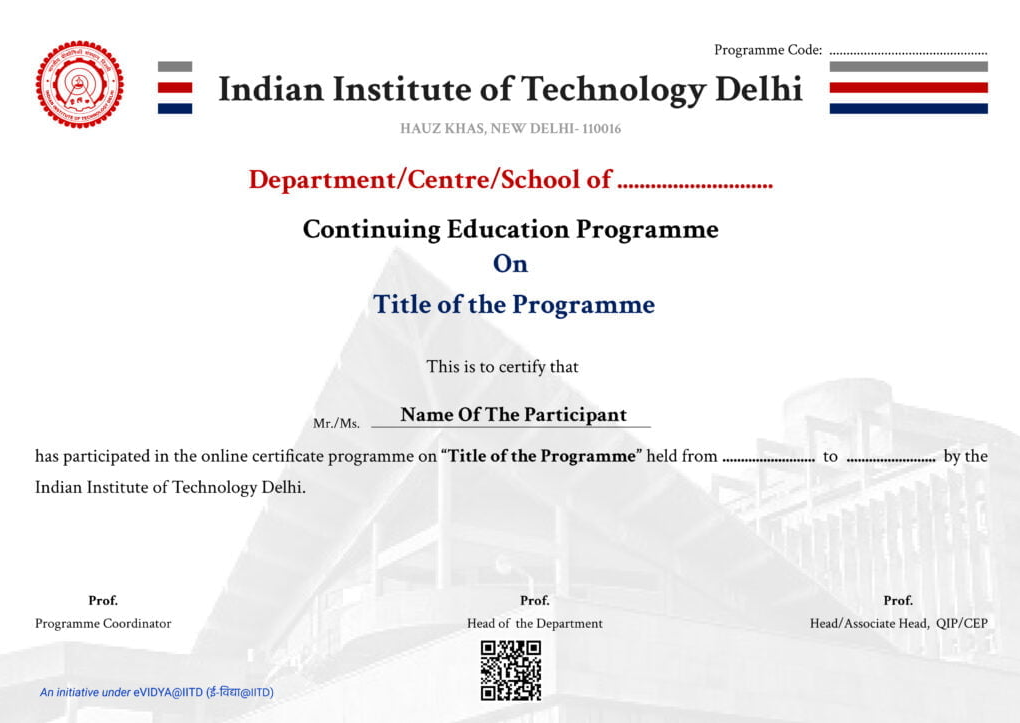
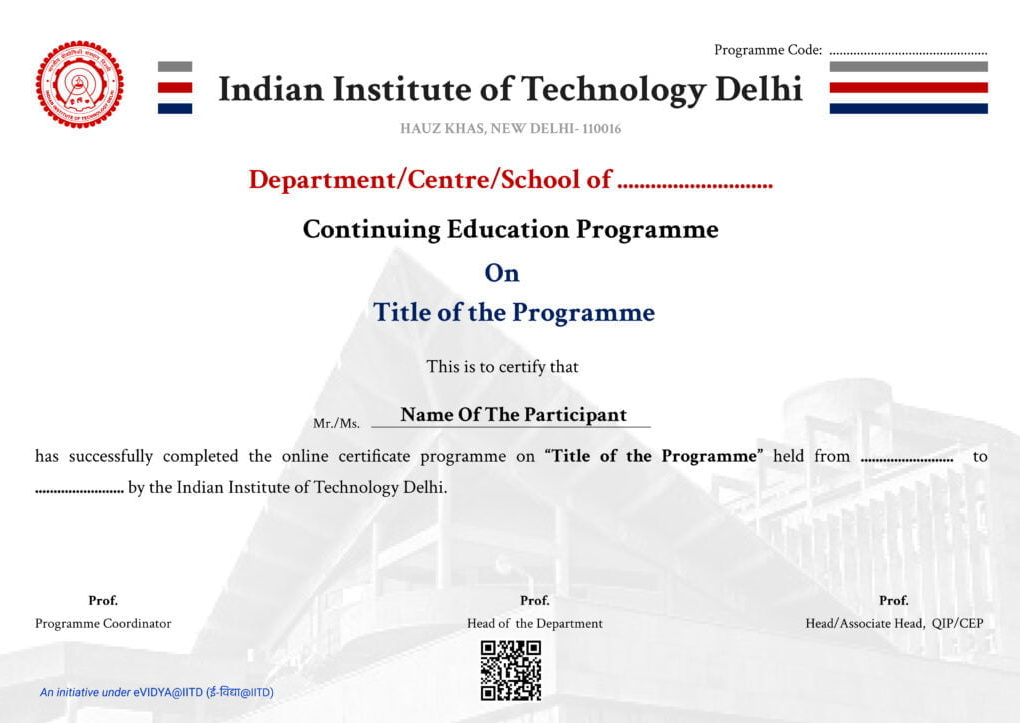
Candidates need to secure a minimum of 50% marks in the evaluation and maintain an overall attendance of 70% to be eligible for the 'Certificate of Successful Completion' from CEP, IIT Delhi.
Candidates who do not secure the minimum 50% marks in the evaluation but meet the attendance requirement shall be eligible for the 'Certificate of Participation' from CEP, IIT Delhi.
The organizing department of this programme is Department of Electrical Engineering.
*Only e-Certificates will be issued by CEP, IIT Delhi for this programme.
Installment Schedule
Programme Fee INR 1,45,000 + 18% GST
Instalment | Date | Amount (₹)** |
Application Fee | Application Fee | 1,000 + 18 % GST |
1st Instalment | Within 4 days of offer letter rollout | 50,000 + 18 % GST |
2nd Instalment | 3th February, 2027 | 50,000 + 18 % GST |
3rd Instalment | 3th March, 2027 | 45,000 + 18 % GST |
Note:
*GST @ 18% will be charged extra in addition to the fees
The application fee of INR 1,000/- + 18% GST is non-refundable and non-transferable. This fee is in addition to the programme fee and will not be adjusted against the total programme fee.
Refund Policy
Candidates can withdraw within 15 days from the programme start date. A total of 80% of the total fee received will be refunded. However, the applicable tax amount paid will not be refunded on the paid amount.
• Candidates withdrawing after 15 days from the start of the programme session will not be eligible for any refund.
• If you wish to withdraw from the programme, you must email to cepaccounts@admin.iitd.ac.in and icare@timespro.com, stating your intent to withdraw. The refund, if applicable, will be processed within 30 working days from the date of receiving the withdrawal request.
Frequently asked questions
The CEP, IIT Delhi Executive Certificate in Agentic AI Systems (Foundation to Deployment) is a 6-month programme designed to equip professionals with the skills to design, develop and deploy autonomous AI systems for real-world enterprise applications.
The CEP, IIT Delhi Executive Certificate in Agentic AI Systems (Foundation to Deployment) is suitable for graduates and working professionals with a technical background and an interest in Artificial Intelligence, Machine Learning, Generative AI or related domains.
The CEP, IIT Delhi Executive Certificate in Agentic AI Systems (Foundation to Deployment) covers LLM foundations, autonomous AI agents, multi-agent systems, Retrieval-Augmented Generation (RAG), AI TRiSM, LLMOps and production deployment.
The CEP, IIT Delhi Executive Certificate in Agentic AI Systems (Foundation to Deployment) is a 6-month programme delivered in a direct-to-device learning format.
Yes. The CEP, IIT Delhi Executive Certificate in Agentic AI Systems (Foundation to Deployment) includes practical learning and an end-to-end capstone project, enabling learners to apply agentic AI concepts to real-world use cases.
Generative AI primarily generates content or responses, while Agentic AI enables AI systems to autonomously reason, plan, use tools and execute multi-step tasks to achieve defined objectives. The programme focuses on building and deploying such agentic AI systems.