
Executive Programme for Quantum in ML & AI Systems (Batch 2)
Features
Programme Overview
AI is evolving faster than classical systems can support, and quantum technologies are redefining how machines learn, optimize, and interpret complex data.
The 6-month Executive Programme for Quantum in ML & AI Systems equips professionals with the essential foundations and applied skills needed to operate at this emerging intersection. Through focused modules covering quantum principles, advanced ML architectures, and quantum optimisation, participants gain a clear understanding of how quantum methods elevate intelligent system design.
₹ 1,50,000 + 18 % GST
Class Schedule
09:00 am - 12:00 pm, Sundays
Eligibility Criteria
B.Tech/BE, B.Sc/M.Sc (all streams), BCA/MCA, BA/MA Mathematics
Programme Highlights
E-Certificate Of Successful Completion From CEP, IIT Delhi
Academic Rigour Guided By IIT Delhi Faculty
Advanced Curriculum For The Quantum–AI Era
Skill Development For High-Demand Strategic Roles
Case Studies & Problem Solving
Hands-on Tools & Simulators
Capstone Project
Programme Modules
Topics Covered
Vector spaces, eigenvalues, SVD, tensor operations
Random variables, distributions, expectation, covariance
Bayesian inference and estimation
Supervised vs unsupervised ML, bias–variance trade-off
Optimization basics (gradient descent, convexity)
Case Study
Classical-to-Quantum Readiness Assessment
Participants analyze a classical ML pipeline (e.g., PCA + SVM for image/audio data) and identify components that can be mapped to quantum feature maps or kernels.
Topics Covered
Quantum states, Hilbert spaces, operators
Single- and multi-qubit gates
Quantum circuits and measurement theory
Noise models and decoherence
Data encoding: angle, amplitude, basis encoding
Variational Quantum Circuits (VQCs)
Hybrid quantum–classical training loops
Case Study
Quantum Feature Encoding for Multimodal Data
Design a quantum encoding pipeline for image or sensor data and study the impact of noise and measurement on learning performance.
Learners will pick one of these problems to solve
Audio event classification (speech vs noise, music vs speech)
Audio anomaly detection in machinery or environmental sounds
Short audio time-series classification using quantum feature maps
Handwritten digit classification using reduced-resolution images
Binary image classification (object present vs not present)
Topics Covered
Quantum kernels and kernel alignment
QSVM architectures
Quantum generative models (QGAN, QVAE, QBM)
Quantum diffusion concepts
Quantum vision models
Quantum RNNs, LSTMs, and Transformers
Circuit pruning and parameter reduction
Hardware-aware circuit compilation
Case Study
Quantum Kernel Advantage in Classification
Compare classical SVM and QSVM performance on high-dimensional datasets using quantum kernels and analyze scalability and expressivity.
Problems picked before will continue with these advanced architectures
Topics Covered
Combinatorial optimization basics
QUBO and Ising formulations
QAOA architecture and parameter optimization
Constraint handling in quantum optimization
Quantum annealing principles
Case Study
Resource Allocation via QAOA
Formulate a scheduling or routing problem as a QUBO model and solve it using QAOA or quantum annealing simulators.
Learners will pick one of these problems to work
Portfolio optimization problem using quantum optimization methods under risk and budget constraints.
Job scheduling across multiple machines to minimize total completion time using quantum optimization algorithms.
Partition a graph into optimal clusters by minimizing inter-cluster connections using quantum optimization methods.
Vehicle routing to minimize total travel distance under capacity constraints using quantum optimization.
Resource allocation among competing tasks by formulating the problem as a QUBO and solving it using quantum optimization.
Optimal sensor placement to maximize coverage under cost constraints using quantum optimization techniques.
Topics Covered
Hybrid quantum-classical learning workflows
Quantum hardware and noise considerations
Model performance and evaluation
Security, privacy, and trust in quantum-AI systems
Real-world applications and deployment challenges
Case Study
Federated Quantum Learning for Sensitive Data
Design a federated QML workflow where multiple nodes train a shared quantum model without exchanging raw data.
We will start the project which should integrate all the above learning.
Capstone Project
Description
Participants work on an end-to-end quantum AI problem integrating encoding, learning, optimization, and deployment considerations.
Example Capstone Themes
Quantum-inspired multimodal perception systems
Quantum optimization for healthcare or logistics
Secure federated quantum ML architectures
Qiskit | PennyLane | TensorFlow | D-Wave | PyTorch | VisualQuantum™
Purpose | Tool to Be Used | Rationale |
|---|---|---|
Quantum Circuit Design & Simulation | Qiskit (IBM Quantum) | Provides a complete environment to construct, visualize, and simulate quantum circuits; supports gate operations, measurement, noise models, and foundational quantum algorithm exploration. |
Hybrid Quantum–Classical Machine Learning | PennyLane | Enables implementation of variational circuits and hybrid ML models; integrates with classical ML frameworks for gradient-based optimization and advanced quantum ML workflows. |
Quantum Annealing & Optimization Concepts | D-Wave (Simulation + Conceptual) | Introduces quantum annealing principles and QUBO/Ising formulations; allows learners to test optimization workflows in a simulated setting without requiring hardware access. |
Quantum-Integrated ML Training Pipelines | PyTorch / TensorFlow (Hybrid Setup) | Used to combine classical neural networks with quantum layers for training hybrid models; supports backpropagation, optimization loops, and model evaluation. |
Quantum State Visualization & Experimental Insight | VisualQuantum™ | Offers intuitive, real-time visualization of quantum states, Bloch sphere trajectories, measurement statistics, phase behavior, and tomography; helps convert abstract theory into observable, interactive experiments. |
Learning Outcomes
Understand Quantum Principles for Intelligent Systems:
Develop a clear conceptual grounding in quantum states, qubits, superposition, entanglement, measurement and noise—specifically in the context of machine learning and computational intelligence.Implement Quantum Feature Encoding & Variational Circuits
Use data encoding methods such as amplitude, angle, and basis encoding, and construct variational quantum circuits (VQCs) for learning tasks.
Build Quantum-Enhanced ML Models
Design and evaluate QSVMs, quantum generative models, quantum sequence networks, and other quantum-augmented architectures for classification and modelling.Formulate & Solve Quantum Optimization Problems
Translate real-world challenges into QUBO/Ising formulations and apply QAOA or annealing-based methods for scheduling, allocation, routing, and portfolio optimization.Analyses Performance, Noise & Scalability Constraints
Assess how quantum hardware limitations, circuit depth, noise, and sampling affect model accuracy and how hybrid quantum-classical workflows can mitigate these factors.Design Secure & Distributed Quantum Learning Pipelines
Develop privacy-preserving and federated learning systems using quantum principles for secure multi-node computation and decision-making.Integrate End-to-End Quantum-AI Workflows
Combine encoding, modelling, training, optimisation, and deployment aspects into a complete quantum-enhanced pipeline suitable for research, prototyping, or industry-oriented applications.
Tools
D-Wave
Penny Lane
Py Torch
Qiskit
Tensor Flow
Visual Quantum
Programme Coordinator
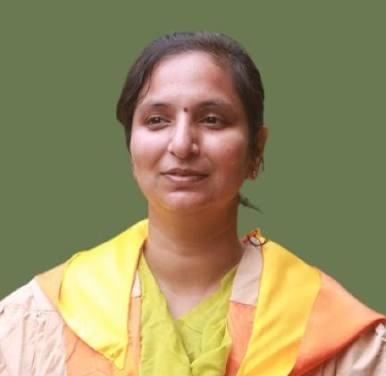
Professor Monika Aggarwal
Professor
Centre for Applied Research in Electronics
Indian Institute of Technology Delhi
Prof. Monika Aggarwal is a Professor at IIT Delhi with a strong background in signal processing, image processing and communication with growing research focus on quantum computing. She brings decades of experience in modeling, analysis, and computation across both classical and emerging computational paradigms.
Her academic and industrial journey includes working at Hughes Software Systems, Gurgaon, and at Uppsala University, Sweden. Her research spans diverse signal domains—ranging from biomedical and underwater acoustic signals, snow acoustic to medical imaging, multidimensional image data, and high-dimensional spatial and vector signals. Her work addresses fundamental challenges such as direction-of-arrival estimation, beamforming, inverse problems, and radar/sonar target detection, and many applications across engineering and healthcare domain.
Building on this strong foundation in high-dimensional systems, and signal representations, Prof. Aggarwal’s current passion lies in quantum computation, with particular interest in quantum information processing, quantum algorithms, and the convergence of signal processing, medical imaging, and quantum system.
Programme Sample Certificate
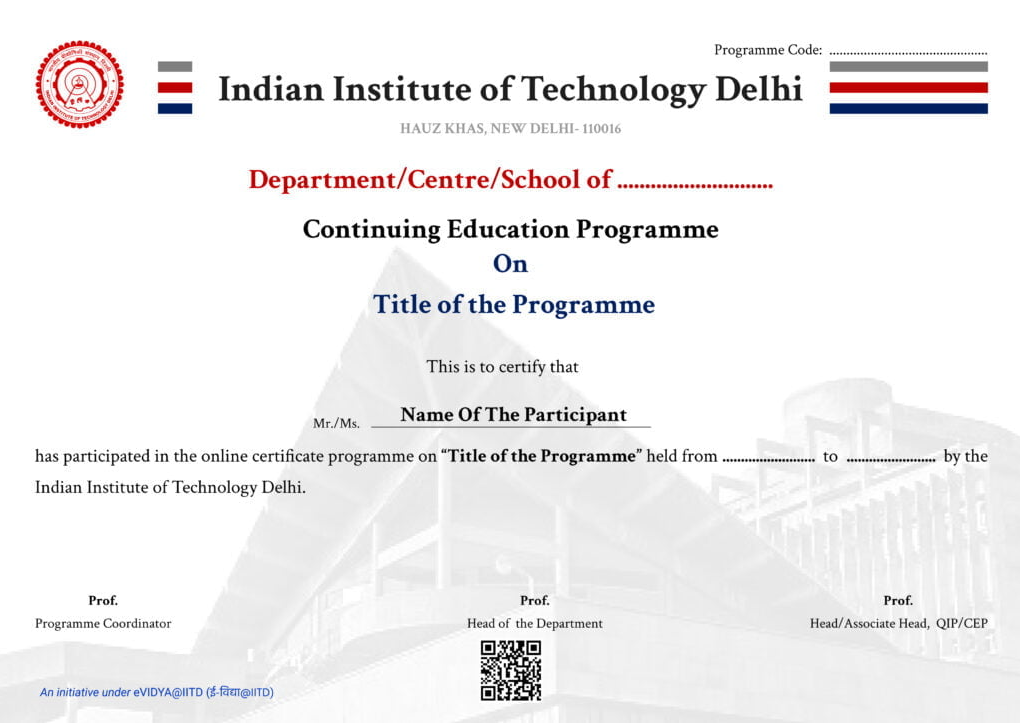
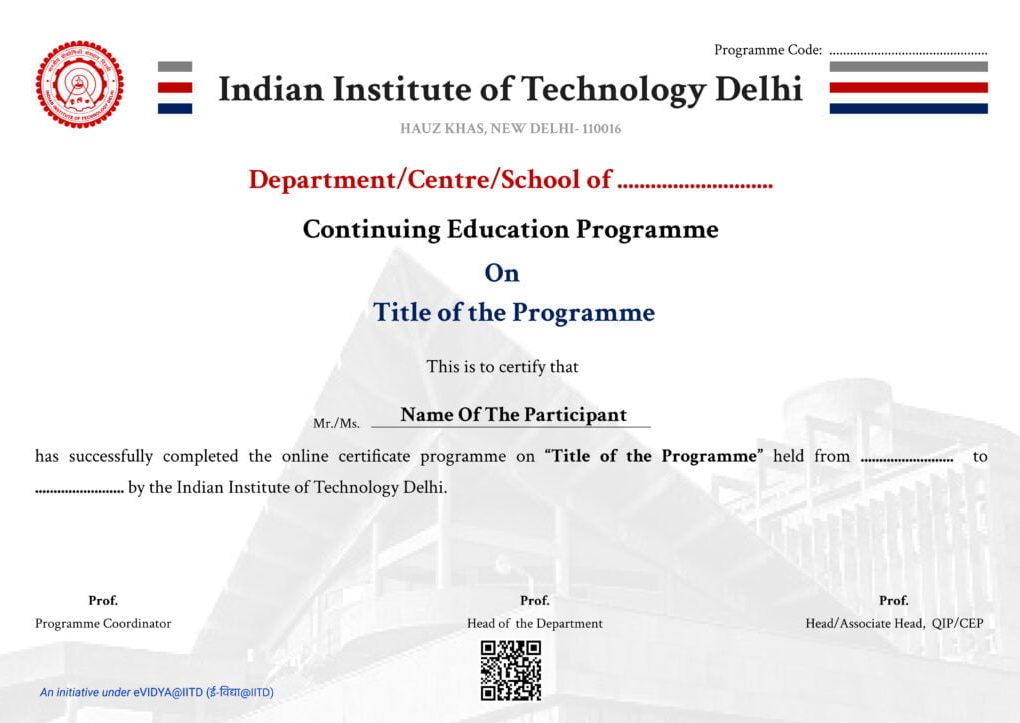
Participation Certificate
Awarded to those with at least 75% attendance.Successful Completion Certificate
Awarded to those with a minimum of 50% marks.The above e-certificate is for illustrative purposes only and the format of the e-certificate may be changed at the discretion of IIT Delhi.
Only e-certificate will be provided and it will be issued by CEP, IIT Delhi.
The organizing department of this programme is Bharti School of Telecommunications Technology and Management.
Installment Schedule
Programme Fees: 1,50,000 + 18 % GST
Installment | Installment Date | Amount (₹) |
I | Within 3 Days of the offer letter. | ₹ 75,000+ 18 % GST |
II | 16th January, 2027. | ₹ 75,000+ 18 % GST |
Note:
*All fees should be submitted in the IITD CEP account only, and the details will be shared post-selection.
*The receipt will be issued by the IIT Delhi CEP Account for your records, which can be downloaded from the CEP Portal.
*GST @ 18% will be charged extra in addition to the fee.
Refund Policy
Candidates can withdraw within 15 days from the programme start date. A total of 80% of the total fee received will be refunded. However, the applicable tax amount paid will not be refunded on the paid amount.
Candidates withdrawing after 15 days from the start of the programme session will not be eligible for any refund.
If you wish to withdraw from the programme, you must email cepaccounts@admin.iitd.ac.in and cepdelhi@digiversity.com, stating your intent to withdraw. The refund, if applicable, will be processed within 30 working days from the date of receiving the withdrawal request.
Frequently asked questions
It introduces participants to the combined domains of quantum computing and machine learning, teaching both foundational theory and practical application for intelligent systems.
Professionals, technologists, researchers, and graduates who want to deepen their competence in quantum artificial intelligence and explore its applications in complex system design and optimization.
No. The curriculum begins with core quantum concepts and systematically builds up to advanced topics within the context of quantum machine learning.
Yes. Participants gain hands-on exposure to tools such as Qiskit, PennyLane, D-Wave simulators, hybrid PyTorch/TensorFlow workflows, and interactive platforms like VisualQuantum.
Learners are assessed through quizzes, projects, and practical assignments designed to measure understanding of both conceptual and applied aspects of quantum computing and artificial intelligence.
Participants who meet the evaluation requirements will be awarded an e-Certificate of Successful Completion from CEP, IIT Delhi. Those who fulfil the minimum attendance requirement but do not meet the evaluation criteria will receive a Certificate of Participation.