
Executive Programme in Autonomous Robotics & AI
Features
Programme Overview
The Executive Programme in Autonomous Robotics & AI represents a paradigm shift in robotics education by uniquely integrating sensor-rich cyber-physical systems with autonomous intelligence. Unlike conventional robotics programs that treat AI and robotics as separate modules, this programme adopts a systems-level integration approach, emphasizing device-to-system co-design, hardware-software confluence, and deployment-ready engineering.
With the global robotics market projected to reach $160-260 billion by 2030 (BCG), industries demand professionals who can not only build robots but also design secure, energy-efficient, and intelligent autonomous systems that operate reliably in real-world environments. This programme addresses this critical gap by combining IITD's cutting-edge research in sensor-rich cyber-physical systems, edge intelligence, hardware security, and indigenous chip design with rigorous hands-on training.
₹ 1,60,000 + 18 % GST
Registration Closed
Class Schedule
Sunday 9:00 AM to 12:00 PM
Eligibility Criteria
Graduate B.Tech/BE/MSc/MCA/M.Tech in EE, ECE, CSE, ME, Mechatronics, Instrumentation, Physics, or related fields
Minimum 1 year of work experience
Programme Highlights
Industry-First: Agentic AI Integration In Robotics Education
End-to-End: Production Deployment Pipeline (Simulation - Edge AI)
Multi-Agent & Swarm Robotics For Defense And Industrial Applications
Progressive Capstone Project: Portfolio-Ready Autonomous System
Direct Access To Enterprise-Grade Industry Platforms
Campus Immersion For One Day
Programme Modules
Robotics ecosystem and introduction to cyber-physical systems
System-level architecture of robotic platforms
ROS2 fundamentals and programming (Python/C++)
Robot kinematics (forward and inverse), dynamics, and workspace analysis
Actuators, sensors, and mechatronic integration
Computer vision for robotics using OpenCV
Depth perception and multi-view geometry
Sensor fusion using LiDAR, IMU, and cameras
State estimation using Kalman filters and particle filters
SLAM (Simultaneous Localization and Mapping)
Event-based vision and neuromorphic sensing principles
Feedback control: PID, state-space methods, and adaptive control
Trajectory generation and path optimization
Motion planning for mobile and articulated robots
Model Predictive Control (MPC) for autonomous navigation
Human-robot interaction and collaborative robotics
ROS2 architecture, middleware, and communication models
Building perception stacks in ROS2
Navigation, localization, and planning frameworks
Manipulation pipelines and control integration
Simulation, testing, and validation using modern robotics simulators
Deep learning for robotics: CNNs, RNNs, and Transformers
Reinforcement learning: DQN, PPO, and Actor-Critic methods
Imitation learning and transfer learning for robotics
Vision-language models for robotic manipulation and task planning
Hardware security fundamentals for cyber-physical systems
Security vulnerabilities in robotic and autonomous systems
Secure boot, trusted execution, and encrypted communication
Resilient system design for fault tolerance and safety-critical operation
Case studies from real-world robotic deployments
End-to-end autonomous system design and deployment pipeline
Transition from simulation to real-world deployment
Energy harvesting and power-aware robotic systems
Multi-robot coordination and swarm robotics
Domain-specific applications:
Healthcare robotics and biomedical wearables
Defense and surveillance systems
Industrial automation and collaborative robots
Agricultural and space robotics
Indigenous technology development and deployment roadmap
Campus Immersion Module
(Optional things that can be covered)
Day 1: Hardware Integration Workshop - Industry Interaction & Valedictory
Note: The list of modules provided is subject to change and may be updated or revised based on the discretion of the professors or instructors.
Learning Outcomes
System-Level Thinking: Develop holistic understanding of autonomous systems from materials to algorithms, emphasizing cross-layer optimization and co-design principles.
Hardware-Software Integration: Master the integration of sensor technologies, embedded computing, edge AI, and secure hardware design for robust autonomous operation.
Deployment Readiness: Equip professionals with skills to translate prototypes into field-ready systems through rigorous testing, validation, and reliability engineering.
Indigenous Technology Leadership: Foster capabilities in developing Atmanirbhar autonomous systems leveraging indigenous chip design and semiconductor process understanding.
Security-First Design: Integrate hardware security, resilience, and safety considerations from the ground up in autonomous system design.
Tools
Python
Tensor Flow
Open CV
Programme Coordinator

Professor Santhosh Sivasubramani
Assistant Professor
Centre for Sensors, Instrumentation and Cyber Physical System Engineering
Indian Institute of Technology Delhi
Prof. Santhosh Sivasubramani is a Faculty at the Centre for Sensors, Instrumentation and Cyber Physical System Engineering (SeNSE), IIT Delhi, and Director of the INTRINSIC Lab (Intelligent Robotics & Rebooting Computing Chip Design Laboratory). He holds a Ph.D. from IIT Hyderabad with research recognized by the IEEE International Roadmap for Devices and Systems. Prof. Sivasubramani serves as an Elected Member of the IEEE Educational Activities Board Continuing Education Committee (EAB CEC) and Board of Governors Member for IEEE Continuing Education Program, bringing global standards in continuing education to this programme. He also serves as Secretary of the IEEE Nanotechnology Council Standards Committee and Vice Chair of IEEE NTC Young Professionals. With 17 patents (8 Indian, 9 US - including 7 granted), a published book on nanoscale computing (Wiley-IEEE Press, 2024), and extensive industry and academic experience at Silicon Labs, Ceremorphic, and the University of Edinburgh, he leads cutting-edge research in autonomous systems, nanomagnetic logic, AI for electronics, and multi-agent robotics. The INTRINSIC Lab maintains strategic partnerships with NVIDIA, ARM, Google Cloud, Intel, and AMD, providing students with access to industry-leading platforms for hands-on learning in autonomous robotics and AI-driven systems.
Programme Sample Certificate
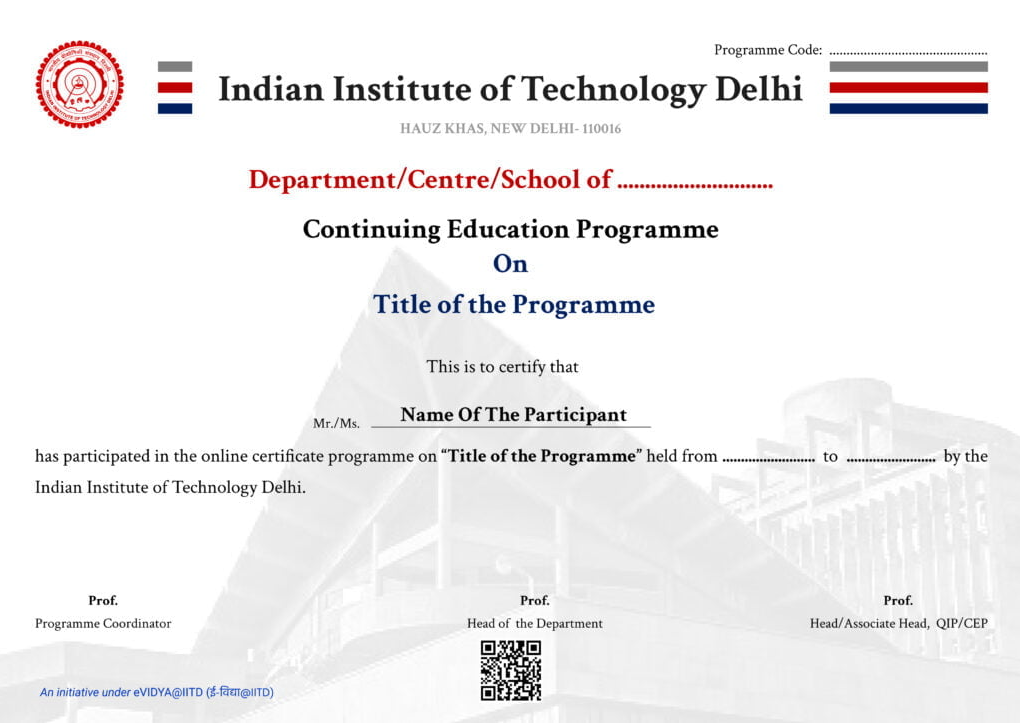
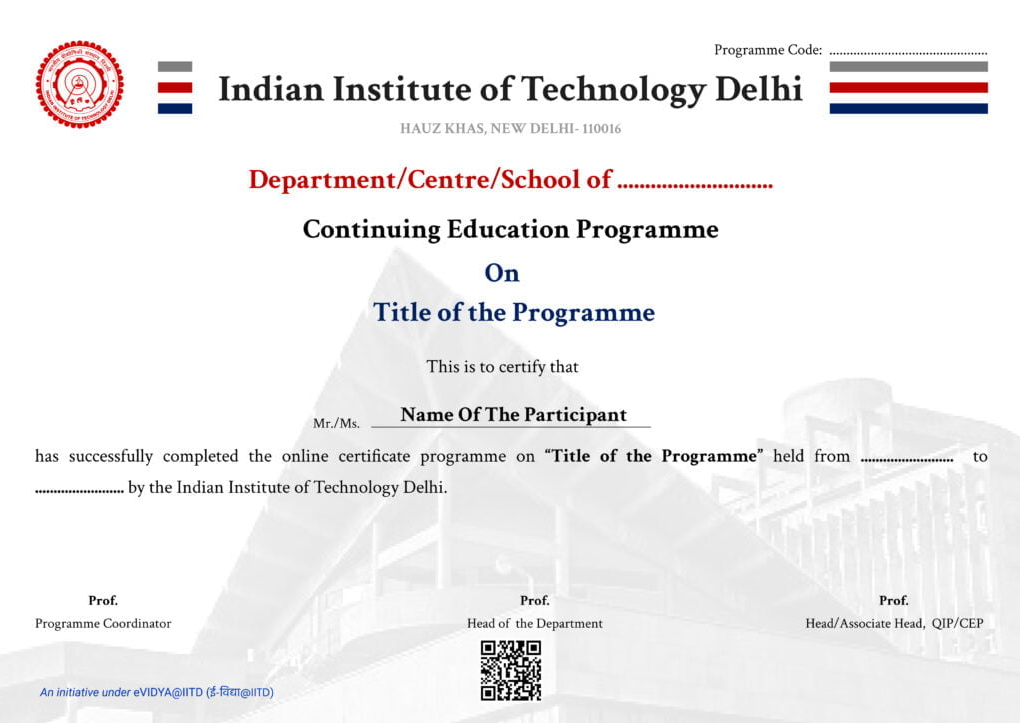
Certification of Completion: Participants who receive at least 50% in the evaluation will receive a 'Certification of Completion.'
Participation Certificate: Participants who do not meet the evaluation criteria (50%) but meet the attendance requirements will be presented with a 'Participation Certificate.'
Note:
The above e-certificate is for illustrative purposes only and the format of the e-certificate may be changed at the discretion of IIT Delhi.
Only an e-certificate will be provided, and it will be issued by CEP, IIT Delhi.
The organizing department of this programme is the Centre for Sensors Instrumentation & Cyber-Physical Systems Engineering, IIT Delhi.
Installment Schedule
Programme Fees: 1,60,000 + 18 % GST
Installment | Installment Date | Amount (₹) |
I | Immediate, within 3 days of offer rollout | ₹ 80,000 +18% GST |
II | 2nd September, 2026 | ₹ 80,000 + 18% GST |
Note:
Payment of fees should be submitted to the IIT Delhi CEP account only. The receipt will be issued by the IIT Delhi CEP accounts team and can be downloaded from the CEP Portal.
The application fee of INR 1,000/- plus 18% GST is non-refundable and non-transferable. This fee is in addition to the programme fee and will not be adjusted against the total programme fee.
Refund Policy
Candidates can withdraw within 15 days from the programme start date. A total of 80% of the total fee received will be refunded. However, the applicable tax amount paid will not be refunded on the paid amount.
Candidates withdrawing after 15 days from the start of the programme session will not be eligible for any refund.
If you wish to withdraw from the programme, you must email cepaccounts@admin.iitd.ac.in and crm.supportiitd@jaro.in, stating your intent to withdraw. The refund, if applicable, will be processed within 30 working days from the date of receiving the withdrawal request.
Frequently asked questions
This programme is designed to help professionals build expertise in robotics, artificial intelligence, and autonomous systems. Delivered by Indian Institute of Technology Delhi, it combines theoretical concepts with real-world applications to prepare learners for future-ready tech roles.
This programme is ideal for:
Working professionals in tech or engineering
AI/ML enthusiasts looking to upskill
Robotics professionals
Graduates aiming to enter the AI & automation domain
Basic programming knowledge (preferably Python) is helpful, but not mandatory. The programme is structured to take you from foundational to advanced concepts.
The programme typically runs for a few months (exact duration may vary by batch), with a structured schedule that allows working professionals to learn alongside their jobs.
The programme is usually delivered in an online or hybrid format, including:
Live interactive sessions
Recorded lectures
Assignments and projects
You will develop skills in:
Robotics fundamentals
Machine Learning & AI
Computer Vision
Autonomous navigation
Real-world problem-solving using AI
Yes, the programme includes hands-on projects and case studies to help you apply your learning in real-world scenarios, including a capstone project.
You will gain exposure to industry-relevant tools such as:
Python
ROS (Robot Operating System)
TensorFlow
OpenCV
Yes, upon successful completion, you will receive a certificate from Indian Institute of Technology Delhi, which adds strong credibility to your professional profile.
This programme prepares you for roles such as:
Robotics Engineer
AI Engineer
Automation Specialist
It enhances your profile with in-demand skills aligned with the future of technology.