
Executive Programme in Robotics (Batch 04)
Features
Programme Overview
We are living in an era where robots are no longer futuristic—they are essential. From healthcare and automotive to defense, logistics, and space exploration, robotics is transforming industries at an unprecedented pace. With the convergence of AI, IoT, rapid prototyping, and cloud computing, the demand for skilled robotics professionals has never been higher.
The Executive Programme in Robotics (Batch 04), offered by the prestigious CEP IIT Delhi, equips learners with the theoretical foundation and practical expertise to design, build, and deploy robotic systems. This first-of-its-kind programme combines IIT Delhi’s academic excellence, and industry expertise from top robotics companies in India & the USA—delivering a truly future-ready learning experience.
₹ 1,69,000 + 18 % GST
Class Schedule
Every Saturday + Biweekly Sundays | Time: 10:00 AM – 2:30 PM
Eligibility Criteria
Graduation (Bachelor's degree with min. 50% marks).
Programme Highlights
Learn Directly From IIT Delhi Faculty (Invited And Guest Lectures From Leaders And Scientists In Top Robotics Companies And Startups.)
Build One Functional Robot From Scratch As Part Of The Programme.
40 % Theory + 60% Practical For Balanced, Application-oriented Learning.
Master Robotics Operating System (ROS), AI/ML In Robotics, Physical AI And CAD Design.
Exposure To Cutting-edge Tools: Embedded Computing, 3 D Printing, Sensor And Actuator Interfacing.
Optional 1 -day Campus Immersion At IIT Delhi* With A Valedictory Ceremony.
Programme Modules
Introduction to robotics in industry and society, historical perspectives
Classification of robots and overview of current research in robotics, applications of AI/ML
Robotics market, current challenges, and opportunities
System-level architecture of robots – Levels of autonomy
Fundamental concepts of robots – Components, joints, coordinate systems, workspace
Kinematics and kinetics of robots
Dynamics of a robot – Trajectory and path
Learning Outcomes:
Learn about the state of the art of robotics and the opportunities
Understand the principles of design and functioning of robot
Role of interoceptive and exteroceptive sensing
Position, velocity, and acceleration sensors
Force and torque sensing
Robotic tactile sensors and soft haptics
Non-contact sensing using ultrasonic, LIDAR, and RADAR
Camera-based robotic sensing and machine vision
Computational models and methods for processing sensor information
Learning Outcomes:
Learn about the fundamentals of robotic sensing in-depth
Understand implementation strategies for robotic sensing
Role and characteristics of robotic actuators
Electrical motors – Servos, stepper motors and drive mechanisms
Pneumatic and hydraulic actuators
Soft robotic actuators
Electroactive polymers, shape memory actuators, and emerging paradigms
Biomimetic actuators, artificial muscle technology and wearable actuators
Role of 3D printing and mechanical testing in robotic fabrication
Learning Outcomes:
Learn how to make a robot move and perform key tasks
Understand mechanical and electrical aspects of robotics
Localisation, navigation, and environment representation
Designing of robotic components using CAD
Introduction to Robot Operating System (ROS)
3D robot modelling, motion planning, and simulation in ROS
Interfacing hardware and sensors to ROS
Introduction to the role of machine learning in robotics – Software architecture, behavior-based systems
Neural networks and genetic algorithms in robotics
Introduction to Deep Learning and applications in robotics
Learning Outcomes:
Learn how to design and strategize movement of a robot
Learn applications of AI and Machine Learning in robotics
Introduction to embedded computing and control
Introduction to embedded hardware platforms – Arduino and Raspberry Pi
Programming and interfacing of sensors and actuators
Wired and wireless communication systems – MODBUS, CAN, and other paradigms
Multi-tasking and closed-loop control of robots
Learning Outcomes:
Learn software development for robotic control
Learn about key sensing and interfacing techniques for robotic functionalisation
Introduction to biorobotics and bionics – Exoskeleton device, prosthetics and surgical robotics
Humanoid robots – Future directions in automation
Human-Robot Interaction (HRI) and Collaboration – Collaborative robotics
Manufacturing automation using industrial robots – The next industrial revolution
Safety standards in industrial robotics
Roboethics: Navigating the ethical use and pitfalls of robotics and AI
Learning Outcomes:
Learn about a range of robotic applications in research and industry
Understand about standards and ethics associated with robotics and AI
Learning Outcomes
Construct robotic devices mechanically and electronically from scratch.
Develop and implement robotic programmes using programming languages commonly used in the robotics industry.
Effectively operate a variety of sensors and actuators, understanding their significance in robotics.
Utilise the Robotics Operating System (ROS) to design, control, and coordinate robotic systems and networks.
Understand the principles of robotic vision and how to apply visual sensors in robotics applications.
Tools
ARDUINO
Raspberry Pi
Python
3 D
ROS 2
Programme Coordinator

Professor Biswarup Mukherjee
Associate Professor
Centre for Biomedical Engineering
Indian Institute of Technology Delhi
Prof. Biswarup Mukherjee is an Associate Professor at the Centre for Biomedical Engineering, IIT Delhi with joint appointment at the Department of Biomedical Engineering at AIIMS, New Delhi. He is also an affiliate faculty at the Yardi School of AI, IIT Delhi and Department of Bioengineering, George Mason University, USA. His research effort is focused towards developing multi-modal platform technologies for bionic and bio robotic control.
He obtained a PhD in Electrical Engineering from IIT Madras in 2015. Thereafter, he was a postdoctoral research fellow at Harvard Medical School and Massachusetts General Hospital (MGH), Boston, USA from 2015 to 2017. He was a Research Assistant Professor with the Department of Bioengineering at George Mason University from 2017 to 2020. He was also an affiliate faculty at the Center for Adaptive Systems of Brain-Body Interactions at Mason.
His has multiple US and Indian patents and has published extensively in top-tier journals. He currently serves as an Associate Editor for IEEE Transactions on Medical Robotics and Bionics and on the editorial board of Nature Scientific Reports. His work has received several awards including Best PhD thesis award at IIT Madras, Innovation Discovery Award at MGH and multiple best paper awards at top conferences worldwide.

Professor Arnab Chanda
Associate Professor
Centre for Biomedical Engineering
Indian Institute of Technology Delhi
Prof. Arnab Chanda is an Associate Professor in the Centre for Biomedical Engineering, IIT Delhi, and a joint faculty at the Department of Biomedical Engineering, AIIMS, Delhi. He is also the founder of a start-up company BIOFIT Technologies LLC, USA. He obtained his PhD from the University of Alabama, USA and has also been a Postdoctoral Researcher at the University of Pittsburgh, USA.
Prof. Chanda is an expert in biomechanics, robotics, and wearable device development. From an upper-limb exoskeleton device development for rehabilitation of patients with spinal cord injury, to rapid manufacturing of ultra low-cost pressure measurement insoles for diabetic patients, Prof. Chanda has been extensively involved in conception-to-delivery of robotic devices. Recently, his lab developed the first portable robotic slip testing device in the world which can measure the frictional performance of any footwear-flooring combination and prevent the incidences of slips and falls. His research has received a lot of media attention and have been published by The Times of India, NDTV, and The Indian Express.
Prof. Chanda is a recipient of the Early Career Faculty Research Award, and Young Researcher awards from ASME and MHRD and AO Spine International-Singapore. He has 10+ US and Indian Patent applications and has authored 4 Books and 100+ articles in reputed international journals. Prof. Chanda is in the list of top 2% scientists worldwide as per Scopus Elsevier 2023 database. He is also serving as the editor for a book series published by Springer Nature, editorial board member for Nature Scientific Reports, coordinator of the “Executive Programme in Healthcare Entrepreneurship and Management”, and guest editor for several journals such as Frontiers in Bioengineering and Biotechnology, and Engineering Research Express, IOP Publishing.
Programme Sample Certificate
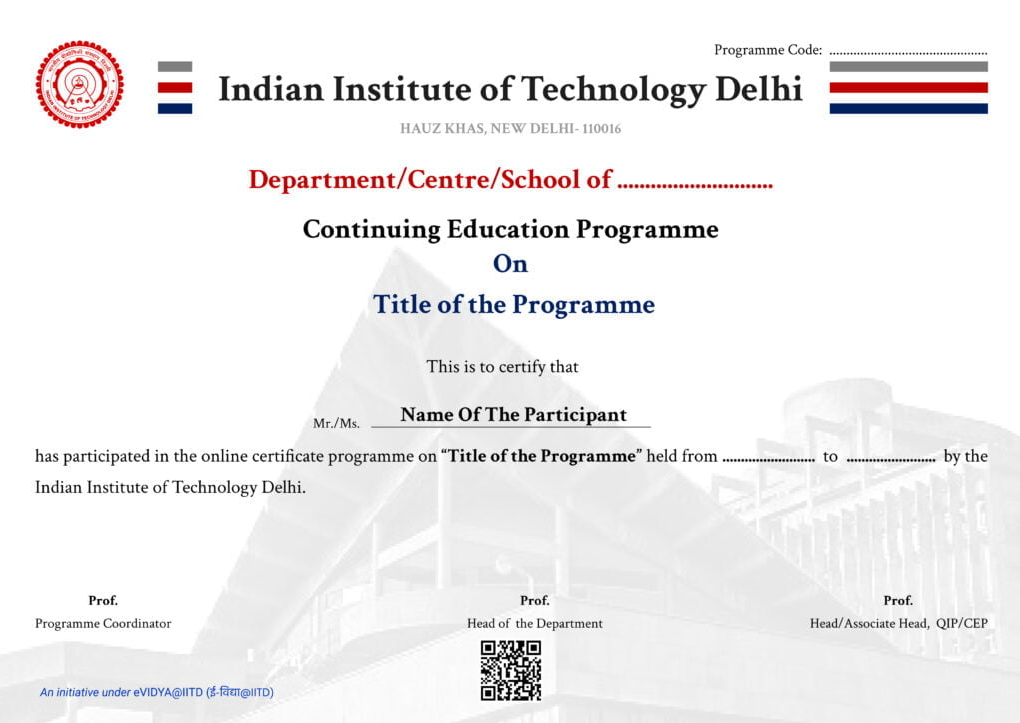
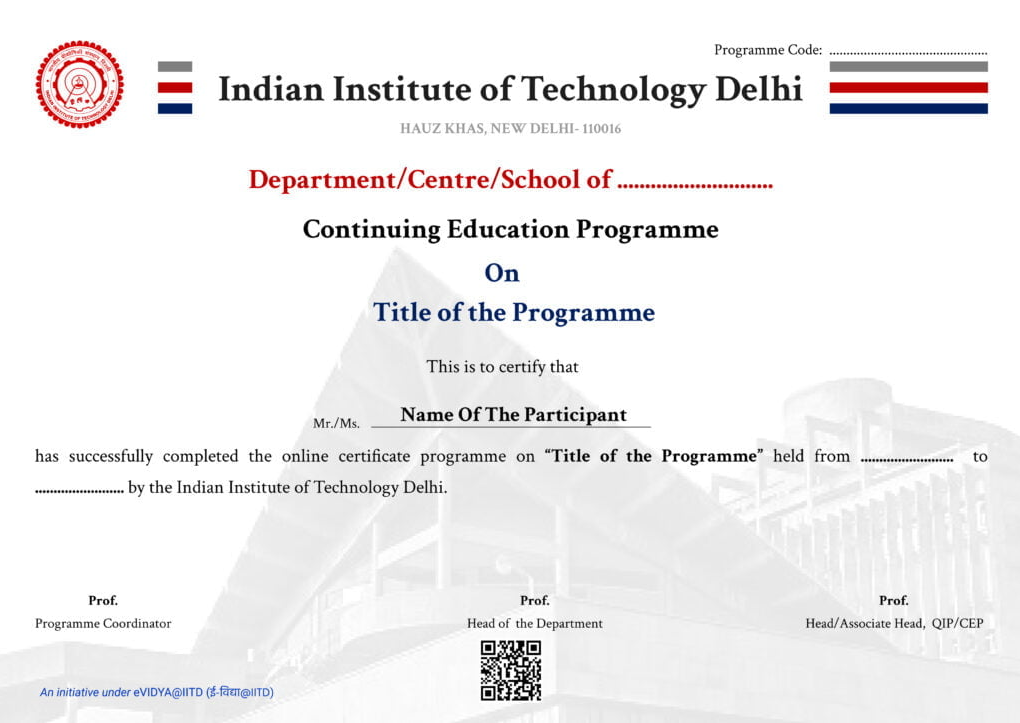
Candidates who score at least 50% marks overall and have a minimum attendance of 50% will receive a ‘Certificate of Successful Completion’.
Candidates who score less than 50% marks overall and have a minimum attendance of 50% will receive a ‘Certificate of Participation’.
The organising department for this programme is the Centre for Biomedical Engineering, IIT Delhi.
Only e-Certificates will be issued by CEP, IIT Delhi for this programme.
Installment Schedule
Programme Fees: 1,69,000 + 18 % GST
Instalment | Instalment Date | Amount (₹)* |
Application Fee* | To be paid at the time of Application | 1,000 |
1st Installment | Within 4-days of offer letter rolled out | 59,000 |
2nd Installment | 06th March, 2027 | 55,000 |
3rd Installment | 06th April, 2027 | 55,000 |
Note:
| ||
Refund Policy
Candidates can withdraw within 15 days from the programme start date. A total of 80% of the total fee received will be refunded. However, the applicable tax amount paid will not be refunded on the paid amount.
Candidates withdrawing after 15 days from the start of the programme session will not be eligible for any refund.
If you wish to withdraw from the programme, you must email cepaccounts@admin.iitd.ac.in and icare@timespro.com stating your intent to withdraw. The refund, if applicable, will be processed within 30 working days from the date of receiving the withdrawal request.
Testimonials
Frequently asked questions
The CEP, IIT Delhi Executive Programme in Robotics provides hands-on exposure to robotics technologies, including sensors and perception, actuators, motion control, embedded systems, ROS, AI/ML and robotic system development. Participants also get an opportunity to build a functional robot, gaining practical experience with tools such as Arduino, Raspberry Pi, CAD and 3D printing.
Yes. The CEP, IIT Delhi Executive Programme in Robotics is designed to build knowledge from the fundamentals of robotics and automation while progressively introducing advanced concepts and practical applications. Professionals from relevant technical and interdisciplinary backgrounds can use the programme to develop a structured understanding of robotics.
The CEP, IIT Delhi Executive Programme in Robotics follows a blended learning approach with approximately 40% theory and 60% practical learning. Participants learn core robotics concepts and apply them through hands-on activities, tools, projects and real-world applications.
Yes. The CEP, IIT Delhi Executive Programme in Robotics covers AI and Machine Learning as part of its robotics curriculum, helping participants understand how intelligent technologies can be integrated with robotic systems for applications involving perception, decision-making and automation.
The CEP, IIT Delhi Executive Programme in Robotics develops skills relevant to industries adopting robotics and automation, including manufacturing, automotive, healthcare, logistics, agriculture and other technology-driven sectors. The programme can help professionals understand how robotic systems can be designed and applied to industry-specific use cases.
Yes. The CEP, IIT Delhi Executive Programme in Robotics includes practical learning and project-based exposure, including the development of a functional robot. Participants work with technologies such as CAD, Arduino, Raspberry Pi, 3D printing and ROS to gain practical experience in building and working with robotic systems.