
Online PG Diploma in Advanced Communication Engineering with Quantum and AI Integration
Features
Programme Overview
The Online Postgraduate Diploma in Advanced Communication Engineering with Quantum and AI Integration is designed to equip professionals with advanced knowledge and practical skills at the convergence of three transformative technologies: Artificial Intelligence (AI), Quantum Networking, and Wireless Communications. This multidisciplinary programme blends theoretical concepts with hands-on applications, enabling learners to tackle complex challenges in modern telecommunications, intelligent systems, and secure network infrastructures.
By integrating machine learning, advanced wireless communication systems, quantum communication protocols, and secure networking techniques, the programme empowers participants to stay ahead in the rapidly evolving tech landscape.
🡢 Click here for the latest batch
₹ 4,40,000 + 18 % GST
Registration Closed
Class Schedule
Duration: 12 Months
Total Learning Hours: 368+ hours
Total Recorded Hours: 270 Hours
Hours for Projects/Assignments: 60 Hours of Capstone Project and 30 Hours of Assignments (appox.)
Class Timings: Every Saturday and Sunday, 10:00 AM onwards
Eligibility Criteria
BE/BTech/MSc/MCA graduates in Electronics & Communication Engineering (ECE), Electrical Engineering (EE), Computer Science & Engineering (CSE), Information Technology (IT), Applied Physics / Engineering Physics, Telecommunications Engineering, Mathematics / Applied Mathematics, Data Science / AI & ML or closely related academic disciplines with minimum 60% marks and 6 CGPA
Working professionals having greater than 2 years of experience with minimum 55% marks or 5.5 CGPA
Working professionals having greater than 5 years of experience with minimum 50% marks or 5 CGPA
Programme Highlights
Online PG Diploma From Prestigious IIT Delhi
Gain Affiliate Alumni Status From IIT Delhi
First-Of-Its-Kind Curriculum Combining AI, Quantum Networking, And Advanced Wireless Communications
Rich Peer Group Learning And Networking
Earn Up To 27 Credits From IIT Delhi, Which Can Be Saved In The Academic Bank Of Credits (ABC)
Industry-Relevant 60 Hours Capstone Project
Hands-On Lab Experience
1 Day Campus Immersion Opportunity
Programme Modules
Supervised and unsupervised learning
Neural networks and deep learning
Reinforcement learning for network optimisation
ML for signal processing and noise reduction
AI-driven network traffic prediction and anomaly detection
Application of ML in 5G and IoT systems
Learning Outcomes
Understand supervised and unsupervised learning, deep learning, and reinforcement learning.
Apply machine learning for signal processing, noise reduction, and network traffic prediction.
Implement AI-driven anomaly detection in communication systems.
Explore ML applications in 5G/6G and IoT networks for performance optimization
Cellular network evolution (4G, 5G, and 6G)
Channel modeling and estimation
Modulation and coding schemes
Interference management techniques, IoT/M2M communication protocols
Spectrum efficiency and resource allocation
Learning Outcomes
Explain cellular network evolution (4G, 5G, 6G) and their technical advancements. Understand channel modeling, modulation, coding, and spectrum efficiency in wireless networks.
Develop interference management techniques for IoT/M2M communication.
Analyse resource allocation strategies for optimising wireless communications
Quantum entanglement and teleportation in communication
Quantum key distribution (QKD) protocols
Quantum repeaters and networking nodes
Integration of Quantum systems with classical networks Applications of Quantum communication in secure networks
Learning Outcomes
Understand the principles of quantum entanglement and quantum key distribution (QKD).
Analyse the role of quantum repeaters and quantum networking nodes in secure communication.
Explore hybrid classical-quantum networking models for data security.
Study real-world applications of quantum communication in secure networks.
Quantum entanglement and teleportation in communication
Quantum key distribution (QKD) protocols
Quantum repeaters and networking nodes
Integration of Quantum systems with classical networks
Applications of Quantum communication in secure networks
Learning Outcomes
Learners will understand key concepts of quantum communication, including entanglement, teleportation, and Quantum Key Distribution (QKD) protocols for secure data transmission. They will explore the role of quantum repeaters and networking nodes in enhancing communication efficiency and analyse the integration of quantum systems with classical networks.
Introduction to Space-Time Diversity
MIMO Channel
MIMO Information Theory
Error Probability analysis
Transmit Diversity and space time coding
Linear STBC design
Differential coding for MIMO
Precoding
Multiuser MIMO
Massive MIMO
Recent advancement in MIMO
Learning Outcomes
Understand the fundamentals of MIMO systems, spatial multiplexing, and diversity gain.
Implement MIMO systems for improved spectral efficiency and network reliability.
Develop real-time signal processing techniques for 5G/6G networks.
Test and analyse advanced beamforming techniques in wireless communication.
Key 5G technologies
5G numerology
5G frame structure
Physical downlink shared channel(PDSCH)
Physical Downlink Control Channel(PDCCH)
Tansmit chain
Demoulation reference signal(DM-RS)
Sounding Reference Signal(SRS)
MIMO in 5G
Learning Outcomes
Gain expertise in Software-Defined Radios (SDRs) and their applications.
Explore Massive MIMO for mmWave and sub-6GHz bands for 5G/6G networks.
Analyse energy-efficient and green communication strategies in wireless networks.
Implement advanced beamforming algorithms for better network performance.
Advanced quantum error correction codes
Post-quantum cryptographic algorithms
Hybrid classical-quantum communication systems
Fault-tolerant quantum network designs
Quantum-enhanced protocols for secure data transmission
Learning Outcomes
Understand advanced quantum error correction codes and post-quantum cryptography.
Explore hybrid classical-quantum communication systems for secure data transmission.
Design fault-tolerant quantum network architectures for real-world applications.
Implement quantum-enhanced security protocols for future communication systems.
Practical project work on quantum communication, network security, or advanced wireless systems
Hands-on experimentation with quantum key distribution (QKD), hybrid classical-quantum systems, and testing of new communication protocols.
Learning Outcomes
Apply theoretical concepts to practical projects in quantum communication, network security, or advanced wireless systems.
Gain hands-on experience with Quantum Key Distribution (QKD), hybrid classical-quantum systems, and the testing of new communication protocols.
Enhance problem-solving skills, research capabilities, and technical proficiency in cutting-edge communication technologies.
Online PG Diplomas are the academic programme of IIT Delhi, and there is no campus placement or assistance provided from IIT Delhi in these programmes.
The evaluation of minor projects is subject to the faculty's discretion, based on academic guidelines and instructional objectives. Assessment criteria may vary depending on the nature of the project and its alignment with the course framework.
Learning Outcomes
Quantum Communication Engineer – Develop secure communication systems using quantum mechanics principles.
AI & ML Engineer (Telecom & Networking) – Design AI-driven solutions to optimize telecom and networking systems.
Wireless Communication Engineer – Work on advanced wireless technologies, including 5G/6G and IoT connectivity.
Network Security Engineer (Post-Quantum Cryptography) – Implement cryptographic solutions to safeguard networks against quantum threats.
Software-Defined Radio (SDR) Engineer – Develop flexible radio communication systems using software-based signal processing.
Telecommunications Consultant – Provide expert guidance on telecom infrastructure, strategy, and emerging technologies.
Research Scientist (AI & Quantum Communication) – Conduct cutting-edge research at the intersection of AI, telecom, and quantum communication.
IoT & Edge Computing Engineer – Design and deploy intelligent, low-latency IoT and edge computing solutions.
Cybersecurity Specialist (Quantum-Safe Networks) – Secure communication networks using quantum-resistant security frameworks.
5G/6G Network Engineer – Develop and optimise next-generation mobile networks for ultra-fast, reliable connectivity.
Tools
Machine Learning
AI
Python
Programme Coordinator

Professor Manav Bhatnagar
Professor
Department of Electrical Engineering
Indian Institute of Technology Delhi
Prof. Manav Bhatnagar is currently a Professor with the Department of Electrical Engineering, IIT Delhi, New Delhi, India, where he is also a Brigadier, Bhopinder Singh Chair Professor. He holds a global rank of 517 in the area of Networking and Telecommunications and features are among the top 2% of scientists in a global list compiled by the prestigious Stanford University. He is a Fellow of IET, INAE, NASI, IETE, and OSI. He has received the prestigious NASI-Scopus Young Scientist Award, the Shri Om Prakash Bhasin Award, and the Dr. Vikram Sarabhai Research Award. He has been an Editor of the IEEE Transactions on Wireless Communications from 2011 to 2014. Currently, he is an Editor of the IEEE Transactions on Communications. He has published more than 100 high-quality IEEE journal papers, of which 10 are single-authored. His research interests include signal processing for MIMO systems, free-space optical communication, satellite communications, and machine learning.

Professor Abhishek Dixit
Associate Professor
Department of Electrical Engineering
Indian Institute of Technology, Delhi
Prof. Abhishek Dixit received his M.Tech. degree in Opto-electronics and Optical Communication from the Indian Institute of Technology (IIT) Delhi in 2010, and his Ph.D. in Computer Science Engineering from the Department of Information Technology (INTEC), Ghent University, Belgium, in 2014. He is currently an Associate Professor in the Department of Electrical Engineering at IIT Delhi, a position he has held since 2022. Prior to this, he served as an Assistant Professor at IIT Delhi from 2015 to 2022. Before joining IIT Delhi, he worked as an Assistant Professor at IIT Mandi (July–December 2015) and as a Post-doctoral Researcher at Ghent University (December 2014 – June 2015). At IIT Delhi, Prof. Dixit teaches courses in Optical Communications, Signal Processing, Communications Engineering, and Networking. He has also delivered an NPTEL course on Principles of Digital Communications.
Programme Faculty

Professor Saif K Mohammed
Associate Professor
Department of Electrical Engineering
Indian Institute of Technology, Delhi
Prof. Saif K. Mohammed is a distinguished academic in electrical engineering, currently a Professor at IIT Delhi. He holds a B.Tech. in Computer Science from IIT Delhi (1998) and a Ph.D. in Electrical and Communication Engineering from IISc Bangalore (2010). With experience in both academia and industry, he has worked at Philips Semiconductors, Ishoni Networks, and Texas Instruments before transitioning to academia at Linköping University, Sweden, and later IIT Delhi (2013). His research focuses on communication theory, wireless communications, OTFS modulation, and large MIMO systems for 5G. He has 27 IEEE journal papers, one IET journal paper, four US patents, and five filed Indian patents.

Professor Harshan Jagadeesh
Associate Professor
Department of Electrical Engineering
Indian Institute of Technology, Delhi
Prof. Harshan Jagadeesh is an Associate Professor in the Department of Electrical Engineering, Indian Institute of Technology Delhi. He is also the co-coordinator of the center of excellence on cybersecurity and information assurance at IIT Delhi. Prior to joining IIT Delhi, he worked as a Researcher in the CyberSecurity group at Advanced Digital Sciences Center, Singapore. Before that he worked as a Research Fellow in the Division of Mathematical Sciences, Nanyang Technological University, Singapore and in the Department of Electrical and Computer Systems Engineering at Monash University, Australia. He obtained the Ph.D. degree from the Department of Electrical Communication Engineering, Indian Institute of Science, India. His research interests are in the broad areas of security and privacy applied to wireless and storage networks.

Professor Gourab Ghatak
Assistant Professor
Department of Electrical Engineering
Indian Institute of Technology, Delhi
Prof. Gourab Ghatak is an Assistant Professor at the Department of Electrical Engineering at IIT Delhi, where he is also affiliated with the Bharti School of Telecommunication Technology and Management. He received his B.Tech degree in Electronics and Communication Engineering from NIT Durgapur, his M.Tech degree in Electrical Engineering from IIT Kanpur, India, and his Ph.D. degree with a thesis on multi-RAT 5G networks from Telecom ParisTech (ENST), France, in 2019. During his Ph.D., he was employed at CEA-LETI, Grenoble, where he developed statistical tools to analyze and develop algorithms for initial access procedures, adaptive beamforming, user association, and traffic distribution in dual-band networks. Prior to that, he was a DAAD Research Scholar with the Vodafone Chair Mobile Communications Systems, TU Dresden, Germany, from 2014 to 2015, where he worked on channel estimation schemes for GFDM. He is the co-inventor of six patents on 5G and the author of several journals and conference publications. His research interests include stochastic geometry and machine learning for wireless communications.

Professor Neel Kanth Kundu
Associate Professor
Centre for Applied Research in Electronics
Indian Institute of Technology, Delhi
Prof. Neel Kanth Kundu is currently working as an Assistant Professor (since Oct. 2023) at Indian Institute of Technology (IIT) Delhi in the Centre for Applied Research in Electronics (CARE). He received the B.Tech. degree in electrical engineering with a specialization in communication systems and networking from the Indian Institute of Technology Delhi, in 2018, and the Ph.D. degree in electronic and computer engineering (ECE) with a concentration in scientific computation from The Hong Kong University of Science and Technology (HKUST), in 2022. From Sept. 2022 to Jan. 2023, he was a postdoctoral research associate with the ECE department, HKUST and from Feb. 2023 to Oct. 2023 he was a postdoctoral research fellow with the Department of Electrical and Electronic Engineering, The University of Melbourne, Australia.

Professor Vivek Venkataraman
Associate Professor
Department of Electrical Engineering
Indian Institute of Technology, Delhi
Prof. Vivek Venkataraman is an Associate Professor in the Department of Electrical Engineering at the Indian Institute of Technology (IIT) Delhi. He holds joint appointments in the Department of Physics and is an associated faculty member at the Bharti School of Telecom Technology & Management. His research interests encompass quantum and nonlinear optics, light-matter interaction, atomic physics, fiber-optics and integrated photonics, all-optical devices and novel light sources, as well as optical signal processing and communication. Prior to his tenure at IIT Delhi, Prof. Venkataraman served as a Research Associate and Postdoctoral Fellow at the Laboratory for Nanoscale Optics within the School of Engineering & Applied Sciences at Harvard University, Cambridge, USA.
Programme Sample Certificate
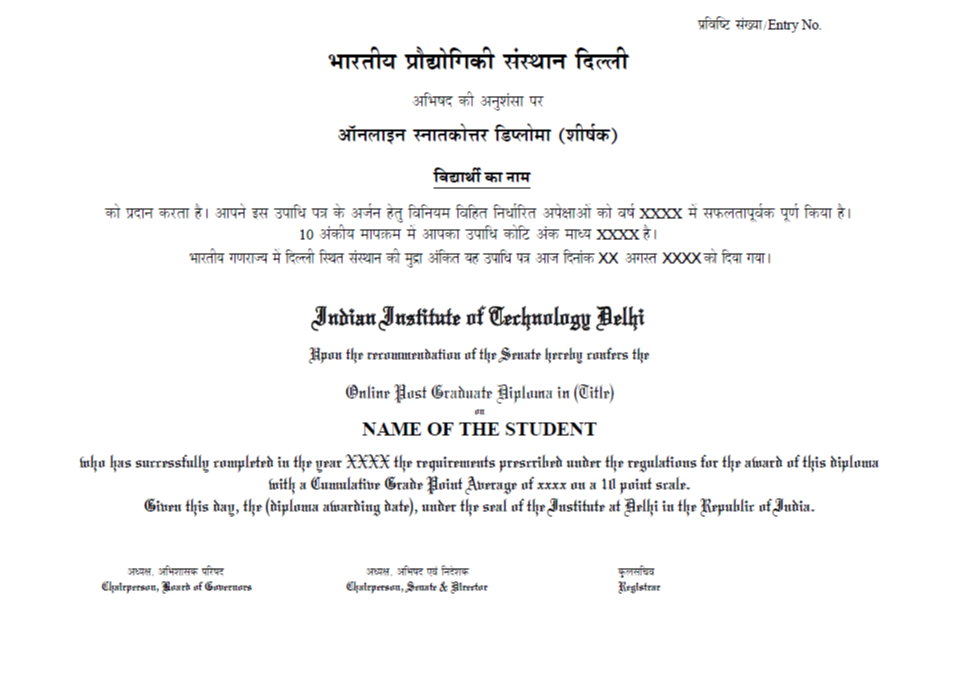
The above Online PG Diploma is for illustrative purpose only, and the format of the certificate may be changed at the discretion of IIT Delhi.
• An online PG Diploma will be issued separately by the organizing department.
• The Organizing Department of this Online PG Diploma is Bharti School of Telecommunication and Management, IIT Delhi.
• Certificates will be offered during the convocation ceremony organized by the Organizing Department.
Installment Schedule
Programme Fee INR 4,40,000 + GST
Instalment | Particulars | Amount (₹)** |
Application Fee* | To be paid at the time of application | 2,000 |
1st Instalment | To be paid within one week of offer release | 80,000 |
2nd Instalment | Within 15 days of the start of the programme | 90,000 |
3rd Instalment | 12th November, 2025 | 90,000 |
4th Instalment | 13th January, 2026 | 90,000 |
5th Instalment | 14th March, 2026 | 90,000 |
**GST @18% will be charged extra in addition to the fee.
Affiliate Alumni Fee* | Within one week of offer roll out | 10,000/- + GST |
Re-examination fee (per course, per attempt) INR 10000/- + GST | ||
Note
*GST will be charged as applicable.
*Application Fee of ₹2,000 will be charged for processing the selected applications only, post confirmation email from the institute. The application fee is not a part of the total programme fee.
Affiliate Alumni Status: To secure the Affiliate Alumni Status, learners will have to pay a one-time, non-refundable, mandatory affiliate alumni membership fee of ₹10,000 + taxes at the time of admission, which is over and above the Programme Fee. Benefits: The Affiliate Alumni, with prior approval from the Alumni and Endowment Office, are allowed to visit the IIT Delhi campus as per the Institute's visitor policy.
An offer letter from CEP, IIT Delhi will be released post the successful receipt of the Registration Fee.
Payment of fees should be submitted in the IIT Delhi CEP account only and the receipt will be issued by the IIT Delhi CEP account for your records.
Re-examination Fee
Re-appearing in the exam is allowed upto 3 attempts by paying the re-examination fee for each attempt in each course.
A Re-examination Fee of ₹10,000 + GST per course will be applicable
Refund Policy
All fees paid are non-refundable and non-transferable.