
3 - Day Online Workshop On Quantum Computing And Quantum Key Distribution (QKD)
Features
Programme Overview
This three-day immersive online workshop is designed to bridge the gap between quantum theory and real-world quantum communication systems. Instead of relying on heavy mathematical formalism, the programme adopts a visualization-driven and engineering- oriented approach to help participants intuitively understand quantum mechanics, quantum computing concepts, and Quantum Key Distribution (QKD).
Through live demonstrations, interactive simulations, and guided hands-on labs, participants will progress from qubit fundamentals to designing and evaluating secure QKD protocols suitable for next-generation communication networks.
Programme Objectives
The workshop aims to:
• Build a strong conceptual intuition of quantum mechanics using visualization instead of heavy mathematics
• Enable participants to understand qubits, quantum gates, measurement, and quantum state tomography through interactive tools
• Develop an engineering-level understanding of Quantum Key Distribution (QKD) rather than rote protocol memorization
• Demonstrate BB84 and advanced QKD protocols using live simulations and practical labs
• Equip learners to analyze security, noise, and real-world implementation trade-offs in quantum communication systems
• Prepare researchers and students to design, evaluate, and deploy secure quantum communication links for next-generation networks (6G / FSO / secure optical links)
₹ 2,000 + 18 % GST
Registration Closed
Class Schedule
Programme Dates: 27th February, 28th February & 1st March 2026
Duration: 4.5 - 5 hours per day (with breaks)
Live online sessions for all three days
Eligibility Criteria
Who Should Attend
• Faculty members
• PhD / MS students
• Final-year undergraduate students
• Industry professionals and R&D engineers
Prerequisites:
• Basic knowledge of linear algebra and probability.
• No prior quantum programming or coding experience is required.
Programme Highlights
Visualization-driven Learning Approach
Live Simulations And Guided Hands-on Labs
Engineering-oriented QKD Understanding
Real-world Protocol Design And Analysis
Access To Interactive Simulations And Guided Labs
Programme Modules
27 February 2026
Participants will learn to:
• Visualize qubit states on the Bloch Sphere
• Interpret quantum gates as rotations rather than matrices
• Understand quantum measurement, randomness, and statistics
• Perform basic quantum state preparation and tomography
28 February 2026
Participants will learn to:
• Explain why classical key distribution is insecure
• Implement and simulate the BB84 protocol step-by-step
• Compute and interpret Quantum Bit Error Rate (QBER)
• Apply error correction and privacy amplification concepts
• Understand the complete QKD system workflow
VisualQuantum™ and VisualQKD Pro™ together form a visualization-first learning and exploration ecosystem for quantum computing and quantum-secure communication. VisualQuantum enables intuitive understanding of quantum states, gates, measurement randomness, and experimental uncertainty through interactive Bloch-sphere and statistical visualizations, without requiring programming. Building on this foundation, VisualQKD Pro treats quantum key distribution as a physical security system, allowing users to analyse BB84 end-to-end and visually compare alternative protocols such as B92, SARG04, and the Six-State scheme under identical channel conditions. The combined platform emphasizes conceptual clarity, system-level reasoning, and engineering trade-offs, making it well-suited for faculty, researchers, and advanced learners.
Learning Outcomes
Visualize qubit states, quantum gates, and measurements intuitively
Simulate and analyze BB84 and advanced QKD protocols
Interpret QBER and assess security under noise and loss
Compare and select QKD protocols for real-world deployment
Tools
Visual Quantum
Visual QKD
Programme Coordinator
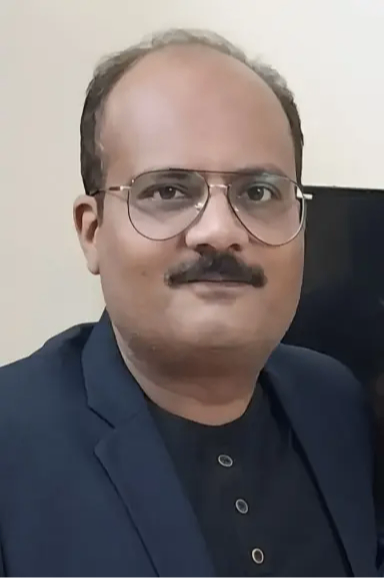
Professor Manav Bhatnagar
Professor and Head QIPCEP IITD
Department of Electrical Engineering
Indian Institute of Technology Delhi
Prof. Manav Bhatnagar is currently a Professor in the Department of Electrical Engineering at the Indian Institute of Technology (IIT) Delhi, New Delhi, India, where he also serves as the Brigadier Bhopinder Singh Chair Professor. He held a global rank of 517 in the area of Networking and Telecommunications and has been continuously featured since the inception of the Stanford University global list among the top 2% of scientists worldwide. He is a Fellow of the IET, INAE, NASI, IETE, and OSI. His honors include the NASI–Scopus Young Scientist Award, the Shri Om Prakash Bhasin Award, and the Dr. Vikram Sarabhai Research Award. Prof. Bhatnagar has served as an Editor of the IEEE Transactions on Wireless Communications (2011–2014) and the IEEE Transactions on Communications (2020–2025). He has published over 120 high-quality IEEE journal papers, including 11 single-authored articles. His research interests include MIMO systems, free-space optical communication, satellite communications, machine learning, artificial intelligence, quantum computing, and quantum communication.
Programme Sample Certificate
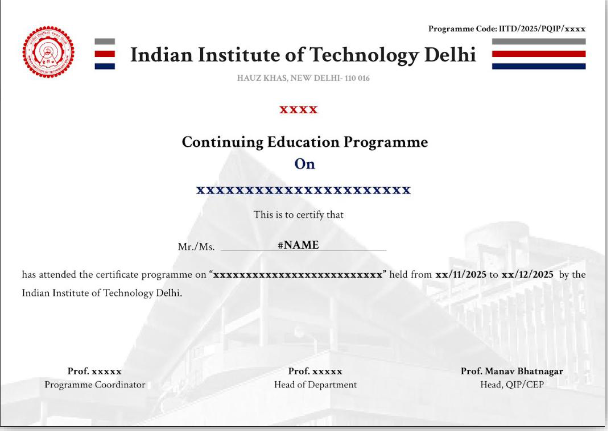
Workshop participation certificate
The organising department of this programme is the Bharti School of Telecommunication Technology and Management, IIT Delhi.
Installment Schedule
Programme Fee: 2,000 + 18 % GST