
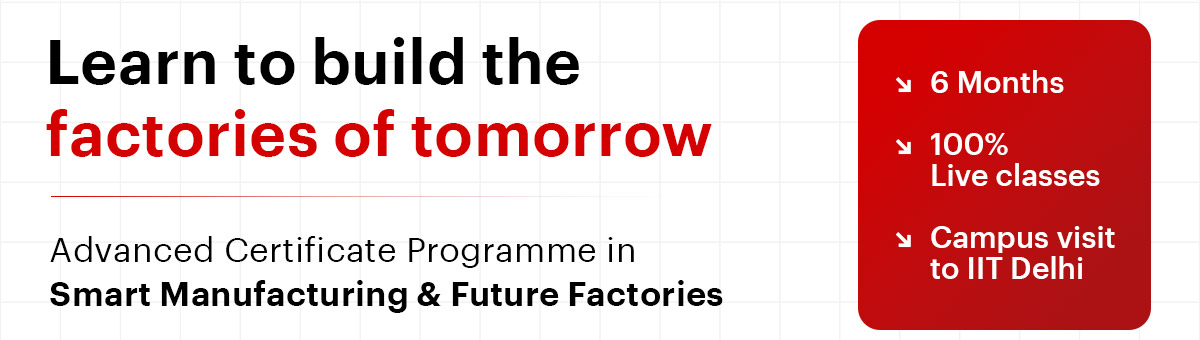
Advanced Certificate Programme In Smart Manufacturing & Future Factories
What Charlie and the Chocolate Factory got right about the future of factories
Twenty-one years ago, Tim Burton's Charlie and the Chocolate Factory slipped a sharp lesson about automation into a children's story. Charlie Bucket's father had one job at the local toothpaste factory: screwing caps onto tubes. Then the factory brought in a machine that did it faster, and Mr. Bucket was out of work. By the end of the film, he was back on the factory floor, maintaining the very machine that had replaced him.
Two decades later, that small subplot feels remarkably relevant. Today, machines can monitor their own operating conditions, algorithms can identify patterns in production data, digital twins can simulate physical systems, and robots can perform increasingly sophisticated tasks. Together, these capabilities are changing how manufacturing operates and the expertise required to keep it running.
Where human judgement meets machine intelligence
Mr. Bucket's return to the factory captures a shift that manufacturers now see on their own floors. In Accenture's report, Rethinking the course to manufacturing’s future, 70% of the 552 factory managers surveyed name workforce transformation as the most critical factor for success. As automation, AI and connected technologies change how factories run, people are moving from manual tasks to oversight, decision-making and optimisation.
Consider an automotive plant where a production-line motor starts to vibrate abnormally. In a conventional setup, the problem could go unnoticed until the equipment fails and stops the line. In a smart factory, sensors flag the anomaly, analytics pinpoint the likely fault, and maintenance teams step in before it escalates.
Technology raises the alert, but people still decide what happens next. Someone has to read the data, weigh the risk and choose the response.
This is the essence of smart manufacturing. Advanced technology, operational expertise and human judgement work as one system to raise productivity, reliability and agility.
Building the Capabilities for Smart Manufacturing
From Wonka's factory to the factories of tomorrow
Making those decisions well takes more than knowledge of individual technologies. It takes an understanding of how sensing, automation, data and AI work together across the factory, and of how a single signal on the line can shape decisions in production, maintenance and quality. As factories move from connected machines to connected intelligence, the professionals who lead them will be the ones who see the plant as one system rather than a set of separate functions.
Wonka’s factory belonged to the world of fantasy. However, the technologies that once seemed magical are redefining the possibilities of manufacturing.
Wonka had magic. Professionals now have intelligent systems to master.
Mr. Bucket’s story reminds us that technological change also changes the skills people need to thrive. Hence, the opportunity lies in staying ahead of that change and reinventing.
The next chapter of manufacturing will be shaped by people who know how to connect their own intelligence with the intelligence of the system they build and operate.
Take the next step towards intelligent manufacturing. Explore the SMFF programme offered by Continuing Education programme (CEP) IIT Delhi with Department of Mechanical Engineering as organizing department.