Certificate Programme in Generative AI (Batch-1)
Features
Programme Overview
🡢 Click here for the latest batch
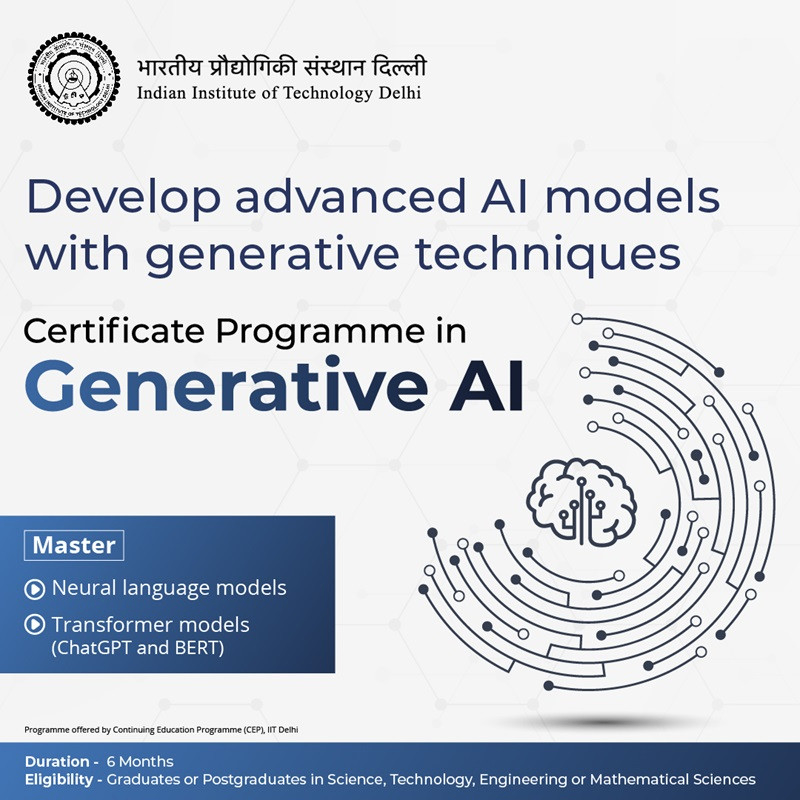
IIT Delhi's Certificate Programme in Generative AI offers a deep dive into advanced AI techniques, focusing on Large Language Models (LLMs) like GPT, BERT, and T5. Starting with foundational concepts like Linear Algebra and progressing to Machine Learning, participants will gain hands-on experience with model optimisation techniques such as fine-tuning and Parameter-Efficient Fine-Tuning (PEFT). The programme also covers cutting-edge topics like Reinforcement Learning with Human Feedback (RLHF) and Vision-Language Models (VLMs). Participants will be equipped to apply LLMs in real-world scenarios and ensure responsible AI use.
₹ 1,69,000 + 18 % GST
Registration Closed
Class Schedule
6 months
60 hours live online sessions
10 hours Capstone Project
12 hours of Tutorials
60 hours Self-paced
6 hours optional campus immersion
Class Timings: Sundays: 9:00 AM to 12:00 PM.
Eligibility Criteria
Graduates or Postgraduates in Science, Technology, Engineering or Mathematical Sciences
Participants with prior experience or knowledge of coding or programming will be preferred
Programme Highlights
Practical Learning With Tutorials And Latest Tools
Advanced Curriculum For Cutting-edge AI Expertise
6 -month, Online Programme For Working Professionals
60 Hours Of Online Live Sessions By IIT Delhi Faculty And Industry Experts
Peer-learning And Networking Opportunities
IIT Delhi Continuing Education Programme (CEP) Certificate
Programme Modules
Linear Algebra: Vector and Matrix Dot Product, Matrix Vector Multiplication, Matrix Decomposition (SVD)
Learning Outcome: Building mathematical foundations, an essential prerequisite for the course
2. Probability Theory: Random Variables, Bayes Theorem, Conditional Probability
Learning Outcome: Understanding the fundamentals of Probability Theory in Machine Learning
3. Optimisation: Gradient Descent, First/Second Order Condition, Convex Optimisation, KL-Divergence
Learning Outcome: Concepts of Optimisation and its application in Machine Learning algorithms
1. Intro to ML: Linear Regression, Logistic Regression
Learning Outcome: Fundamental ML concepts, understanding regression methods
2. Optimisation Continued, SVM, Decision Tree, Ensemble Methods
Learning Outcome: Learning supervised ML methods
3. Unsupervised Learning: Clustering, Dimensionality Reduction (PCA, LDA, t-SNE)
Learning Outcome: Introduction to unsupervised methods
4. Artificial Neural Networks: Perceptron, Multilayer Network, Backpropagation
Learning Outcome: Understanding the basics of neural networks and their training
1. Basic Text Processing (NLTK, spaCy), Morphology, Stemming, Edit Distance
Learning Outcome: Use of NLP tools for text processing
2. Language Modelling: N-gram Modelling, Smoothing Techniques, Perplexity
Learning Outcome: Learning different language modelling approaches
3. POS Tagging: Sequential Learning, HMM, Viterbi Algorithm
Learning Outcome: Introduction to sequence learning for NLP
4. Parsing: Constituency vs Dependency Parsing, CKY Algorithm, CFG, PCFG
Learning Outcome: Learning techniques for syntactic analysis in NLP
5. Text Classification: Naive Bayes Algorithm, Lexical Similarity (Word Embeddings, TF-IDF, Word2Vec, GloVe)
Learning Outcome: Understanding classification in NLP using traditional and modern approaches
1. Neural Language Models (CNN, RNN, LSTM, GRU, Seq2Seq)
Learning Outcome: Introduction to neural models and attention mechanisms for text generation
2. Attention Mechanism: Self-Attention, Transformer Architecture
Learning Outcome: Understanding self-attention and Transformer architectures for language models
3. Pre-trained Models: BERT, GPT, T5
Learning Outcome: Architecture and training of different pre-trained large language models
4. Fine-tuning Strategies: Task-specific Fine-tuning, Instruction Fine-tuning, Preference Tuning (RLHF, PPO)
Learning Outcome: Learning various fine-tuning approaches to improve model performance
5. Prompting Strategies: In-context Learning, Chain of Thought, Knowledge Probing, Text Generation
Learning Outcome: Techniques for optimising LLM performance through effective prompting
6. Augmented LLMs: Retrieval-Augmented Generation (RAG), Tool Augmented LLM
Learning Outcome: Leveraging RAG and tool augmentation to improve LLM efficiency and reasoning capabilities
1. Vision Language Models (VLM)
Learning Outcome: Understanding how VLMs enable combined text and image generation for multimodal applications
1. Misinformation, Bias, Toxicity, Security and Fairness
Learning Outcome: Learning strategies to mitigate bias, toxicity, and hallucinations in AI outputs
Python
NumPy
Pandas
PyTorch
TensorFlow
scikit-learn
Hugging Face
NLTK
spaCy
Jupyter Notebooks
Implement a fully connected neural network using PyTorch or TensorFlow for some task. Train the model and visualise its accuracy and loss over epochs
Fine-tune a pre-trained transformer model on a text classification task. Evaluate the model on a test set and report its accuracy, precision, and recall.
Implement a simplified version of the transformer architecture focusing on self-attention and positional encoding. Train the model on a small dataset for translation or another task. Compare the results with a pre-trained transformer model.
Implement PEFT on a large LLM for a specific task. Compare the training time and resource usage between standard fine-tuning and PEFT.
Create a simple reward model using human-labelled data for a text generation task (e.g., summarisation or sentiment correction). Implement a reinforcement learning loop to improve the LLM's responses based on the reward model.
Compare the performance of different open-source Large Language Models (LLMs) on reasoning tasks using various prompting techniques—zero-shot, few-shot, chain-of-thought, self-consistency prompting.
Compute matrix operations using NumPy
Preprocess a text dataset and generate embeddings using spaCy or Hugging Face
Build a simple neural network using TensorFlow/PyTorch.
Train the model on basic NLP tasks like text classification problem.
Implement a simplified self-attention mechanism.
Use a pre-trained transformer models for various NLP tasks like translation or summarization.
Fine-tune a GPT or BERT model on a custom dataset for various NLP problems
Use Hugging Face's pre-trained transformer model to generate text.
Apply PEFT to a large model for fine-tuning on a small dataset.
Apply quantization and pruning on a pre-trained model to optimize for lower resource usage.
Implement a RAG model using Hugging Face transformers and document retrieval from a custom corpus.
Use Hugging Face multilingual models for problems in cross-lingual scenarios.
Learning Outcomes
Master text processing tools like NLTK, spaCy, and Pandas for efficient data handling and preprocessing.
Explore key Transformer models such as GPT, BERT, and T5 for various NLP tasks.
Learn scaling laws to optimize LLM size, cost, and performance effectively.
Fine-tune LLMs in low-resource environments using advanced optimization techniques.
Enhance LLM task performance and align them with human values through Reinforcement Learning with Human Feedback (RLHF).
Improve LLM reasoning and integrate external tools to tackle complex real-world challenges.
Mitigate bias, toxicity, and hallucinations in LLMs for safe and responsible AI deployment.
Gain expertise in cutting-edge LLM and Generative AI technologies for diverse applications.
Tools
Python
Num Py
Pandas
Py Torch
Tensor Flow
Spa Cy
NLTK
Jupyter
Programme Coordinator

PROF. TANMOY CHAKRABORTY Associate Professor
Department of Electrical Engineering
Indian Institute of Technology Delhi
Dr. Tanmoy Chakraborty is an Associate Professor of Electrical Engineering and the Yardi School of AI at the Indian Institute of Technology (IIT) Delhi. He leads the Laboratory for Computational Social Systems (LCS2), a research group specializing in Natural Language Processing (NLP) and Computational Social Science. His current research primarily focuses on empowering small language models for improved reasoning, grounding, and prompting and applying them specifically to two applications -- mental health counselling and Cyber-informatics. Tanmoy obtained his PhD in 2015 from IIT Kharagpur as a Google PhD scholar. Subsequently, he worked as a postdoctoral researcher at the University of Maryland, College Park, USA.. Tanmoy has received numerous awards, including the Ramanujan Fellowship, the PAKDD Early Career Award, ACL'23 Outstanding Paper Award, IJCAI'23 AI for Good Award, and several faculty awards/gifts from industries like Facebook, Micorosft, Google, LinkedIn, JP Morgan, and Adobe. He has authored two textbooks – "Social Network Analysis" and “Introduction to Large Language Models.”
Programme Faculty

PROF. RACHIT CHHAYA Assistant Professor
Dhirubhai Ambani Institute of Information and Communication Technology (DA-IICT), Gandhinagar
Prof. Rachit Chhaya is currently an Assistant Professor at Dhirubhai Ambani Institute of Information and Communication Technology (DA-IICT), Gandhinagar. He completed his Ph.D. in Computer Science and Engineering at IIT Gandhinagar in 2022. His research focuses on scalable algorithms for machine learning problems with provable guarantees, specifically by creating small summaries of data called ‘coresets’. He has worked on machine learning problems involving regularization and/or fairness constraints. He has published in prestigious venues like ICML, AAAI, AISTATS, and TMLR. Currently, he teaches courses like machine learning and approximation algorithms. He has also been involved in various training programs on AI/ML.

PROF. RAHUL MISHRA Assistant Professor
Language Technology Research Centre (LTRC)
International Institute of Information Technology, Hyderabad
Prof. Rahul Mishra is an Assistant Professor at IIIT Hyderabad's Language Technology Research Centre (LTRC), where his research focuses on Controllable Text Summarization, Misinformation Detection, Model Explainability, Graph Representation Learning, and Natural Language Generation. Previously, he served as a senior postdoctoral researcher at the University of Geneva, Switzerland, specializing in biomedical NLP. Prior to that, as a Senior Staff Engineer/Researcher, he contributed to research projects at Samsung Research Lab in Bangalore, optimizing and benchmarking large language models on process in memory (PIM) enabled GPUs. He holds a PhD from the University of Stavanger, Norway and an M.Tech from IIIT Delhi. During his doctoral studies, he also worked as a visiting researcher at the Computer Science Department of ETH, Zurich, Switzerland and University of Hannover, Germany. Before pursuing his PhD, he worked as an NLP data scientist in the automatic vehicle diagnostic department at KPIT Technologies, Pune, focusing on automatic fact extraction from car service manuals. Prior to that, he also held roles as a consultant researcher at Tata Research Development and Design Centre (TRDDC) and a research intern at IBM Research Bangalore.

PROF. SOURISH DASGUPTA Associate Professor
Dhirubhai Ambani Institute of Information and Communication Technology
Prof. Sourish Dasgupta is an ever-curious researcher and educator. His deep interest in the role of AI in research methodologies led him to take a break from academia and set on an entrepreneurial journey for five years, which resulted in the founding of RAx Labs Inc., Delaware, USA. With some bright ex-students of DA-IICT, Prof. Dasgupta built RAx (https://raxter.io) - an AI-powered online assistant for making literature-review faster and more enriching for young researchers. Prof. Dasgupta is currently actively engaged in the analysis of less explored but important aspects of "intelligence" in LLMs, such as their personalization capabilities, and also designing personalized models that are a lot smaller and more eco-friendly than contemporary LLMs. In his pastime, Prof. Dasgupta loves to cook and debate with students. Prof. Dasgupta did his Ph.D. in Computer Science from the University of Missouri – Kansas City, USA
Programme Sample Certificate
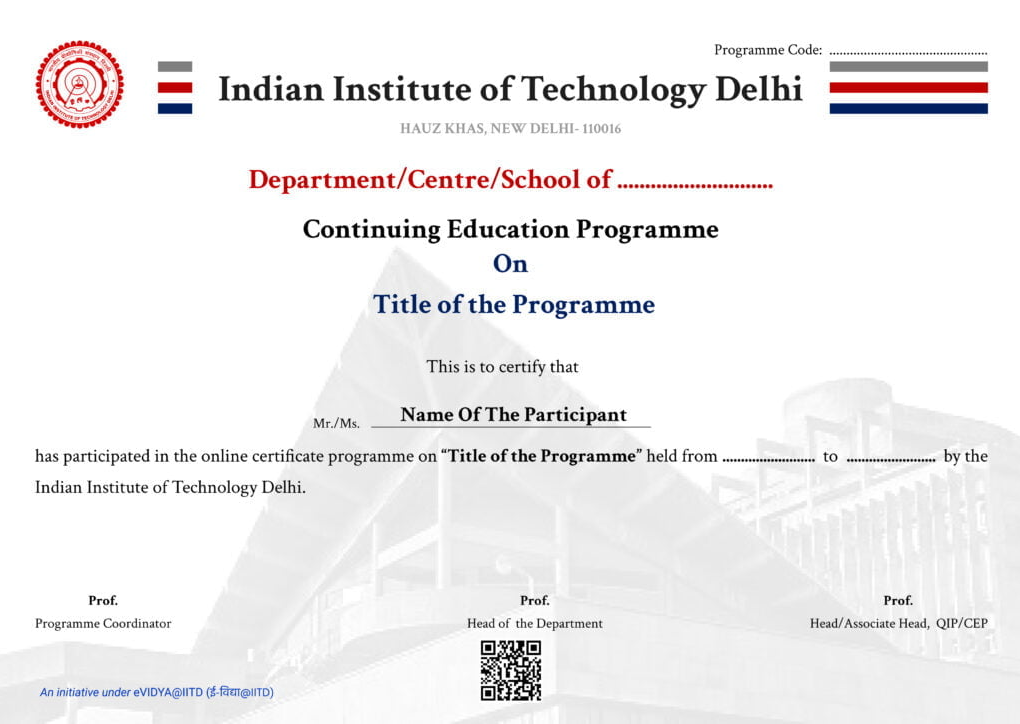
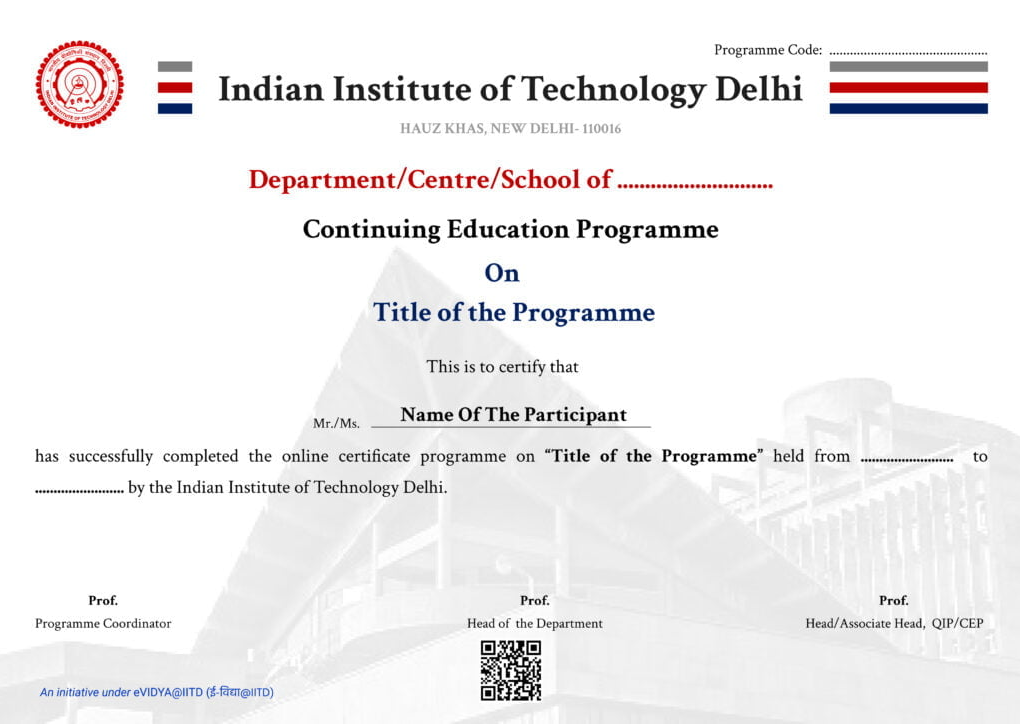
Candidates who score at least 50% marks overall and have a minimum attendance of 70%, will receive a 'Certificate of Completion'.
Candidates who score less than 40% marks overall and have a minimum attendance of 60%, will receive a 'Certificate of Participation'.
The organising department of this programme is the Department of Electrical Engineering, IIT Delhi
*Only e-certificates will be issued by CEP, IIT Delhi for this programme.
Installment Schedule
Programme Fee INR 1,69,000 + GST
Component | Date | Amount (₹)** |
Application Fee* | To be paid at the time of application | 1,000 |
1st Instalment | Within 5 days of the offer rollout | 49,000 |
2nd Instalment | 17th March, 2025 | 40,000 |
3rd Instalment | 16th April, 2025 | 40,000 |
4th Instalment | 16th May, 2025 | 40,000 |
Note:
The Application Fee of ₹1,000 is non-refundable and will not be adjusted in the total programme fee.
**GST will be additional as applicable.
Refund Policy
Candidates can withdraw within 15 days of the programme start date. A total of 80% of the total fee received will be refunded. However, the applicable tax amount paid will not be refunded on the paid amount.
Candidates withdrawing after 15 days from the start of the programme session will not be eligible for any refund.
If you wish to withdraw from the programme, you must email cepaccounts@admin.iitd.ac.in and icare@timespro.com stating your intent to withdraw. The refund, if applicable, will be processed within 30 working days from the date of receiving the withdrawal request.
Frequently asked questions
The IIT Delhi Certificate Programme in Generative AI is designed to provide professionals with in-depth knowledge and expertise in the dynamic field of Generative AI. The course focuses on advanced Large Language Models (LLMs) such as GPT, BERT, and T5. Beginning with foundational concepts like Linear Algebra, the curriculum advances to Machine Learning techniques, allowing participants to gain hands-on experience with model optimization strategies, including fine-tuning and Parameter-Efficient Fine-Tuning (PEFT). The programme also explores cutting-edge areas such as Reinforcement Learning with Human Feedback (RLHF) and Vision-Language Models (VLMs). By the end of the course, participants will be equipped to apply LLMs effectively in real-world applications while ensuring ethical and responsible AI practices.
Any graduates or postgraduates in Science, Technology, Engineering or Mathematical Sciences are eligible to apply for this IIT Delhi Certificate Programme in Generative AI.
The IIT Delhi Certificate Programme in Generative AI is ideal for AI/ML professionals looking to deepen their expertise in Generative AI and Large Language Models (LLMs). It is also well-suited for Data Scientists and Engineers eager to advance their skills in natural language processing and deep learning techniques. Tech leaders and managers can benefit from the program to drive AI innovations within their organisations. Product Managers and innovators focused on AI-driven product development will find the course valuable for integrating advanced AI solutions. Additionally, academics and researchers can explore the latest AI advancements and their real-world applications, while software developers interested in NLP and model fine-tuning will gain practical insights. Lastly, AI enthusiasts seeking to transition into the AI/ML field will gain hands-on experience in cutting-edge methodologies.
The IIT Delhi Certificate Programme in Generative AI course curriculum consists of Mathematical Foundations for ML, Machine Learning, NLP, Generative AI for Text and Vision, Responsible AI, Projects and more.
The duration of this IIT Delhi Certificate Programme in Generative AI is 6 months.
To enrol in the IIT Delhi Generative AI course, simply click on the “Enrol Now” button and provide your details. Our program advisors will reach out to you for any clarification or assistance needed to complete the registration process. Please ensure you meet the eligibility requirements. If admissions are closed or to be announced, kindly fill out the Enquiry Form by clicking the “Enquire Now” button, and our program advisors will get in touch with you to provide further information and updates.
Upon completing the IIT Delhi Certificate Programme in Generative AI, you can explore a wide range of career opportunities in AI-driven roles. These include positions such as AI/ML Engineer, Data Scientist, and Natural Language Processing (NLP) Specialist, where they can apply their expertise in Generative AI and Large Language Models (LLMs). Other roles include AI Researcher, AI Product Manager, and AI Solution Architect, focusing on integrating AI technologies into products and services. Tech leaders and managers can transition into Chief AI Officer or AI Strategy Consultant roles. Additionally, professionals may move into AI Ethics and Policy roles, ensuring responsible AI deployment. Overall, the program opens pathways across various industries, including tech, healthcare, finance, and e-commerce.
The IIT Delhi Certificate Programme in Generative AI offers significant scope in India, a rapidly growing hub for AI innovation. As the country increasingly adopts AI across industries like healthcare, finance, e-commerce, and manufacturing, the demand for skilled professionals in Generative AI and Large Language Models (LLMs) is rising. This program provides participants with cutting-edge knowledge in areas like NLP, reinforcement learning, and AI model optimization, making them highly valuable in roles such as AI Engineer, Data Scientist, and AI Researcher. The course’s practical focus on real-world applications also positions graduates to drive AI-driven innovations within organisations. With India’s push toward digital transformation, the program provides an excellent opportunity for professionals to capitalise on the expanding AI job market.
Choosing IIT Delhi for the Generative AI course offers several compelling advantages. As one of India's premier institutions, IIT Delhi is renowned for its rigorous academic standards and cutting-edge research in AI and technology. The program provides access to world-class faculty, who are experts in AI, machine learning, and deep learning. Participants gain hands-on experience with state-of-the-art techniques like Large Language Models (LLMs), reinforcement learning, and AI optimization. IIT Delhi’s strong industry connections and focus on real-world applications ensure that learners are equipped with the skills needed to meet the growing demand for AI professionals. The course’s practical approach, combined with IIT Delhi's legacy of excellence, positions graduates for success in the rapidly evolving AI landscape.
Students can request a withdrawal within 15 days from the programme start date, and they will receive a refund of 80% of the total fee paid. However, taxes paid on the amount will not be refunded. If a withdrawal is requested after these 15 days, no refund will be applicable. To initiate a withdrawal, please send an email stating your intent to withdraw to cepaccounts@admin.iitd.ac.in and icare@timespro.com.